Monday Project: An agent of change

Audrey was alone, but sleepy and warm. She moved her lips over her gums, getting used to their fleshiness, sans dentures. She remembered, suddenly, having watched her own grandmother do the same thing.

She pulled the blanket up under her chin, neatly folded the top sheet over it so it wouldn’t tickle her, and closed her eyes. The darkness behind her eyelids was heavy, and her bones seemed to sink deeper into the mattress. A deeper heaviness than sleep. But she wasn’t ready for this yet. She wasn’t ready for this change, and so she fought it like she had every night for the last three months.

With her eyes still closed she drew her attention around the room she was lying in — her room, she had to keep reminding herself — repeating a journey she’d made physically many times that day, and for many days before that.

On her day trips around the room, she would touch the trinkets she’d brought with her to this place when she’d moved out of her last home, trying to recall the story behind each of them. Some days she would remember; some days not. Some days seeing a particular object in this place would bring to her an image of it elsewhere — an old house, the hands of one of her children, the store in which she’d bought it. At times she was not sure how many of these trips she made in one day. She’d look back around the room, trying to match the small new memories — a fingerprint in some dust, the way the light fell on a picture of her husband — with what she saw now. But she could never be sure if those memories belonged to another day, or to half an hour ago.

When she made the trip in her mind’s eye, warding off sleep and that bone-heaviness, it was like all the day trips became one. She saw each object a thousand times. The memories — old, new, real, invented — crowded inside her head, keeping her awake for what was probably hours. She floated around the room, and through the many years of her life, until she eventually went towards sleep.

Tonight, however, the heaviness loomed. It sat at the edge of every memory, cast a shadow on every object, every photo in the room. For the first time, the room in Audrey’s mind felt small, and she found herself wanting to go elsewhere. Not to escape the heaviness, rather to find a way to let it in.

For a moment she thought of all the faces looking down at her from the frames on the walls, and how what she was about to do would change them. She hoped they were ready.

~

This is my response to this month’s Monday Project theme. There’s been a bit of delay this month, but we should have the other responses up later today, along with the new monthly theme.

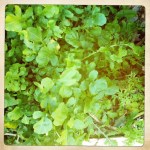
Gardening

I never thought I’d be a gardener.

The house I grew up in had an enormous front and back yard, and my brothers and I spent many hours playing in the garden, making cubby-houses out of bushes and soup out of mud and berries. A trip to the local nursery on a weekend with Mum and Dad was a fairly regular occurrence. But I never really understood the appeal of being on hands and knees, with dirty hands, at risk of attack from any number of nasty creepy crawlies.

And yet, as an adult, most weekends I find myself looking forward to spending some time in the garden. I get distracted by nurseries. I notice when my neighbours have planted something new, or pulled something out. These days, gardening for me is very much like yoga: it requires a regular commitment, is full of frustration and disappointment, but made entirely worth the effort by the joy that comes with any achievement, no matter how small. Gardening, like yoga, gives me a chance to really appreciate small things.

The switch from non-gardener to gardener has been a gradual one, and I can’t say exactly where it started. My Mum, a certain former housemate and a few other people have helped me along the way. Hey, maybe I was never really a non-gardener in the first place.

My love of gardening can be directly attributed to my love of food — most of my garden is edible. (Except the jonquils. They’re just purdy.)

In some of my research for a writing project on food and culture, I came across this article on The Conversation (an independent source of information, analysis and commentary from the Australian university and research sector, launched earlier this year):

“Food. It is the great unifier of place and race, the common ground sustaining our very existence. Why then, does food production feature so minimally in public space and urban design?

Under the weight of looming threats to energy, population and economy, the time is ripe to rethink our design focus.

Traditionally, urban design has been dominated by the use of ornamental exotic and indigenous plants while edible species have been minimally utilised.

Now, as we move towards a potential crisis in food production it is more important than ever to rethink our design practices.”

(Read the rest over at The Conversation.)

I firmly support the idea of bringing some food production into cities. It’s unlikely that cities will ever support themselves entirely, but I don’t think that’s the point. My garden does not produce enough to be my sole source of food, but it does contribute to what ends up on my plate. Perhaps more importantly, it gives me a much better idea of where the food I do buy has come from, and the kind of work that’s gone into producing it. That increased awareness, I think, can only lead to good things.

So much of any yoga practice is about noticing what’s there — often below the surface. Food gardening, for me, is another way of practicing yoga without a mat.

~

This is cross-posted over at my yoga blog, om gam yoga.