
It’s not until my skis touch the ground at the top of the chair lift and it sinks in that I have to stand up and ski away from the lift that I realise how terrified I am. Down the tiny slope that leads away from the lift, I pick up more speed than I am ready for and do exactly what you’re not supposed to: crouch down. I fall. I haven’t got my gloves on yet, and I graze several of my fingers in the icy snow. It stings. But more than anything, I’m embarrassed. I haven’t even actually done any skiing yet and I’ve already fallen over.
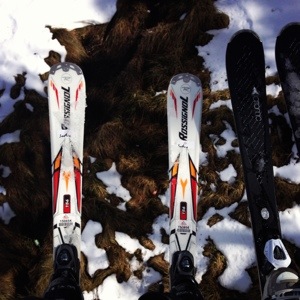 The slope — a beginners’ slope — brings more frustration and shame. I am most definitely the least experienced skier in my lesson group. This is not surprising: I haven’t skied since I was a teenager, and I was a novice then. The teacher is trying to show us how to execute turns. I just fall over every time. We get just a third of the way down the slope, and I have fallen over about eight times. Then I slide backwards across the mountain, off the snow and into the grass. The whole lesson group is watching me. I cry. Just a little; the hot tears of frustration and shame. I remember this feeling about skiing from when I was five and ran into a fence in my ski lesson. I cannot do something that everybody else can. They have all watched me fail miserably.
This moment, where I have to ask the ski instructor just to give me a minute to collect myself, makes me think of my beginners’ yoga students. It reminds me that it’s possible they feel this shame and frustration when they can’t do something I’m asking them to; that it’s important I always remember to approach a student’s difficulty with the compassion the ski instructor is showing me now.
~
I’ve been thinking a lot lately about falling. For the last few weeks, I’ve started my day by rolling out of bed and standing on my head for a short while. In the lamplight of my bedroom, I rest my weight on my elbows, forearms and a fist I’ve made with my hands. The top of my head touches the floor lightly, and I walk my toes closer to my face so my torso is perpendicular to the floor, hips up in the air. I lift one leg, then the other. Often I wobble and my feet touch the wall behind my head. As I hold myself there, reaching my feet towards the ceiling, I play, slowly, with my balance. What happens if I tilt my pelvis so my lower back lengthens a little? What happens if I tilt it the other way? Some days I really notice the comparative weakness in my left shoulder, and my legs and feet sway a little from left to right. Some days I am steady, and this usually surprises me, because most days I’m wobbly. As I wobble around upside down, I ask myself: am I falling?
Mostly, the answer is no. I sway a little, I adjust. I sway a little, I adjust. The balance takes focus. If I wander off in my mind, I lose it. I need to bring my feet down or they’ll fall down.
It’s the same on the ski slopes. That shifting of balance. The focus. Lean away from the slope, put your weight in the outside foot, or in the toes if you’re facing downhill. Lean the way you don’t want to fall.
It fascinates me: balance, falling. The fear. When I’m skiing, I’m afraid I’ll fall and get my skis caught up in one another and twist my ankle or knee or hip. I’m afraid I’ll wobble my already unstable hips out of alignment, because I know how easy it seems to be for me to do that just in regular life. I’m afraid of the pain, I guess. Which is a fairly reasonable fear, except that it so often means I focus on that when I should be noticing where my weight is, adjusting where necessary and thereby avoiding a fall.
Slowly, I get better at skiing. I fall less and less. And when I do fall, it’s mostly strategic, because I’m aware of the limits of my skills and would prefer to fall myself than plough down a small child. I get better at noticing the minute changes I need to make in the direction of my skis and the weight in my hips and legs to turn a certain way. I notice how much more difficult it is for me to get my left side to hold my weight than my right; how much more difficult again this is when I start to get tired. Or if I let my mind wander too much. Being present just in that moment is immensely useful for balance.
I am not, by any means, a good skier, but I do okay. And that’s enough.
For about the same amount of time that I’ve been doing headstands each morning, I’ve also been reading Illness, by Havi Carel. I will, at some point, write more here about this book and its ideas, because it’s having a profound effect on how I view my own chronic illness, and the periods of greater or lesser health within that, but for now I want only to mention one idea that returned to me as I alternately fell and skied down the slopes. Carel writes about how a serious illness — chronic or otherwise — can bring with it a sense that one’s body has failed them, betrayed them. That because of this failing in this one part of myself, I am somehow not enough. This is certainly how I’ve felt about my own body because of illness at various points. And I wonder if, on a different scale, that is part of what I was ashamed of when I kept falling and falling and falling that first time down the slope. Whether that is part of what any person might be ashamed of when they’re asked to do something with their physical body that proves difficult or impossible.
Because, to a certain degree, we are our physical bodies and their capabilities and limits. We are our illnesses, our falls, our tears of shame. We are also that steady headstand that comes along every now and then, that brilliantly executed turn on the skis.
Of course, we’re also not any of those things. We both are and are not our dys/functionality. This is something I have to remind myself on a regular basis. It’s all about perspective.
And so it is about perspective with falling. Perhaps when I’m standing on my head I am actually falling most of the time; it’s just that I catch myself. And when I’m skiing, I am, of course, actually falling down a hill the whole time, even if I’m not falling over. It’s a sort-of-controlled falling, or at least it’s a falling I’m sort-of-almost comfortable with most of the time.
~
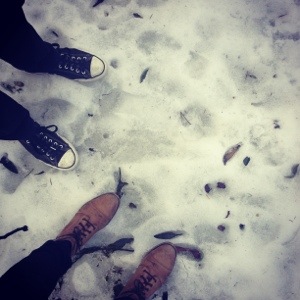 Several days into our week away, on a day where the snow is too slushy to ski, my brother and I go for a long walk. We talk, among other things, about falling. About how falling is not so bad anyway. Yes, sometimes you hurt yourself when you fall over, but mostly the physical injury is minor; the injury to the ego is greater. It’s embarrassing. We talk about how facing a fear of falling can teach you so much. About how falling can teach you so much.
This is something I think about often with physical activity, that it so often brings up questions about self and identity and capability and worth. I can stand on my head, and that makes me feel capable and strong. But I am at best a novice skier, and that makes me feel small. There’s something to learn from each feeling, if I’m up to looking at it a little closer.
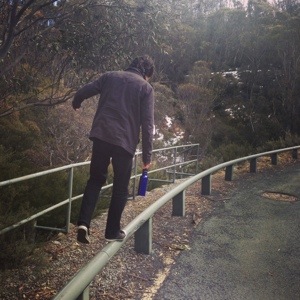 As my brother and I talk about being afraid of falling, he jumps up onto a pole running along the side of a road, and walks along it, balancing. He talks about the relationship between balance and falling and play. We trudge through snow in inappropriate shoes, and I am conscious of the risk of slipping, but we go ahead anyway. We discover a small creek, we climb on rocks, we peer at plants. At one point we come across a snowman someone built earlier in the day. I take pictures of moss and rocks, he throws snowballs at me. It reminds me of adventures we had as children. Adventure, triumph, play, fear of falling, failure, and shame are all so tied up in one another. Shining in the midday winter sun, the snow crunches under our feet, a wonder and a danger all at once.

 avocado and lemon