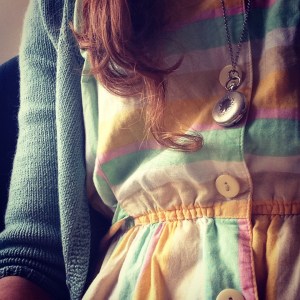
 We are talking about the frying pan I’m about to buy when the woman behind the counter notices my necklace, a locket.
That’s lovely, she says. Is there anything in it?
I open it to show her the watch inside. My parents gave it to me some years ago, I tell her.
Her face softens immediately. Oh, it’s lovely. I bet you love it. Gifts like that are special, aren’t they?
She begins to tell me about gifts, of jewellery in particular, her now deceased parents gave her. She is one of those women who have worked in a department store for twenty years or more: immaculate blonde hair, just a little too much foundation, long manicured fingernails, rings with big stones on at least two fingers on each hand, just the right amount of some age-appropriate fashionable perfume. As she talks, I notice suddenly how small she is—she comes up to my chest, at most.
She tells me the story of her falling on the way home from the train station one day and losing a beloved bracelet her parents had given her.
Half way through the story, just at the part where she injured herself falling over and walked the twenty minutes home only to discover the bracelet was gone, she starts laughing at herself failing the necessary steps to put my frying pan transaction through because she is distracted by her storytelling.
Hang on, let me put this through first, she says. I laugh too. We finish the transaction and fiddle about sticking receipts to boxes and deciding about whether I need a bag. I am about to leave when she remembers—
Wait, let me tell you the rest of my story. Please do, I say.
When she realised she had lost the bracelet—which she never usually wore to work, but this one day, of course—she called her Dad in tears. At this time her mother was in a nursing home, but her Dad still lived in their home. Her Dad listened and soothed her distress with all the appropriate words. The next day when she could walk okay again she went back to the spot she had fallen, but the bracelet, predictably, was gone.
Some time later, she went to visit her father at his home—I still get teary thinking about this now, she tells me—and at the end of her visit her father remembered suddenly, and disappeared to his bedroom. When he came back, he had a small jewellery bag. In it was a replacement bracelet. Not the same kind, nothing like it, she tells me—he probably wasn’t involved in buying the first one, even. But this one, this one was even more special than the first, and she would never wear it to work.
Oh, Dad, I say to her, touched.
I know, she says. I miss my Dad. He was the kind of man who’d be thinking about whose birthday was coming up in the next month or two, so he could be sure they’d have a gift. He loved giving gifts. She gazes out past my shoulder. But I should let you go, she says.
And I do go, but I thank her for sharing the story with me, feeling that what she shared was so much more than a story about a lost bracelet. What she showed me, a complete stranger, was grief. Not the kind we usually think of—sobbing, distressed, wild—but an everyday kind. The kind where a person is suddenly reminded of a hole that’s been left.
Walking back through the department store with my frying pan under my arm, on my way back to work, I am, for a few moments at least, a little less overwhelmed and irritated by department stores and shopping centres and crowded places where people seem to forget that other people are moving in those places too. Instead, I am aware, in a way that makes my skin tingle, of what it is that all these people might carry around with them that stops them from seeing other people, and I am reminded of this speech by David Foster Wallace about the world and people and changing our attitude to others. And this reminder, perhaps, more than the story itself, lovely though it was, is why I will remember that small blonde woman’s story, and the image I have of her elderly father holding out for her a small velvet bag containing a bracelet.

 The initial shuddering crash — more like a crack, really, like thunder — as the car meets the telegraph pole wakes me. My heart is thumping and I’m expecting the roof to fall in. My bedroom is full of light.

 avocado and lemon