More nepotism | the Value Chain

I’m afraid there’s going to be a fair bit more of this nepotism stuff happening around here, because I’ve got a keen interest in this project my brother’s working on. His latest Sustainable Marketing Project post is about the Value Chain, and how that relates to sustainability and the carbon footprint of a product.

If you’re interested, read more here.

~

PS. Posts about Melbourne and the Melbourne Writers’ Festival are coming, I promise.

A little bit of nepotism…

My brother Tom is nearly finished a Captain Planet degree — that is, a Bachelor of Interdisciplinary Studies in Sustainability. As part of the degree, he’s pulling together what’s called a Sustainable Marketing Project, with a particular focus on a post- or low-carbon future. Because he’s just as much of a food nut (pun intended) as I am, he’ll be looking specifically at food.

It’s interesting, I think, that the two of us have both come to be writing and thinking about food, and that we’ve come at it from such different educational backgrounds (at least on a tertiary level). A large part of Tom’s degree has been necessarily science-based; I, however, have not studied any science since the hopefully-named ‘Physics is Fun’ semester I did at the end of year ten. My background is in arts and communications.

And I guess that’s why I’m particularly interested in this project. I think it’s safe to say that I’m obsessed with food; eating it, yes, but also thinking about where it comes from and how it gets to be on my plate. These questions are sometimes questions about process, and they’re sometimes questions about ethics. Tom’s project is attempting to cover both: how carbon is embedded in our food, and how to calculate that, but also why knowing that is important or relevant. This project is about information, but it’s also about telling a story.

The marketing element to this project, I think, is what makes it so interesting. Information about this thing we call ‘sustainability’ (what does that word even mean anymore?) is so often tinged with negativity, or completely overwhelming because of its sheer volume. It’s something I certainly struggle with in my non-fiction writing on food. The story-telling element is so important to get right, or you lose your reader (or viewer or listener) after about half a second.

Have a look at Tom’s first few posts on this project here. He’s just getting started, and I’m sure he’d really appreciate some feedback. I can’t wait to see what he comes up with.

Busy

Lately I’ve been busy. It’s easy to forget that I’m busy sometimes, when I’ve got whole days at home, spent in my house clothes, drinking multiple cups of tea. I forget that I’m working on those days too — planning and writing.

Other days I leave and re-enter the house three, four, sometimes five times a day. I spend lots of time outdoors, and my shoes are well-worn.

I have a whole list of things that have fallen by the wayside, waiting (sometimes not so) patiently for a quiet week.

I’m tired. I don’t sleep well because I dream all night about the things I have to do in the coming days: banking, catching buses, doing laundry. Process dreams, I call them. My hips, my knees and my shoulders buzz, reminding me to stop every now and then. I find myself sighing when my work day is over.

But I like being busy. Especially because I’m doing things I love. My days are filled with yoga and reading and writing. I just need to remember that it’s okay for me to sleep in occasionally.

Monday Project: An agent of change

Audrey was alone, but sleepy and warm. She moved her lips over her gums, getting used to their fleshiness, sans dentures. She remembered, suddenly, having watched her own grandmother do the same thing.

She pulled the blanket up under her chin, neatly folded the top sheet over it so it wouldn’t tickle her, and closed her eyes. The darkness behind her eyelids was heavy, and her bones seemed to sink deeper into the mattress. A deeper heaviness than sleep. But she wasn’t ready for this yet. She wasn’t ready for this change, and so she fought it like she had every night for the last three months.

With her eyes still closed she drew her attention around the room she was lying in — her room, she had to keep reminding herself — repeating a journey she’d made physically many times that day, and for many days before that.

On her day trips around the room, she would touch the trinkets she’d brought with her to this place when she’d moved out of her last home, trying to recall the story behind each of them. Some days she would remember; some days not. Some days seeing a particular object in this place would bring to her an image of it elsewhere — an old house, the hands of one of her children, the store in which she’d bought it. At times she was not sure how many of these trips she made in one day. She’d look back around the room, trying to match the small new memories — a fingerprint in some dust, the way the light fell on a picture of her husband — with what she saw now. But she could never be sure if those memories belonged to another day, or to half an hour ago.

When she made the trip in her mind’s eye, warding off sleep and that bone-heaviness, it was like all the day trips became one. She saw each object a thousand times. The memories — old, new, real, invented — crowded inside her head, keeping her awake for what was probably hours. She floated around the room, and through the many years of her life, until she eventually went towards sleep.

Tonight, however, the heaviness loomed. It sat at the edge of every memory, cast a shadow on every object, every photo in the room. For the first time, the room in Audrey’s mind felt small, and she found herself wanting to go elsewhere. Not to escape the heaviness, rather to find a way to let it in.

For a moment she thought of all the faces looking down at her from the frames on the walls, and how what she was about to do would change them. She hoped they were ready.

~

This is my response to this month’s Monday Project theme. There’s been a bit of delay this month, but we should have the other responses up later today, along with the new monthly theme.

Home

Last night I was drifting off to sleep, finally, when a thought pulled me suddenly back into the waking world: this weekend, I’ll be able to visit the bakery of my childhood.

This weekend, you see, I’m heading back to Forbes, the town I grew up in. It’s the first time I’ve been back in four years. My immediate family all live in Canberra now, and most of the people I still keep in touch with from school no longer live in Forbes. Family friends still live there, but somehow I’ve not found reason to visit.

I very rarely think about Forbes. I mean, I reminisce about high school, and childhood, but I hardly ever think about the place itself, and the impact it had on me. The last time I did, I wrote an essay, which ended up being published in issue 77* of Voiceworks.

But I do often think about the concept of ‘home’, and the places I associate with that word.

My brother and his girlfriend are in Forbes today. This morning they sent me a picture of a roundabout on the main street. I’m sentimental at the best of times, but my propensity for nostalgia has been higher lately. The instant I opened that picture file, I was hit with a wave of nostalgia, and I wondered how I could possibly have excluded Forbes from the list of places I call home.

Melbourne is home for me. Sydney is home for now; Canberra sometimes home. Forbes doesn’t even get a look in. But I think it should. I lived in Forbes for many more years than I’ve lived anywhere else.

I guess, being the home of my childhood, its impact on me is something subtler than those other places, part of my subconscious.

Last year sometime, I got in a cab to go home late one night, and was chatting to the driver.

“You’re a country girl, aren’t you?” he said, suddenly.

I don’t think I’ve ever thought of myself as a country girl, but he guessed that I hadn’t grown up in a city because I got into the front seat of the cab and struck up a conversation. City girls, he said, sit in the back and avoid eye contact. Conversation? Ha.

Of course the cabbie’s guess is based on a huge generalisation about ‘city people’ and ‘country people’, but I did start wondering how many other aspects of my everyday behaviour might be related in some way to me having grown up in Forbes.

I’m not sure what to expect from myself this weekend. As I write this, more and more memories find their way into my thoughts. Sometimes it amazes me that one human being can have so many memories, so many that a whole period of your life can be tucked away somewhere safe. Sometimes so safe that those memories are never found again.

Judging by pensive mood, just anticipating the trip, it’s probably safe for me to assume there’ll be more of the same over the next two days. (I’m going back for a party though, so I’m sure there’ll also be plenty of plain ol’ fun.)

I get the feeling that some of this wistfulness will become writing. Fiction, maybe. Watch this space.

~

* Express Media’s website is down at the moment, so you might not be able to access that back issues link. I’ll keep an eye on it though, and update it when I can.

Whimsy and web-spinning

After a weekend with my family — a weekend of stories, memories, tears and laughter — I feel like I’m brimming with words. Characters I’ve written about before, and new ones, are floating in the air around my head, as if they’re attached to the end of spider webs caught in my hair.

I hope I can gently capture some of them and spin them into something before they float away.

Storytelling

What has struck me over the last few days, since my Mamie’s death very early Friday morning, is how important storytelling is to the grieving process. Apart from the day she died, when I withdrew into a little shell and moped about the house by myself, I’ve spoken to one or more members of family every day. And each time we’ve told stories about Mamie.

I’ve found out things about her I didn’t know, and heard stories that cement my ideas about her. I said to my Dad the other night (Mamie was his mother) that I’m sure there are lots of things about Mamie that I was never going to know until she had died, and I’m kind of looking forward to getting to know her better — or at least in a different way — through the stories I’ll hear about her.

The storytelling is vital, I feel. Mamie was frail when she died — if we weren’t able to tell our stories about her to one another, I think we’d not be able to remember her as she was in the rest of her life. In the stories, she gets to live again.

I’ve always been fascinated by religion and spirituality. I went to Catholic schools growing up, and every year I did very well in the compulsory Religious Studies. I don’t really consider myself a religious person, but I have always loved learning about how people explain to themselves life and death and everything in between. Life after death — again not something I’m decided on — is a particularly interesting concept to me. I wonder whether these stories, these memories we have of Mamie, are her next life.

Mamie was religious. She believed in God, and Heaven, and that she was going to be with my grandfather, Da, again when she died.

Once, a few years ago, she and I started having a conversation about God. I told her I didn’t know whether I believed in a higher being or not, but that I didn’t think it mattered if I was able to be a good person. She listened. At that point in the conversation we were interrupted, but she looked at me, touched my arm, and said, “Please let’s continue this conversation when we can later, darling.” I knew, from the way she said it, that our later conversation would not involve her trying to change my mind, only wanting to know more of it.

Sadly, we never got the chance to finish that conversation. I would dearly love to talk to her about those things now, and it saddens me to think that I won’t be able to.

But that I can tell that story, and imagine how the conversation might have gone — have the conversation with her in my head — is enough. Whichever way you look at it, Mamie’s having a life after death right now.

I’ve shared my thoughts about the social function of literature here before, and I’m sure what I’m describing here fits into that idea somehow. Stories encourage compassion and empathy, and in doing so I think they can perpetuate a person or character’s voice and existence. Which reminds me, I’m due to write more about my ideas on using different narrative voices — my efforts here don’t do the subject any kind of justice.

Nostalgia

I’ve been writing this post for weeks, on an off. It seems appropriate to finish it now — a death in the family always lends itself to remembering and nostalgia.

For a couple of months now I’ve been carrying around a little vial of nostalgia, everywhere I go. Sometimes I really do feel as though it’s rattling around in the bottom of my handbag, and when I go searching for something else I come across it.

The thing about nostalgia (at least for me) is that it’s so unspecific. I can’t really say where it’s come from, or even what it’s about. Or maybe it’s that I can say where it started, but then I’m unable to contain it to that. Nostalgia breeds nostalgia.

Sometime last week I found myself sitting on the couch, home by myself for the night, with a huge pile of recipe books, flicking through pages, making mental lists of things I’d like to cook next time I find half a day to spend in the kitchen. As I turned the pages I came across recipes I’d marked months ago, and finally worked out the root of this bout of nostalgia: I love my new house, but I’m also missing my old one. I miss my old housemates, I miss the house itself, I miss Astro the cat, I miss living down the south end of Newtown. I’m not despairing in the missing, it’s just a lingering sense of… sadness at the finality, I guess.

We cooked a lot in my old house. I cooked a lot. It wasn’t a great kitchen — it had a huge oven, but we also spent the last six months in the house cooking by lamp light — but it’s where I really feel like I cemented my love of cooking. I spent hours and hours cooking in that kitchen, sometimes many dishes at once, often on my own. Cooking became a kind of meditation; thoughts about other things popped into my head during big cook ups, but the focus always came back to whatever was on the stove top.

I also spent many hours in that kitchen, sitting on the step between the lounge and the kitchen or perched gingerly on the barely-held-together stool we’d borrowed for a party and somehow never returned, chatting to one of my housemates about life — work, boys, politics, religion, music, books, writing, cats, dogs, babies, family. We cooked, we talked.

The kitchen in that house will always be somehow special to me.

Thinking about that kitchen inevitably leads to thinking about the garden at that house, my little room and the neighbours whose backyards my windows overlooked, the creaky floorboards in the upstairs hallway, the sunny lounge room, the cracked walls, the ballroom-sized bathroom… the list goes on and on. And then spills over into other parts of my life, occasionally going as far back as childhood.

That my trip to Melbourne happened in the middle of all this nostalgia really hasn’t helped things. I miss Melbourne with such a visceral ferocity that it’s sometimes overwhelming. Going back there, I wander around the streets, amazed that I still feel so at home there, even though I’ve now lived in Sydney nearly as long as I lived in Melbourne.

Strangely, I also feel nostalgic about writing (this is far harder for me to explain). Spending time at writers’ festivals, like I have this last month — especially ones like EWF where I spent a lot of time in the company of other writers — exacerbates this kind of nostalgia. I think maybe what I’m trying to do when I write (fiction, at least) is capture that feeling of nostalgia, that little twinge of melancholy. So somehow thinking about or talking about writing brings about those feelings I’m trying to capture. Does that even make sense? I don’t know.

Perhaps this nostalgia, and its settling in for a lengthy stay, is why I’ve found myself wanting to write more fiction. For the last six months I’ve been working steadily on a big non-fiction project. I love it, and I don’t want to put it away, but I think maybe I need to let myself venture a little more into whimsy from time to time.

Grief

My beloved grandmother, Mamie, died early on Friday morning.

It brings tears to my eyes to type that, and I’m sure it will for quite some time. My Mamie had class. She had a sweet tooth, and a fondness for a G&T or a whiskey. She also had a wicked sense of humour, which she retained until the end. I loved her dearly.

Fridays are usually quiet days for me, work-wise. I made yesterday a quieter Friday than usual. Mum had called me with the sad news just before I went into my usual Friday Yin Yoga class (as a student, thankfully), and I’d spent the entire class watching the waves of tears and quiet calm come and go. Yin Yoga has come to play such an important role in my life. It’s a quieter form of yoga than the Vinyasa that I mainly teach, and often practice; it’s passive, reflective, it allows you time to notice things that are sitting below the surface. The challenge of this style of yoga is to just let those things be, even if they’re not pleasant or ideal, which is really tough sometimes. Yesterday was one of those tough times for me.

The poses were more challenging physically. Every time I moved into balasana (child’s pose) the tears would come. As I sat in stillness, they ran down my face and dripped onto my mat. My nose blocked, and I had to breathe through my mouth if I wanted to breathe at all. Keeping my breath slow and even was extremely difficult. Hip stretches were almost unbearable (according to yogic teachings, we store the effects of strong emotions in our hips).

But more challenging still was my mind. It traversed a lifetime of Mamie-memories, and fixated on other members of my immediate and extended family, who I knew would be feeling grieved too. Every time a new thought arose, the lump in my throat would return, and my breathing would become shallow. In Yin Yoga, the idea is to notice your mind wandering and continue to gently bring it back to focus on your breath. For so much of that class, my mind was so far away from any kind of breath focus, and it did not want to come back. Being patient with myself, rather than being angry at my lack of focus, was extremely difficult.

After class, I realised that attempting the editing or research work I had been planning to do would be completely ridiculous. So for the rest of the day, I pottered around, catching up on some reading I needed to do, writing a few bits and pieces. And crying a whole lot more.

Mamie is not the first person close to me to die. Grief is not new to me. But this way of dealing with it — actually allowing myself to just sit and cry — is. And it feels far more natural than anything else I’ve tried. Not denying those feelings, actually expressing them, while not pleasant, is liberating. Don’t get me wrong, I still feel sad, but I feel like I’m allowed to feel sad.

My Mamie was not at all well by the time she died. She’d had dementia for quite some time, and in December last year, she’d had a stroke. She was frail, and she was ready to be free of this life. I am truly glad for her that she can be now.

My sadness is all for myself and the other people left behind. I’ve often thought this about grief: it’s so strangely selfish. Understandably so, obviously. But it’s still an odd thought. And it’s such a mixed bag of feelings. There’s just plain sad; there’s regret and guilt; there’s anger, frustration; there’s holding on for dear life; there’s fear. In the last two days I’ve felt all of these things. At times I haven’t known where the tears were coming from, I haven’t been able to attach them to a specific part of my grief. They’ve just come, almost spontaneously. And I’ve let them.

But maybe I’m wrong; maybe grief isn’t entirely selfish. Grieving for someone shows they meant something to you, it acknowledges that they’ve made an impact. And I can’t say that’s entirely selfish. Mamie was very dear to me — and indeed to many people who knew her. That saying goodbye to her is difficult shows how deep the groove she made in my heart is.

One of my favourite bloggers, Claire Bidwell Smith, writes beautifully about grief. (You can read some of her posts on the subject here.) She has known so much grief in her life. Both her parents had died by the time she was 25, and she often writes about how much she misses them.

I already miss my Mamie, and I will continue to — probably for the rest of my life.

I will miss her smile. I will miss her voice. I will miss her saying things are ‘glorious’ and calling me ‘darling’. I will miss her soft hair, which resisted grey for so long. I will miss her big old glasses, without which she could hardly see a thing. I will miss her telling me I’m in her prayers, which I always loved even though I’m not religious myself. I will miss her asking me how old I am, and being shocked each time that the number is so high. I will miss her silliness. I will miss her wicked sweet tooth. I will miss her handwriting. I will miss her hands. I will miss so many more things about her — many I’m yet to think of or realise, I’m sure.

Goodbye, dearest Mamie. You will stay in my thoughts always.

~

When I first heard the sad news, we were unsure of exactly when Mamie had died, and I was under the impression that it was sometime on Thursday evening. It was, in fact, early Friday morning. I’ve updated the beginning of this post for the sake of accuracy.

Monday Project Theme: Beach Baths

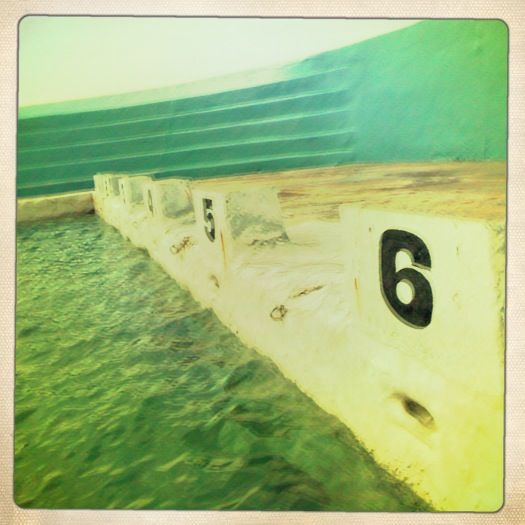
The water on the cement is cool between her toes. She tries not to think about the temperature of the water in the pool as she pulls her goggles down over her eyes. The suction on these goggles isn’t great, and the last few mornings water has seeped through; when she gets out out of the water her eyes feel as though she is still mostly submerged, peering along the water line. In at attempt to avoid this today, she pushes the goggles firmly into her eye sockets, then steps up onto number six.

This moment, before she dives in, is her favourite part of the day. Looking around at the world she’s about to forget for an hour, anticipating the shock of the cold water.

She stands up tall, her spine long, chin tucked in slightly. Her arms come up over her head, palms touching. She chuckles at her own drama, drops her arms and dives in casually. Her arms and legs feel it first — the tingle. Then her scalp, as her limbs grow numb to it. Even with her tied back the cold manages to find its way in and around every hair folicle. Some days she can still feel the scalp-tingle several hours later, post-shower, post-breakfast.

The first few laps she swims quickly, more quickly than usual. With each new stroke comes a new thought. There is barely room for pause, and she realises she is forgetting to let herself breathe. A breath. A snippet of sound from the world outside, then back to the muted heaviness of underwater.

After lap five, she slows down, allows herself to feel the frustration rather than swimming away from it. She doesn’t know where it’s coming from, and that somehow makes it worse. With her next inhale — a big one — she realises her lungs feel trapped by her ribs, like she could breathe deeper if only her skeleton would get out of the way.

Another breath. Later, she will recognise the sound as a scream, but now it only registers as something harsh; she notices the relief when her ears are blocked with water again.

~

This is my response to this month’s Monday Project theme. The next theme went up yesterday — you can have a look here.

I cruelly forced my writers’ group to respond to the theme on Sunday, when we all got together. I’m hoping some of them will send me what they wrote. We did share with each other on the day, but it might take a little more prodding to get some of their words here.