Moving House

This last fortnight I’ve been moving house. And it’s been harder than any other move I’ve made. Harder even than moving out of home, or moving from Melbourne to Sydney. It’s strange, because I’ve only moved from one end of Newtown to the other. Both the aforementioned moves involved a great deal more distance, and probably more obvious emotional upheaval. So I’ve spent a lot of time thinking about why this move has been as difficult as it has — and wondering whether I’ve just turned into a big wimp.

It’s been different to any other move I’ve made though. For starters, it was a reluctant move. My housemates and I got a phone call halfway through December telling us the owner of our house was returning from the UK and would like her house back. Two of my housemates were already planning on leaving (they’re travelling around Australia this year in a pop-top van — you can read about their adventures here), but Housemate Three and I were planning on staying in the house. When we realised we’d all be leaving the house at the same time, the phrase “end of an era” found its way into conversation more than a few times.

This house had become home, these housemates like family.

So I guess we began the process of sorting, packing and moving with… well, heavy hearts. Sometime towards the middle of January, I found myself thinking about how I’d only walk this route to a yoga class (or get off the train at this station, or stare out my bedroom windows, or go for a walk in this park, or see this or that neighbour on the street) a finite number of times. And every now and then the four of us would be standing together in the kitchen talking and/or cooking, and one of us would sigh. Sentimentality became a big part of our last weeks in the house.

Then I suppose there was the move itself, which was a bit of a shit fight, if I’m honest. We were really settled in that place. Which is really just a nice way of saying we had a lot of crap, spread out all over the place. Packing, sorting and cleaning was not fun.

For the fortnight it took us all to pack up and move out, I felt like I didn’t really have a home. My new housemates and I had picked up the keys to our new house, so a lot of my stuff was in the new place, but so much of me remained in the old place. For the last week I was sleeping at the new house, and getting up each morning to go to the old house to work more on moving out. That week felt more like ten weeks.

That last week the five of us (four housemates plus Housemate Three’s girlfriend) went out for dinner and drinks — a kind of farewell. I had such a great time with my little sharehouse family.
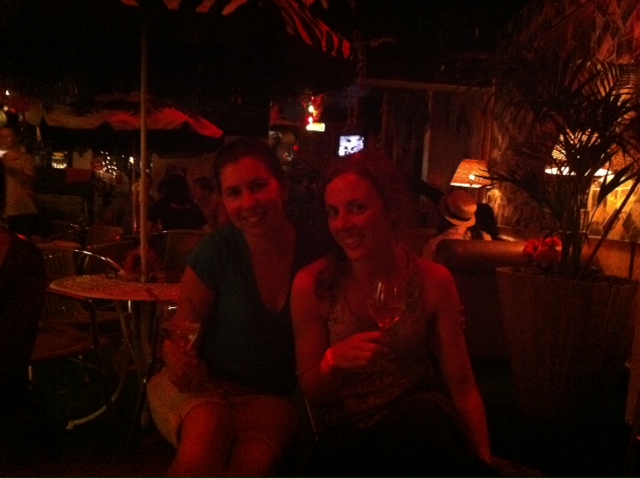
And I drank a little too much wine. Getting up the next day was difficult.
When we finally handed the keys back last Friday, and went out together for a final housemate breakfast, I think we were all ready to leave. We were glad the move was over (we were also very hungry — we’d all been up since 6 or 7am and we were eating at midday). So in a way, I guess the sadness that had made the process so difficult in the first place was kind of worked through by the horror of the move itself. Or at least pushed to the background for now. I’ll miss that house, and I’ll miss my housemates, but for now I’m ready to focus on what’s going on in my life right now.

I’m excited to be working again. I’ve got writing projects slowly starting to make their way from my head onto paper; next week I’m going to Adelaide for Format Festival’s Academy of Words; and I’m preparing for some new yoga classes I’ll start teaching in the next month.

This move though, and the process of moving in general, is still flitting about inside my head. I’m writing about moving for this month’s Monday Project theme, and I’m thinking again about some of the other writing I’ve done on travel, moving and connection to place.

As difficult as it’s been, moving house has certainly got the cogs turning again. Change, as they say, is as good as a holiday. Except that I feel like I need a holiday to recover from this particular change.
A Strange Picture

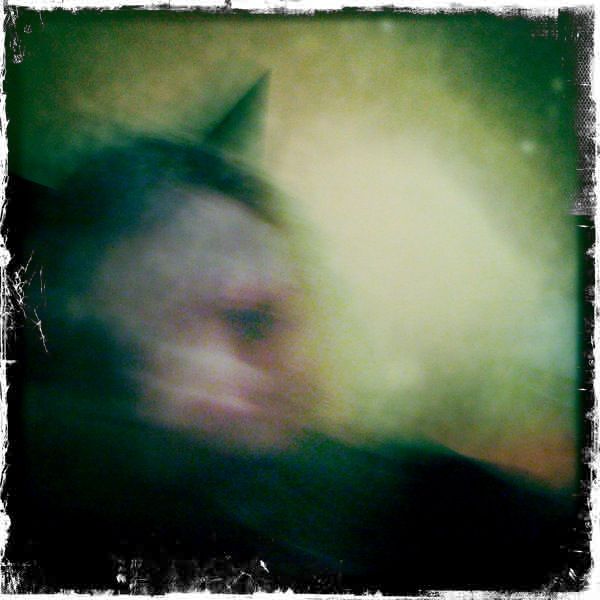
This, believe it or not, is a picture of me. I’ve got cat ears on, but I’ve no idea how I managed to get my face looking so animal-like as well.

Occasionally I go back through all the photos on my phone, camera and computer, and I usually manage to find at least one strange one. Especially if I’ve spent time with my brothers — the younger of the two likes to borrow a camera and take macro shots of… well, anything really. I have to take credit for this one though.

I seem to have gone through a stage of looking back over old art journals, photos and writing journals lately. It’s sort of a strange concept, looking back through yourself for inspiration. And it’s funny just how much of your own brain-stuff you forget. Memory is an intriguing thing.

New Year’s Resolutions

Like many people, I’m not a huge fan of New Year’s Eve. I don’t like the pressure to do something really fun and amazing, but nevertheless feel I should be doing something. This year, I spent the night in Canberra at a BBQ with some of my wonderful friends. It was low-key, which I’m beginning to realise is exactly how I like most things in my life to be. And because there was no pressure, I really did have fun.

For the first time in a long time (maybe ever) I actually had several options for New Year’s celebrations. Maybe as a result of agonising over which I would choose, I thought a lot about what the celebration at this time of year really is for me. I don’t think I’ve ever really thought about why we celebrate the beginning of a new year quite as much as we do. But when I eventually came up with an answer, it helped me feel comfortable about the things I was saying no to.

New Year, for me, is simple really: it’s a chance to reflect on what has been and to look forward to what might be.

All of the events I was invited to would have allowed me to do that, but some of them would have come with the added pressure of getting somewhere and spending money that I just don’t have. So I chose the simplest of the otherwise equally appealing options.

My Mum said to me the other day, as I thumbed through the year 12 art diary we’d just found in a box in the garage, that I’ve always been a dreamer. I guess she’s right. I dream, I plan. I’m pro-active about lots of things — I’m no stranger to jumping into the deep end, hoping it will all work out — but there are so many more things I’ve dreamt up that never make it into reality.

In 2010, some of those dreamer-plans actually started to happen. And it was great.

And hard.

And great.

Looking through my old art diary, I felt an affinity with my seventeen-year-old self that I’ve not felt in a long time. She was in equal parts excited and confused by all the possibilities that were coming her way (and she wrote terrible poetry). I feel like that now.

That afternoon I sat down to write out some resolutions, something I’m not sure I’ve done before. None of them are particularly wacky or difficult to achieve. But it is a list I think I’ll need to come back to more than once throughout the year, because much of what’s on there is stuff that slips through the cracks: keeping in touch with friends (which I’m terrible at), writing regularly, getting to the arts events I want to.

I know I’m not going to do everything on this list. It’s not unusual for me to expect far too much of myself. But if I can do just half, this time next year I’ll be very pleased with myself.

Happy New Year!

——

PS. Upon re-reading this post, I’m conscious of several claims about my character that seem contradictory. This is something that’s been pointed out to me by a friend once before. My theory is that most of us are walking contradictions. Unless it’s just me.

Reading: And the Rat Laughed

I don’t normally have an urge to write about a book I’ve read. I’m not sure why that is — something to do with internalising the ideas, the atmosphere. Perhaps I’m a bit protective of the world a fiction book has created in my head (although my brother reminded me the other day that I used to constantly steal books he’d started, so I’m obviously not as concerned about other people maintaining those worlds in their own heads — sorry Tom!). I’m perfectly willing to talk endlessly about non-fiction, but I find it more difficult to articulate my feelings about fiction.

And so I was surprised when my reaction to Nava Semel’s ‘And the Rat Laughed’ was to write about it. It’s an unusual book. Essentially, it’s about remembering the Holocaust — how a story should be told, if it should be told, how to tell a story of trauma to a young family member without traumatising them too, how to avoid diluting the story so much that the essence of the experience is lost, how to then continue passing the story on without it turning into a warped game of Chinese whispers. Memory fascinates me, which is possibly why I loved this book so much, despite whole sections that simultaneously irritated me with their format or style.

The book is in five sections.

The first is the old woman’s story, told in bits and pieces, at times difficult to decipher among her wondering about the damage she might do to her granddaughter, to whom she is telling the story, her guilt about telling her granddaughter when she has never told her own daughter, and through the cloud of her own memory loss.

In the second section, the granddaughter apologetically tells her teacher that she failed to get a story from her grandmother, and could only elicit from her a seemingly meaningless legend about a rat that desperately wanted to laugh and a little girl in a pit who could not help him.

The third section is a series of poems. Short, simple. Devastating to the reader having already read sections one and two. They sound like poems written by children, and in a later section we discover that this is exactly what they are.

In part four I found myself skipping sections and forcing myself to go back and re-read them. It is set in 2099, in a time where people can communicate with one another through their dreams and send ‘b-mails’ (brain-mails, like emails). All the futuristic stuff was a bit far-fetched for me, but this section did serve to explore what can happen to a personal narrative once it’s removed from the person who had the experiences, and becomes a sort of myth.

The fifth and last section comes back to the original story, and shows us the diary of the priest who eventually saved the little girl (who became the grandmother) from the pit and tried to rehabilitate her.

At times I couldn’t help but feel that the Girl and Rat myth became a bit gimmicky, and took away from the devastating story of darkness and abuse, but then perhaps that’s the point. What does happen to our stories when they are told and retold in less and less accurate ways? Do the important parts disappear? Do they become myth? And if they become myth are they necessarily less emotionally potent?

And this, perhaps, is why I felt compelled to write about this book: it left me with questions.

Writing exercises

This semester I’m doing just the one subject at uni, in an effort to slow down. It’s a short story workshop, which is right up my alley, because I love short stories (to read and write). Each week we’re being given an exercise to explore the various elements of stories (short or long, really); character, place etc etc. I thought I might share them each week.

For last week’s class we had to take a character from one of our stories to the supermarket. In writing, that is. I’m working on a short story I wrote last year — and that needs a lot of improvement! — so any feedback would be more than welcome.

I’ll also be posting these entries on The Monday Project.

——

The supermarket is only just opening when Bella steps off the bus. This is her favourite time to shop because the place is virtually empty and she can be as slow as she likes without worrying that she will in someone’s way.

She recognises the cashier at the only open register and attempts a smile, but is rebuffed with a look of confusion and lack of recognition. The girl is here every week, but Bella supposes there’s not much interest in remembering a little old lady with a squeaky fabric grocery trolley. She certainly wouldn’t have been interested when she was the girl’s age. Bella sighs and moves to the toilet paper and laundry powder end of the supermarket. She has always moved through the supermarket this way, ‘backwards’ as her husband put it on the few times she convinced him to come shopping with her. He hated supermarkets and couldn’t understand the sense of freedom she found in them. “They depress me,” he used to say, but would not, or could not elaborate further.

After comparing the prices, Bella chooses the least expensive toilet paper, which is unfortunately located on the top shelf, almost out of her reach. She will have to risk an avalanche of toilet paper to get a packet down. She looks around her. There is no one in the aisle; no one who could help. On her tip toes, her hand on the handle of her cart to push herself a little higher, Bella manages to knock the paper towards herself and move out of the way to let it drop to the floor. She smiles. Last time she knocked down four or five packets and was too embarrassed to ask for help, so piled the packets on the floor neatly. Later that day, when she got home, she realised that the store probably had cameras and that the store manager could have watched the whole thing. She had caught two extra buses to shop in another supermarket for the next three weeks.

She carefully crosses toilet paper off her list with a pencil from her dress pocket. Laundry powder is also on the list. Thankfully her favoured brand is usually found on the bottom shelf — she assumes this is because not many other people buy it. Sometimes it is not in stock, but today she is in luck. Another straight pencil line on her list.

Late! Again. Monday Project: Treasure

She has been trapped in this room for a month, watching. One morning the television screens were just there when she woke up. A whole wall of them, flickering at her, humming quietly.

That morning she couldn’t find the door to her bedroom; the screens had been erected in front of it. There was no escape. At first she had yelled, screamed, cried, but no one had come and there had been no change in the television screens.

Then she would not watch them. She closed her eyes, blocked her ears and hid under her blankets. For a while it was blissful. But her imagination eventually got the better of her. ‘What if no one comes for me?’ she thought. ‘There must be a way out.’

And so she spent the first day inspecting the space around the screens, trying the window. But there was no way out. Here she was stuck, at least for now.

Each of the screens showed a different image. Some screens were clear and distinct, on others the image was intermittent and sometimes blurry. On that first day she became transfixed on a screen that flickered between a hazy yellow light, as if the camera taking the footage was pointed directly at the sun , and images of a little girl building a sand castle with her pregnant mother. The little girl was chattering incessantly and the mother replying occasionally, but their voices could not be heard.

Sally looked for a volume knob and turned it as far to the right as she possibly could. But only the hum of the television screen got louder, the voices still only heard as if from a distance.

This is my (late again) submission for this month’s Monday Project. Come and play along!

This clearly isn’t finished, but I thought it was better to submit something unfinished than to submit nothing at all. I’m not entirely sure where this is going, so any suggestions or impressions would be welcome!

The Monday Project: Missing You

She looked at the pile of boxes in the room. They reached higher than her head. The heavy step ladder helped her reach the top box, which she brought out of the room with her.

New memories were in her head now, they filled up nearly every corner of her brain, trickled down her spine and flowed into other parts of body. They dictated how she moved through the world, what she saw, what she smelled, whether she danced or frowned. But one little part of her refused to forget, refused to live in the present. It lived in this box, in the memories.

She did not open the box for a long time, just sat on the end of the bed with the box on her knees. When her legs started to fall asleep she moved the box to the floor at her feet and continued to watch it, to feel its heaviness with her eyes. She was frightened of this box and its contents, even as she simultaneously loved it.

Packing it had been difficult. It had taken her days, even months, in her head, but the physical packing was over in mere minutes. Years of her life, years she needed to forget, had been thrown carelessly into this box. She had thought that packing her memories away would help her move on. If she couldn’t remember she wouldn’t mourn what she was leaving behind. But she had missed the memories, missed who she was with them in her head, and this had kept her off-centre. Now, more than a year later, here she was. Box at her feet, about to dive back in.

“Wish me luck,” she whispered to someone unseen, and cut open the tape on the top of the box.

This is my submission to the Monday Project this month (the project theme is Missing You). It’s a little late — sorry!

Television screens

Without her fully realising it, her life had become a strange dream-land where things didn’t really happen. Or at least they didn’t really happen to her. She often felt like she was standing outside the window of an electronic goods store, watching the many televisions displayed there. Even her thoughts and memories were on show. She wondered if anyone could come up and watch her life like she was now. The thought terrified her: her life was like melodramatic day-time television.

She wondered if maybe the out-of-body problem she was having might be depression. She worried that because she couldn’t work out how to climb back into the television set – or even which set to try first – she was missing out on some rather nice things. Each day she would wake up and watch herself stumble to the bathroom in the dark; use the toilet; have a shower; poke contact lenses in her tired eyes; catch the bus and walk to work; stare mindlessly at a computer screen for nine hours; take a similar route back home again; pull together some ingredients for dinner; stare mindlessly at a different screen for an hour or so; and then crawl into a borrowed bed.

She wondered if maybe her real life was happening while she was asleep. As a child she had often worried that, if one’s dreams and real life got mixed up, one might never know. And how could she know what kind of person she was in her real life if she forgot it like a dream the instant she woke up? Her childhood concern had a little more weight now.

The thing that had broken her all those months ago had done a very good job: she wasn’t sure if she would ever heal.

The Doll

She is just a little bit broken, the forgotten doll on the shelf whose arm is starting to tear off at the seam. Just a few stitches have broken now but, with time, it could easily be the whole arm. She still smiles, mostly blankly, but underneath all the intricate face paint she is terrified of losing her limb. After all, she thinks, it always starts with the arm, and who knows which body part might come next?

Things started to go awry the day she was put on the shelf and left behind. The day was otherwise just like any other; the sun rose, the birds cheeped, some clouds passed over, games were played, imaginary tea was drunk from tiny plastic teacups, dinner was eaten, baths were had, bedtime stories were told. But instead of her usual place on the pillow, the doll was placed carefully on the shelf high above the floor.

That first night she hardly slept at all. She missed the child’s warm breath brushing lightly across the top of her wooden cheek. She could hear the breathing in the dark but it was so faint. For the first time, a tear came to her wooden eye.

For years she sat on the shelf, made stationary and silent by the fear of losing her limbs. After many years no more of the stitches have broken but the doll’s surroundings have changed and her wooden face has aged.

No longer does she sit, lump in her throat, in a child’s bright bedroom. Instead of colourful posters on the walls there is dull mould and damp rot. The floorboards have mostly disappeared to reveal a dark pond of uncertain space. No longer does a door hang in the frame. Curtains still hang about the large windows but they are littered with holes from visits by moths; the light that comes through is mottled and gives the room the appearance of a shadowy underwater cavern. Through the cavern, like the rise and fall of the ocean, echoes the faint memory of the child’s sleeping breath.

The paint on her face is faded and patchy, her hair has mostly rotted away, and what is left is covered in a crown of furry mould. She is the only toy in the cavern and she still sits high above the floor; the sad, reluctant queen of the forgotten room.