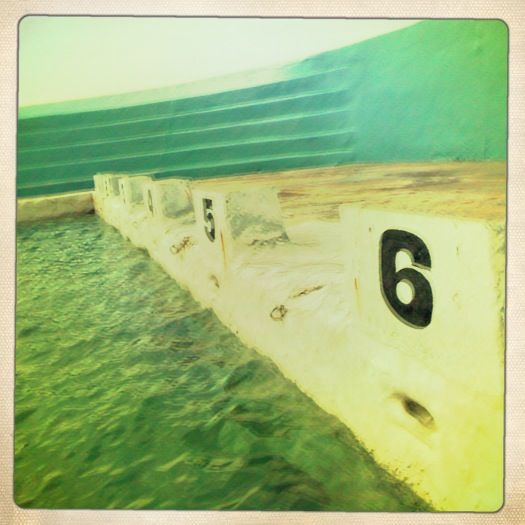
Monday Project Theme: Beach Baths

The water on the cement is cool between her toes. She tries not to think about the temperature of the water in the pool as she pulls her goggles down over her eyes. The suction on these goggles isn’t great, and the last few mornings water has seeped through; when she gets out out of the water her eyes feel as though she is still mostly submerged, peering along the water line. In at attempt to avoid this today, she pushes the goggles firmly into her eye sockets, then steps up onto number six.
This moment, before she dives in, is her favourite part of the day. Looking around at the world she’s about to forget for an hour, anticipating the shock of the cold water.

She stands up tall, her spine long, chin tucked in slightly. Her arms come up over her head, palms touching. She chuckles at her own drama, drops her arms and dives in casually. Her arms and legs feel it first — the tingle. Then her scalp, as her limbs grow numb to it. Even with her tied back the cold manages to find its way in and around every hair folicle. Some days she can still feel the scalp-tingle several hours later, post-shower, post-breakfast.

The first few laps she swims quickly, more quickly than usual. With each new stroke comes a new thought. There is barely room for pause, and she realises she is forgetting to let herself breathe. A breath. A snippet of sound from the world outside, then back to the muted heaviness of underwater.

After lap five, she slows down, allows herself to feel the frustration rather than swimming away from it. She doesn’t know where it’s coming from, and that somehow makes it worse. With her next inhale — a big one — she realises her lungs feel trapped by her ribs, like she could breathe deeper if only her skeleton would get out of the way.

Another breath. Later, she will recognise the sound as a scream, but now it only registers as something harsh; she notices the relief when her ears are blocked with water again.

~

This is my response to this month’s Monday Project theme. The next theme went up yesterday — you can have a look here.

I cruelly forced my writers’ group to respond to the theme on Sunday, when we all got together. I’m hoping some of them will send me what they wrote. We did share with each other on the day, but it might take a little more prodding to get some of their words here.

Stalking… I mean, observing

The other week at uni, instead of a tutorial, we were asked to make our way to one of a list of places in the city and make some observations. With the brief ‘cities at night’, we were to produce two 150 word pieces — the first a description of the place, the second a description of a person within that place.

I chose the supermarket at Broadway. I chose it because I’m writing about supermarkets for one of my feature articles, and because I really dislike the place. Actually, most supermarkets make me vaguely anxious. And that fascinates me. What is it about them that makes me anxious?

My written pieces for this exercise don’t really attempt to address this question, but I thought I’d share them here.

    The place is full of people, but not their voices. A hum fills the space – the cooling system for the fruit and vegetable section. Beep, beep, beep; items scanned and placed in bags. “Next waiting, please.”

    On the whole, it is a place devoid of smell. Only the bread and meat sections have a scent: both vaguely sugary.

    There are few Supermarket Rushers at this hour. People move in a dream-like state, eyes sliding over the shelves, occasionally stopping to peer more closely. To speak to someone is to wake them.

    Away from the hum of the fruit and vegetable section, people’s footsteps can be heard on the bright white hospital floors. The high heels and heavy business shoes have gone for the day, left are those who have had time to slip their feet into something more comfortable. White light — a Hollywood yellow in the cosmetics section — shines down from above. This place seems both small and enormous; with no windows there are no landmarks for perspective.

    ~

    Phone between her shoulder and ear, basket dangling from her arm, she puts two heads of broccoli into her basket. Her grey sneakers take a few steps away. She is not speaking English on the phone, but her sigh is clear; she returns to remove one head of broccoli from her basket.

    The white phone now hangs in her hand. She has moved to cosmetics. Her eyes amble over the face creams on display, looking without really looking.

    In her basket she has a box of oats, a carton of soy milk and the green vegetable. She seems unsure what to add next, moving briefly back towards the vegetable section before drifting in the opposite direction towards the frozen foods. For several minutes she stands in front of the garbage bags, squinting at the many choices. She decides on purple bags a shade or two darker than her shorts.

    She scuffs towards the self-checkout. Basket down now, she gazes at the screen a moment before moving to scan her first item. She has not brought her own bags.

It was an interesting exercise. I ran into someone I knew at one point, and had to pretend I was doing some last minute shopping — even though I was at the opposite end of the supermarket to the milk and cheese, which is what I said I was there to get. And I discovered that stalking is really quite difficult.

But the exercise was fun. I had trouble keeping to the word limit because I had many, many notes. Being asked to observe something almost always has me listening harder than I normally do, and I had lines and lines about the sound of the supermarket.

As much as I dislike these places, supermarkets are fascinating. People behave strangely in them. This observation exercise was as much an exercise in trying to find the kind of compassion for other people I ranted about in my last post. People are rude and vague, tired and careless. Maybe they dislike the place as much as I do.

In last week’s class we got back an edited version of our pieces and discussed the exercise. There were some fairly heated discussions about some of my classmates’ observations of other people. I won’t discuss those here just yet (they relate, again, to my last post and I want to give them a little more time when and if I do write about them).

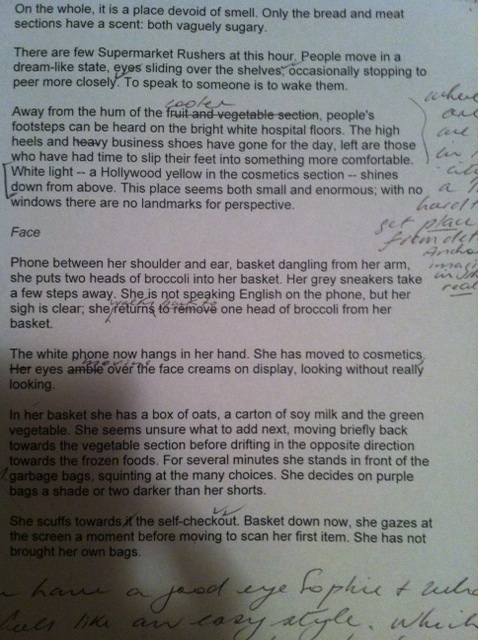
When I got mine back it was covered in notes, questions, underlines and crossings out. I love the way something looks when it’s been edited. I’m not really sure why.

(Excuse the terrible photography.)

The social function of literature?

On Thursday I rushed (quite unnecessarily, as it turns out) from a lunchtime yoga class I teach at UNSW to get on a bus to Canberra to visit my family. I’ve written here before about how I like catching a bus or a train somewhere by myself. It means I get Thinking Time.

I’ve got a lot to think about at the moment. Exciting plans, not-yet-plans, writing, reading, family stuff, money (sigh). When I slumped back in the seat on the bus yesterday, I realised that it’s actually been quite some time since I’ve given myself a break to think. I mean, I think a whole lot as I travel all over the place to teach yoga and various forms of writing. But it’s really been ages since I’ve let myself just think. When you’re travelling to teach, there’s only so far you can let your thoughts wander, in case you end up missing the bus stop or distracting yourself so much that you end up referring to your students’ feet as their hands and inadvertently instructing them to tie themselves up in strange knots. (I frequently say things like, “Inhale, walk your feet forwards between your feet… I mean…”)

Anyway. That’s a (very) round about way of saying that I got some thinking time yesterday. I put my headphones in, found some thinking music and stared out the window.

One of the things that’s been on my mind lately is the social function of literature. In my ramblings on writing as activism I touched on the idea that my writing is often an attempt to understand the world from someone else’s point of view. I’m starting to try and unpack that idea bit by bit.

Allow me to be embarrassingly earnest here for a moment.

Essentially, for me, trying to put myself in other people’s shoes in writing is about compassion. Most of the things that anger me most about the world come down to other people’s lack of compassion. Human beings seem to have this innate ability to lose all compassion for other people. And then they’re jerks to one another. It drives me nuts. (Happily, I’m also often pleasantly surprised by people’s capacity — sometimes those very same people — for compassion.) I’m guilty of it too, of course, and I reserve my harshest judgement for myself.

One of things that interests me most about yogic philosophy is its teachings on compassion. Yoga teaches compassion for all living things, human or otherwise, because all those living things are really part of the same thing. Atman, Brahma, the Self, the Buddha Self, the Universe. A whole lot of names for the same idea. Whatever you want to call it, and whether or not you’re interested in identifying yourself as belonging to one of the traditions that teaches this stuff, the idea that we’re all connected to one another — all dependent on one another — is intriguing.

When I write, I certainly don’t sit down and think, “I know, I’m going to write a piece that teaches everybody that they’re equal to the homeless man they wouldn’t normally look at.” I’m not out to write didactically. But I don’t think it’s possible to write or read stories about human beings — particularly fiction — without being pushed in some small way to think about the world from another person’s perspective. Even if just for a moment. And hey, we might not always feel compassion for the people or characters that we’re reading about (especially if you’re not a bleeding heart, like I apparently am), but even just a glimpse into that perspective, I think, has the potential to shift something in the writer and the reader.

For me, this is what literature is all about: exploring and presenting different perspectives, suggestion and question. The word that I use to explain that process is compassion, because it makes sense to me. Compassion doesn’t mean agreeing with the person or character’s perspective, but it does mean attempting to understand it. Which of course means, for me, also attempting to understand the perspective of the people in the world who are jerks to each other.

Let me get down from my soapbox now. Pack away my pompous wanker pants.

Talking about compassion and linking it to the social function of literature is problematic, I think. I’m an eldest child, and was often accused of lecturing my younger brothers (most of the time the accusation was probably spot on). As a result, as an adult I’m really conscious of not lecturing people. Saying that literature teaches people compassion makes me uncomfortable, as if I’m advocating the kind of writing that’s overtly didactic, even patronising. Writing that lectures, in other words. That kind of writing, I think, actually creates obstacles in people’s thinking, rather than chipping away at the obstacles that are already there. I certainly observe that reaction in myself.

I’m not sure how to resolve this discomfort. I don’t know where the balance is. I don’t know if I even need to resolve it.

This is really the beginning of my thinking on this topic — it’s by no means an exhaustive exploration of what’s in my brain (although I do feel slightly exhausted after typing it all up). I feel like my thinking has a lot of room for development. Any thoughts on the matter (the social function of literature or the need for brain development on my part) would be most welcome.

Music obsession

You know, back in the day, how you used to buy a new CD and have it in your seedy player for the next month? I still do that with albums, even though I now use an iPod.

This guy has been my soundtrack lately. For everything. Writing, yoga, working, bed time. He’s made it onto my yoga class playlists too, so I’ve made my students listen to him. Maybe it’s because I play the piano (lazily, and therefore badly), and have done so since I was seven, but piano music seems to work its way right into the deepest, darkest parts of me and hang around for days or weeks at a time.

I also happen to love this clip, as well as the music that it accompanies.

Where to start?

The fire in my belly from my last post has me frustrated. I’ve got all this energy, all this desire to do something, but no idea where to start.

My appetite has gone nuts. For a few days there it was almost at hyperactive thyroid level — the kind of eating not uncommon to me before I had my thyroid zapped. Just like back then, it’s a need to do something (eat) rather than an actual hunger. I mean, if I don’t eat, I get hungry, but the feeling itself is not like normal hunger. And, again, it’s a hunger that doesn’t know where to start. When I get like this I’ll eat just about anything. I’ll open the pantry and the fridge and just eat things as I come across them: yoghurt followed by sultanas, followed by dry crackers, followed by a spoonful of onion jam, followed by a handful of nuts, followed by whatever chocolate I can get my hands on, followed by an intense desire to cook porridge, and while that’s cooking I’ll eat some more nuts and some more jam and maybe some more crackers and definitely some more chocolate. Of course, when the porridge is cooked I feel like I’m going to explode. But I still want to eat. And so I eat the porridge.

I should clarify. One of the ‘benefits’ of having an overactive thyroid is the crazy-fast metabolism. Constant eating, no weight gain. Sounds brilliant, doesn’t it? Read back over that last paragraph, will you? It’s terrifying and exhausting. And kinda expensive.

Now that I don’t have a thyroid, and my thyroid levels come from a little white pill every morning, my metabolism, while still fast, is much more normal. Except when my brain goes into overdrive like it seems to have in the last few weeks. (The list above, while an accurate description of the appetite of someone experiencing thyrotoxicosis, is a little hyperbolic when used to describe my appetite now. Take a few things off the list. That’s about right.) It’s like my brain needs extra fuel.

Also fuelling my brain are the many, many journal articles, newspaper articles and books I’m reading, and the videos I’m watching and the radio programmes I’m listening to. I’m jamming (ha) them all in there, hoping that my brain is like my metabolism and can process them quickly.

The other thing I’ve found myself doing is taking up lots of new projects. House projects, mainly. Today a friend of mine came around for lunch and I convinced him that it’d be a great idea for him to drive me to Bunnings (I don’t have a car) so I could spend a voucher I had. I bought a lot. Almost the second his car was out of sight I had my (new) gardening gloves on and manically planted just about everything I’d bought, even though my plan had been to leave the planting until the weekend. Then scrubbed the dirt off my hands (I’d ditched the gloves to plant the smaller stuff) and rushed off to teach a yoga class.

Now that I think about it, I’m probably achieving more than I realise with this energy. But it sure doesn’t feel that way. And therein lies the problem, I think. A while ago, I wrote over at the Monday Project about how I’ve got lots of start-up energy, but struggle with follow-through. As well as just running out of steam, not getting the time to appreciate what I’m managing to get done means that I feel like I haven’t done anything, become disheartened and, often, give up.

Kinda like how your stomach takes about twenty minutes to process what you’ve just eaten, feel full, and tell you to stop eating. If you eat quickly you end up with that discreetly-undo-the-top-button-of-your-pants-full. Not good for you in the long run, and not overly pleasant at the time.

So, in the same way that you might, say, actually finish chewing and swallowing one mouthful before moving on to the next, I’m going to try to take a bit of time with some of the writing I’m working on and some of the ideas that are floating about in my head. It doesn’t need to be finished tomorrow. It does have a deadline, of course, but that deadline is a little way away yet.

Right now though, I’m going to go downstairs to see if there’s some chocolate in the cupboard.

~

In case you’re not familiar with the Monday Project, or missed the newest project theme because I’m a bit of a dill and accidentally scheduled it a week early, you can have a look at it here.

Writing as activism

Things seem to be pushing me lately to get writing again about the things I talk passionately about. Heated discussion (not necessarily heated because of disagreements) has always been a part of my life. My parents always encouraged me to think for myself, to find out when I didn’t know, to constantly question.

Talking about literature as activism (and activism for literature) at the Academy of Words started this ball rolling. Then I went back to uni and my teacher talked about how we use words to explore the consequences of the world’s happenings (“If this is so, then what are the implications?”). Then I read some of my uni texts and found myself sobbing by myself on my couch, hoping my housemates wouldn’t come home in time to see me like that (even with the explanation “Kids with cancer”, a red-eyed 25-year-old with tears running down her face, unable to speak properly, is not a pretty sight). Then my brother posted this to his new blog. He’s doing what’s basically an environmental science degree at ANU, and it’s not unusual for a phone conversation between us to be entirely about worm farms or gardens or cooking or food or what’s wrong with society. Our conversations aren’t short. But I’ve never really spent much time writing about them before.

Everything seems to be pushing me back towards writing about what intrigues me, what sets off that fire in my belly.

See, I tend to write to explore issues or relationships that intrigue me.

In fiction I write about characters with dementia, or men who are trying to deal with grief and still be ‘manly’, or middle-aged siblings trying to deal with their parents’ old age and death. These are situations I’ve not been in myself, but things I’ve observed in other people’s lives. And I just wonder, you know? I just wonder what it’s like to be them, how it feels. I want to come closer to understanding, and in sharing it with other people, I hope to provide an opportunity for others to at least think twice about people they pass in the street.

In non-fiction I write about food and cooking, yoga… Well. See, I’d like to write a whole lot more about some of the things that anger me, or frustrate me. Like some of the muddy definitions of ‘climate change’ that my brother refers to here. I’d like to write about lots of the ideas that he and I discuss. And lots of the ideas that I discuss with other members of my family, and those of my friends who are willing (or have no choice but) to listen to me ramble on in such a non-sensical way.

I’d also like to write a little more about the concepts I ramble about in my yoga classes (and write about on my yoga teacher blog), while my students hang their heads in paschimottanasana. I wonder, sometimes, if they’re wishing I’d just shut up and tell them about their hamstrings, or hurry up and get to the bit where I make the little relaxation-inducing adjustments on them. But they keep coming back, so maybe they don’t mind (or they suffer through it to get to the relaxation bit).

Anyway, I don’t really know what I’m getting at here. This is a bit of a rant. And this is me telling someone what my ideas and goals are, rather than just setting about achieving them — which apparently I’m not supposed to do if I actually want to achieve them.

I feel like my brain’s switching back on after a little rest. I guess that’s not a bad thing.

Summation of Academy – from notes in my phone

My original plan with this was to write up some thought-provoking, rambling discussion that somehow approximated what went on at the Academy of Words. That plan was a little ambitious.

Instead, I’m going to put up some of my notes from the day (still in note form). Unfortunately it looks like I only took notes for three of the sessions. And didn’t take anything down at all for the one that I took part in as a panelist. For anyone watching me thumbing away on my phone on the day, I promise I was taking notes, not distractedly sending text messages. Because, would you believe, I actually didn’t think to pack a notebook to take with me to a festival about words. The bits in italics are thoughts I’ve added after the fact.

I write therefore I am… A writer.

  • Realised that writing is how I deal with the world. It’s how I find out how I feel about things.
  • Fiction writing is how I explore certain ideas; non-fiction is an exploration of other kinds of ideas — I seem to have an innate knowledge of whether I can deal with an idea better in fiction or a non-fiction
  • Realised one day that I’m actually good at putting sentences together (am I?), and that it’s not something that everyone is good at.
  • Connection between writing to get to know yourself and yoga practices. (There have been times in my life when I’ve felt it necessary to write pages and pages of personal journals — hopefully something that will never, ever be read by another individual. What comes out in those journals often surprises me. Sometimes it’s like I don’t know how I feel about something or what I think unless I write it down. My yoga practice is the same. Getting on a yoga mat, for me, is a way of getting myself to look at what’s actually there, rather than whatever it is I imagine might be there.)

Honk if you’re the publishing industry

  • “A book itself is a really good piece of technology.”

Literary activism

  • Advocating for a better industry, using literature as a form of activism.
  • People who are lobbying for more accessible cultural artefacts
  • Developing communities — feeling passionate about developing a writing community
  • “Activism is about knowledge, about finding out” director of SA Writers’ Centre
  • “Doing something is activism. You can’t ever be apolitical.” (This reminds me of a conversation I had with a friend of mine recently about how we’d grown prematurely disillusioned with ‘activism’ and felt useless, but then realised that only a small amount of effort was needed to feel active. She now schedules a little time each week in her diary that’s devoted to acting on social and political things she feels are important.)
  • Need to change the social attitude so that cultural artefacts are valued as highly as, say, season tickets to the local footy team’s games.
  • Chloe Langford (Format Festival): recontexturalusing art so it’s just a part of life.

Tiny snippets of things. Tiny snippets that have started to spring off in all sorts of weird and wonderful directions in my brain. More on that shortly…

~

If you’re in a generous mood (or even if you’re not), you might like to donate some spare change to Format, so they can pay their rent and continue contributing to Adelaide’s cultural community. You can donate here.

Monday Project submission: Redux

For my response to this month’s theme, I returned to some of short pieces I wrote last time I made a big move. Since most of my energy in February seemed to be taken up with moving house, it seemed appropriate somehow.

Unfortunately I was unable to get it together enough to actually put the story together into something that made sense. But then perhaps that’s okay, since it’s really about the chaos of packing up a life. I thought I’d type out what’s in my writing journal pretty much verbatim. I’d love to hear if you think this is going anywhere.

~

Her fingers were dry from handling all the cardboard and she had a collection of bruises on her legs. But before her stood a pile of brown cardboard. It sat in the middle of the room, surrounded by the absence of her furniture and the trails of dust and cobwebs that had been hidden beneath it.

The curtains were freshly washed, still a little damp and slightly crushed. The space around the box mountain looked smaller than it had when the contents of the boxes had been spread around it.

You stand next to her in the doorway as she looks around again and sighs.

“Why do I own so much crap?” She doesn’t want an answer.

Another box marked ‘books’. There have been thousands of these already, you think. Your daughter’s reading habit doesn’t quite keep up with her book-buying one. She sighs again, running her fingers over her own handwriting on yet another box of books, then follows you downstairs with it.

~

You worried vaguely about having an accident as you drove through the city, thought maybe you should pull over until the tears subsided. But then you knew you’d only turn around if you stopped, and that wouldn’t help anyone.

She’d looked small in the rear vision mirror as you drove away. Not at all grown up. You knew she was probably crying too – and that her ridiculous new boyfriend would have no idea how to handle it. He’d helped her find the dingy flat that was to be her first home away from home, and in doing so had proved to you that he had no idea what your daughter might need.

The place was filthy, for starters. Your daughter’s new housemates had layers of newspaper on the dining table so they could just throw away the top one after a meal, rather than wipe down the table; the drain in the bathroom was full of hair; everything was covered in grimy dust. Your daughter’s bedroom was full of someone else’s furniture. Even with some of the knick knacks and books of hers that you’d brought down with the rest of her clothes, she looked out of place in the room.

You told yourself, as you continued to drive away from her, that you’d only thought all that because you were being overprotective – that probably also explained why you thought her boyfriend was an idiot. The thought wasn’t comforting though. It only made you cry more – you felt sorry for yourself. And it wasn’t true anyway.

~

In your garage there are three boxes with her name on them, and several bags that aren’t labelled but that you know are hers. About once every six months – or more often if you haven’t heard from her in a while – you wake up early, pad down the internal stairs and stand in front of the small pile of her things. Both you and her mother are guilty of reminding her a little too often that these things are taking up space in your garage, but if she came to take them away you’d be upset.

The boxes are labelled in her neat handwriting – their contents described in brief detail on the masking tape that keeps them shut. They are mostly full of old things: high school and university books, photo albums, knick knacks, CDs. One box is simply labelled “special things”. Many times, as you’ve stood in front of her boxes and bags, you’ve wondered what constitutes “special” to your daughter. What would she pull out of that box? Undoubtedly it would be a collection of things that mean nothing to you, and whose story you will never know – trinkets from old friends and boyfriends, from far-flung places; letters from people you’ve never known, photos of people you’ve never met.

One day she’ll come back for these boxes – she might even open the “special things” box. The extra space in the garage would be good, certainly, but you’re not sure you could bear watching her going through them. You like the idea that you have a part of her here, neatly contained and labelled, and somehow mysterious.

Often, as you look at the boxes and run your fingers over her handwriting, you wonder what she is doing now, all those plane-hours away. You like to imagine that she is sitting at the kitchen table drinking tea, or reading to her own small daughter.

~

You don’t understand why, but she feels she needs to do it. She’s packing up again – this time leaving him, when it’s always been him leaving her. The him has changed over the years, but it’s been pretty much the same story every time. Being in a relationship with your daughter, you imagine, is very intense.

But no, this time she’s leaving him, and that’s at least half the reason why you think maybe he’s the right one. She’s determined though; packing boxes, taking things that are definitely his, leaving things that are definitely hers because she’s unsure in her frenzy. As she packs she babbles at you, her voice so close to tears. You should really be packing in another room, to speed the process up, but you can’t bear to leave her alone when she’s like this.

Even a little girl she was prone to working herself into a frenzy. Never over nothing, but always over something that didn’t really deserve all the energy she was giving it.

And there is the other half of the reason you think he’s the right one. Determined as she says she is, every part of her seems to be fighting against her own decision. Her hands shake, as if saying no to the words that are coming out of her mouth.