Gardening

I never thought I’d be a gardener.

The house I grew up in had an enormous front and back yard, and my brothers and I spent many hours playing in the garden, making cubby-houses out of bushes and soup out of mud and berries. A trip to the local nursery on a weekend with Mum and Dad was a fairly regular occurrence. But I never really understood the appeal of being on hands and knees, with dirty hands, at risk of attack from any number of nasty creepy crawlies.

And yet, as an adult, most weekends I find myself looking forward to spending some time in the garden. I get distracted by nurseries. I notice when my neighbours have planted something new, or pulled something out. These days, gardening for me is very much like yoga: it requires a regular commitment, is full of frustration and disappointment, but made entirely worth the effort by the joy that comes with any achievement, no matter how small. Gardening, like yoga, gives me a chance to really appreciate small things.

The switch from non-gardener to gardener has been a gradual one, and I can’t say exactly where it started. My Mum, a certain former housemate and a few other people have helped me along the way. Hey, maybe I was never really a non-gardener in the first place.

My love of gardening can be directly attributed to my love of food — most of my garden is edible. (Except the jonquils. They’re just purdy.)

In some of my research for a writing project on food and culture, I came across this article on The Conversation (an independent source of information, analysis and commentary from the Australian university and research sector, launched earlier this year):

“Food. It is the great unifier of place and race, the common ground sustaining our very existence. Why then, does food production feature so minimally in public space and urban design?

Under the weight of looming threats to energy, population and economy, the time is ripe to rethink our design focus.

Traditionally, urban design has been dominated by the use of ornamental exotic and indigenous plants while edible species have been minimally utilised.

Now, as we move towards a potential crisis in food production it is more important than ever to rethink our design practices.”

(Read the rest over at The Conversation.)

I firmly support the idea of bringing some food production into cities. It’s unlikely that cities will ever support themselves entirely, but I don’t think that’s the point. My garden does not produce enough to be my sole source of food, but it does contribute to what ends up on my plate. Perhaps more importantly, it gives me a much better idea of where the food I do buy has come from, and the kind of work that’s gone into producing it. That increased awareness, I think, can only lead to good things.

So much of any yoga practice is about noticing what’s there — often below the surface. Food gardening, for me, is another way of practicing yoga without a mat.

~

This is cross-posted over at my yoga blog, om gam yoga.

Cities and food

I’ve spent my entire adult life living in cities. And at the moment I seem to be spending every spare waking moment reading about them — part of some research I’m doing on how cities are fed.

Cities are complex — an extension of the human beings they house, I suppose. I’m finding the research fascinating, even though I’m still in that stage of not really knowing what I’m going to pull out of it. Most of what I’m reading suggests that we should treat cities as living things, allowing room for them to develop organically.

Geoff Mulgan, from the Young Foundation, says their research suggests that we need to practice “designing in incompleteness, recognising that the best cities evolve themselves rather than just following somebody else’s master plan… the more perfectly planned and conceptualised the new city, the more certain you can be that it will fail.” (You can access the transcript of his presentation, The Social Life of Cities, on the Grattan Institute‘s website.)

Allowing for uncertainty and growth, I guess. As a teenager, I was interested in architecture, and briefly considered going down that path when I left school. Design on that scale — and broader still, looking at urban and suburban planning — still interests me. What we see around us, in urban and suburban environments, is very rarely there arbitrarily. Mulgan (and a number of other people whose work I’m reading at the moment) suggests that much thought needs to be given to how our built environments impact our social lives, because one of the very basic human needs is interaction with other humans.

Food, of course, is another basic human need. I think the two can and should cross over.

But enough for now. Back to work for me.

Whimsy and web-spinning

After a weekend with my family — a weekend of stories, memories, tears and laughter — I feel like I’m brimming with words. Characters I’ve written about before, and new ones, are floating in the air around my head, as if they’re attached to the end of spider webs caught in my hair.

I hope I can gently capture some of them and spin them into something before they float away.

Storytelling

What has struck me over the last few days, since my Mamie’s death very early Friday morning, is how important storytelling is to the grieving process. Apart from the day she died, when I withdrew into a little shell and moped about the house by myself, I’ve spoken to one or more members of family every day. And each time we’ve told stories about Mamie.

I’ve found out things about her I didn’t know, and heard stories that cement my ideas about her. I said to my Dad the other night (Mamie was his mother) that I’m sure there are lots of things about Mamie that I was never going to know until she had died, and I’m kind of looking forward to getting to know her better — or at least in a different way — through the stories I’ll hear about her.

The storytelling is vital, I feel. Mamie was frail when she died — if we weren’t able to tell our stories about her to one another, I think we’d not be able to remember her as she was in the rest of her life. In the stories, she gets to live again.

I’ve always been fascinated by religion and spirituality. I went to Catholic schools growing up, and every year I did very well in the compulsory Religious Studies. I don’t really consider myself a religious person, but I have always loved learning about how people explain to themselves life and death and everything in between. Life after death — again not something I’m decided on — is a particularly interesting concept to me. I wonder whether these stories, these memories we have of Mamie, are her next life.

Mamie was religious. She believed in God, and Heaven, and that she was going to be with my grandfather, Da, again when she died.

Once, a few years ago, she and I started having a conversation about God. I told her I didn’t know whether I believed in a higher being or not, but that I didn’t think it mattered if I was able to be a good person. She listened. At that point in the conversation we were interrupted, but she looked at me, touched my arm, and said, “Please let’s continue this conversation when we can later, darling.” I knew, from the way she said it, that our later conversation would not involve her trying to change my mind, only wanting to know more of it.

Sadly, we never got the chance to finish that conversation. I would dearly love to talk to her about those things now, and it saddens me to think that I won’t be able to.

But that I can tell that story, and imagine how the conversation might have gone — have the conversation with her in my head — is enough. Whichever way you look at it, Mamie’s having a life after death right now.

I’ve shared my thoughts about the social function of literature here before, and I’m sure what I’m describing here fits into that idea somehow. Stories encourage compassion and empathy, and in doing so I think they can perpetuate a person or character’s voice and existence. Which reminds me, I’m due to write more about my ideas on using different narrative voices — my efforts here don’t do the subject any kind of justice.

Nostalgia

I’ve been writing this post for weeks, on an off. It seems appropriate to finish it now — a death in the family always lends itself to remembering and nostalgia.

For a couple of months now I’ve been carrying around a little vial of nostalgia, everywhere I go. Sometimes I really do feel as though it’s rattling around in the bottom of my handbag, and when I go searching for something else I come across it.

The thing about nostalgia (at least for me) is that it’s so unspecific. I can’t really say where it’s come from, or even what it’s about. Or maybe it’s that I can say where it started, but then I’m unable to contain it to that. Nostalgia breeds nostalgia.

Sometime last week I found myself sitting on the couch, home by myself for the night, with a huge pile of recipe books, flicking through pages, making mental lists of things I’d like to cook next time I find half a day to spend in the kitchen. As I turned the pages I came across recipes I’d marked months ago, and finally worked out the root of this bout of nostalgia: I love my new house, but I’m also missing my old one. I miss my old housemates, I miss the house itself, I miss Astro the cat, I miss living down the south end of Newtown. I’m not despairing in the missing, it’s just a lingering sense of… sadness at the finality, I guess.

We cooked a lot in my old house. I cooked a lot. It wasn’t a great kitchen — it had a huge oven, but we also spent the last six months in the house cooking by lamp light — but it’s where I really feel like I cemented my love of cooking. I spent hours and hours cooking in that kitchen, sometimes many dishes at once, often on my own. Cooking became a kind of meditation; thoughts about other things popped into my head during big cook ups, but the focus always came back to whatever was on the stove top.

I also spent many hours in that kitchen, sitting on the step between the lounge and the kitchen or perched gingerly on the barely-held-together stool we’d borrowed for a party and somehow never returned, chatting to one of my housemates about life — work, boys, politics, religion, music, books, writing, cats, dogs, babies, family. We cooked, we talked.

The kitchen in that house will always be somehow special to me.

Thinking about that kitchen inevitably leads to thinking about the garden at that house, my little room and the neighbours whose backyards my windows overlooked, the creaky floorboards in the upstairs hallway, the sunny lounge room, the cracked walls, the ballroom-sized bathroom… the list goes on and on. And then spills over into other parts of my life, occasionally going as far back as childhood.

That my trip to Melbourne happened in the middle of all this nostalgia really hasn’t helped things. I miss Melbourne with such a visceral ferocity that it’s sometimes overwhelming. Going back there, I wander around the streets, amazed that I still feel so at home there, even though I’ve now lived in Sydney nearly as long as I lived in Melbourne.

Strangely, I also feel nostalgic about writing (this is far harder for me to explain). Spending time at writers’ festivals, like I have this last month — especially ones like EWF where I spent a lot of time in the company of other writers — exacerbates this kind of nostalgia. I think maybe what I’m trying to do when I write (fiction, at least) is capture that feeling of nostalgia, that little twinge of melancholy. So somehow thinking about or talking about writing brings about those feelings I’m trying to capture. Does that even make sense? I don’t know.

Perhaps this nostalgia, and its settling in for a lengthy stay, is why I’ve found myself wanting to write more fiction. For the last six months I’ve been working steadily on a big non-fiction project. I love it, and I don’t want to put it away, but I think maybe I need to let myself venture a little more into whimsy from time to time.

Theme: An agent for change | the monday project

In case you missed the new Monday Project theme yesterday, here it is. Responses to this theme will be due Monday 4 July.

Theme: An agent for change | the monday project.

An Agent for change

I’m really not sure where I’m going to go with this one… I’ve used the last couple of themes to explore some characters I’ve had kicking around in my head for a while now. I guess I’ll probably find myself doing the same thing for this month’s theme.

Come play along. You know know want to.

Monday Project: “They grouped under the lamp post, alone.”

Lamp Post

He didn’t smoke, but he’d accepted the offer of a cigarette from the pale man shuffling his feet in the waiting room. Outside, they’d shared that brief intimate moment, leaning in to light their smokes from the same lighter flame, but now they ignored each other, just as they had inside.

Jonathon could only assume the pale man was here for similar reasons to him: waiting for his girlfriend to emerge from somewhere deeper in the clinic, not sure what to expect — from her or from himself.

The pale man coughed, ground the stub of his cigarette into the ground with his foot, and lit another. Jonathon was glad there was no offer of a second for him; he was struggling with the first. He shivered; the pale man did too. The sun had disappeared suddenly, taking its warmth below the horizon. The street lamp overhead flickered on, and the two men moved closer to it. Standing under the shower of light, the darkness seemed to deepen quicker. Jonathon ground his own cigarette stub into the cement. Hands buried deep in his pocket, he rocked back and forth from his heels to his toes.

The pale man finished his second smoke, and dropped it on the ground.

“Good luck man,” he said, and wandered back towards the clinic. Jonathon looked at the butts the man had left on the ground and suddenly felt ill.

~

This is my response to this month’s Monday Project theme. The new theme (due at the beginning of next month) will go up later today. Come play along!

[The new theme has gone up — check it out here. New players are always welcome.]

Post-EWF blues

Last weekend I went down to Melbourne for the Emerging Writers’ Festival, a festival that really is a writer’s writers’ festival. To borrow from the EWF’s ‘about’ page, “Each year the Emerging Writers’ Festival brings writers, editors, publishers and literary performers together with the reading public for a festival that is fast becoming an essential part of Australia’s literary calendar.”

It’s hard for me to know where to start describing my experience of the festival. I tweeted over the weekend that I felt like the conversations I was taking part in, and the panels I was attending, meant I was collecting thoughts in an in-tray, to be processed later. I feel like I’m still working through that in-tray. This, I think, is at least in part a reluctance on my part to ‘finish’ with EWF for the year — the logic being that if I process Thought In-Tray, I’ll have to face the fact that it’s over and deal with the post-festival blues I’ve just managed to keep at bay all week. (So basically, I had a good time, and I’m not ready for it to be over, even though it already is.)

Yogic philosophy would tell me that everything is impermanent, and that holding onto it like this is just going to make eventually letting it go more painful. So here I go, whisking the band-aid off. I’ll try to express some of the major points I took from the conversations and sessions I found myself in.

On Friday, Saturday and Sunday nights I found myself at bars and restaurants, talking through the problems of the world (literary and otherwise) with various emerging writers. I think we solved a few of them, at least in theory. On Sunday evening I also found myself sitting on a futon with my three hosts (A, G and S) flicking through art history and mythology books, wishing I had enough time in my life and space in my head to pursue these minor interests of mine with more gusto.

On Saturday and Sunday I went into the city for the Town Hall Writers’ Conference. When I bought my weekend pass for this I really wasn’t sure what I’d attend. I found myself in sessions about writing and health, blogging, typecasting and different voices. I wish now that I’d gone along to a few other things as well, but I’m actually not sure that I would have been able to contain all the thoughts safely inside my head.

I’ll try to give you a snapshot of each session.

Writing and health: If you’re a writer with health problems, chances are it will have an impact on your writing — sometimes good, sometimes bad. Sam Twyford-Moore, whose brilliant essay on writing and mental health can be found here, made an excellent point about the treatment for health problems (mental or physical) having a negative impact on your writing: if you don’t seek treatment, especially for serious health problems, your death is going to have a very negative impact on your writing indeed — to risk avoiding treatment because it might dampen our ability to write is not really worth it.

Blogging: This ‘in conversation’ was fun, because it was run by a blogger who blogs only for fun, and a blogger who also blogs for money. They both agreed that blogs need to have a personal voice, or they’ll not find readers, but didn’t necessarily agree on whether bloggers should be paid. Philip Thiel blogs because writing about himself forces him to actually do interesting things, and feels like the experiences he has as a result are payment enough; Jessica Au used to contribute to Meanjin’s blog, Spike, and thinks bloggers who write for organisations should be paid, and that perhaps it is the origin of blogs as (sometimes very personal) online journals that means this financial arrangement between organisations and their bloggers hasn’t quite been worked out.

Typecasting: I feel like I’m not going to do this session justice, despite having taken pages of notes during it. (Just in case I don’t, Angela Meyer and panellist Ryan Paine have both blogged about this session.) The panel included Anita Heiss (the ‘indigenous writer’), Julian Leyre (the ‘gay writer’), Ryan Paine (the ‘young writer’) and Karen Pickering (the ‘feminist writer’), and was chaired by Dan Ducrou (a ‘young adult fiction writer’). Each panellist discussed the benefits and pitfalls of stereotypes. Anita said that “being in a category called ‘chicklit’ somehow devalues your work. It says that your stories don’t have value… if the work of a chicklit writer is devalued, then so too are the lives of the women I write about.” Julian spoke about the freedom he has in the ‘queer writing’, because that category hasn’t been properly defined, so he’s able to bring into his writing other things he’s interested in, like cross-cultural issues and racism. Ryan addressed the problematic idea that young writers are less qualified to write about the world because of their inexperience (in life and writing), and said that he’s found that maybe the opposite is true, because young writers are far more likely to consider new ideas, perhaps because of their inexperience. He warned though, that even young writers need to be vigilant in questioning commonly-held beliefs, saying, “By pedalling the same opinions to one another because we’re too timid to question our friends we are actually inhibiting the very progress of human thought we claim to advocate.” Karen sees writing mainly as an idea delivery system, but hopes “to reach out beyond [her] natural allies and engage”.

The ideas from this panel in particular are hanging around in my head. I’ve always found it really grating to be typecast as anything, but I can see there are advantages to finding a particular niche. With all the changes I’ve made in my life in the last year or so, I sometimes think that being typecast might actually help me work something things out about myself. I’d just like to be able to shed that stereotype when it was no longer useful to me — and perhaps that’s exactly where the problem lies: shedding the stereotype is really difficult to do.

Different voices: I think perhaps I’ve written here before about the people that live in my head. I have fiction characters sitting in there, and occasionally they pop into my thoughts as if they’re real people. Sometimes I wonder whether I have the right to write from the perspective of an elderly man with dementia, or a young boy whose brother has drowned, so I was interested to know what other writers thought. Perhaps I will elaborate on my thoughts from this panel at some point over the next few weeks (I have pages and pages of notes), but for now I’ll leave you with the summary agreed on in the question time: to write from the perspective of someone who is not like you, you need a healthy curiosity (which might mean lots of research) and a genuine feeling of empathy for that character — only then will you write with a voice that sounds authentic and avoids condescension.

I also want to write a little about the TwitterFEST discussion I hosted on Tuesday (when I was, sadly, back in Sydney), but this post is already far too long. I’ll try to get to writing about that discussion later this week.

Now excuse me while I go off to nurse myself through my post-festival blues.

Monday Project Theme: Beach Baths

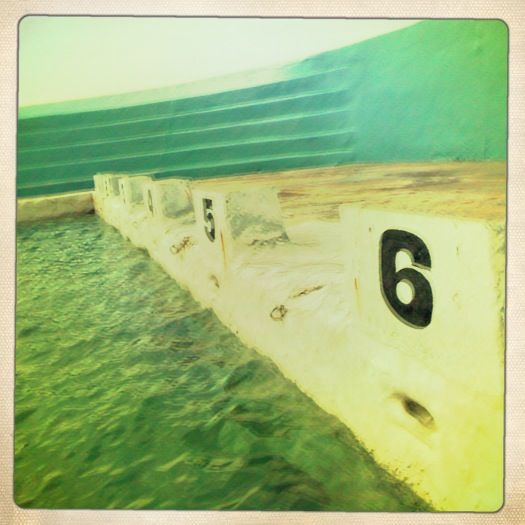
The water on the cement is cool between her toes. She tries not to think about the temperature of the water in the pool as she pulls her goggles down over her eyes. The suction on these goggles isn’t great, and the last few mornings water has seeped through; when she gets out out of the water her eyes feel as though she is still mostly submerged, peering along the water line. In at attempt to avoid this today, she pushes the goggles firmly into her eye sockets, then steps up onto number six.

This moment, before she dives in, is her favourite part of the day. Looking around at the world she’s about to forget for an hour, anticipating the shock of the cold water.

She stands up tall, her spine long, chin tucked in slightly. Her arms come up over her head, palms touching. She chuckles at her own drama, drops her arms and dives in casually. Her arms and legs feel it first — the tingle. Then her scalp, as her limbs grow numb to it. Even with her tied back the cold manages to find its way in and around every hair folicle. Some days she can still feel the scalp-tingle several hours later, post-shower, post-breakfast.

The first few laps she swims quickly, more quickly than usual. With each new stroke comes a new thought. There is barely room for pause, and she realises she is forgetting to let herself breathe. A breath. A snippet of sound from the world outside, then back to the muted heaviness of underwater.

After lap five, she slows down, allows herself to feel the frustration rather than swimming away from it. She doesn’t know where it’s coming from, and that somehow makes it worse. With her next inhale — a big one — she realises her lungs feel trapped by her ribs, like she could breathe deeper if only her skeleton would get out of the way.

Another breath. Later, she will recognise the sound as a scream, but now it only registers as something harsh; she notices the relief when her ears are blocked with water again.

~

This is my response to this month’s Monday Project theme. The next theme went up yesterday — you can have a look here.

I cruelly forced my writers’ group to respond to the theme on Sunday, when we all got together. I’m hoping some of them will send me what they wrote. We did share with each other on the day, but it might take a little more prodding to get some of their words here.

Stalking… I mean, observing

The other week at uni, instead of a tutorial, we were asked to make our way to one of a list of places in the city and make some observations. With the brief ‘cities at night’, we were to produce two 150 word pieces — the first a description of the place, the second a description of a person within that place.

I chose the supermarket at Broadway. I chose it because I’m writing about supermarkets for one of my feature articles, and because I really dislike the place. Actually, most supermarkets make me vaguely anxious. And that fascinates me. What is it about them that makes me anxious?

My written pieces for this exercise don’t really attempt to address this question, but I thought I’d share them here.

    The place is full of people, but not their voices. A hum fills the space – the cooling system for the fruit and vegetable section. Beep, beep, beep; items scanned and placed in bags. “Next waiting, please.”

    On the whole, it is a place devoid of smell. Only the bread and meat sections have a scent: both vaguely sugary.

    There are few Supermarket Rushers at this hour. People move in a dream-like state, eyes sliding over the shelves, occasionally stopping to peer more closely. To speak to someone is to wake them.

    Away from the hum of the fruit and vegetable section, people’s footsteps can be heard on the bright white hospital floors. The high heels and heavy business shoes have gone for the day, left are those who have had time to slip their feet into something more comfortable. White light — a Hollywood yellow in the cosmetics section — shines down from above. This place seems both small and enormous; with no windows there are no landmarks for perspective.

    ~

    Phone between her shoulder and ear, basket dangling from her arm, she puts two heads of broccoli into her basket. Her grey sneakers take a few steps away. She is not speaking English on the phone, but her sigh is clear; she returns to remove one head of broccoli from her basket.

    The white phone now hangs in her hand. She has moved to cosmetics. Her eyes amble over the face creams on display, looking without really looking.

    In her basket she has a box of oats, a carton of soy milk and the green vegetable. She seems unsure what to add next, moving briefly back towards the vegetable section before drifting in the opposite direction towards the frozen foods. For several minutes she stands in front of the garbage bags, squinting at the many choices. She decides on purple bags a shade or two darker than her shorts.

    She scuffs towards the self-checkout. Basket down now, she gazes at the screen a moment before moving to scan her first item. She has not brought her own bags.

It was an interesting exercise. I ran into someone I knew at one point, and had to pretend I was doing some last minute shopping — even though I was at the opposite end of the supermarket to the milk and cheese, which is what I said I was there to get. And I discovered that stalking is really quite difficult.

But the exercise was fun. I had trouble keeping to the word limit because I had many, many notes. Being asked to observe something almost always has me listening harder than I normally do, and I had lines and lines about the sound of the supermarket.

As much as I dislike these places, supermarkets are fascinating. People behave strangely in them. This observation exercise was as much an exercise in trying to find the kind of compassion for other people I ranted about in my last post. People are rude and vague, tired and careless. Maybe they dislike the place as much as I do.

In last week’s class we got back an edited version of our pieces and discussed the exercise. There were some fairly heated discussions about some of my classmates’ observations of other people. I won’t discuss those here just yet (they relate, again, to my last post and I want to give them a little more time when and if I do write about them).

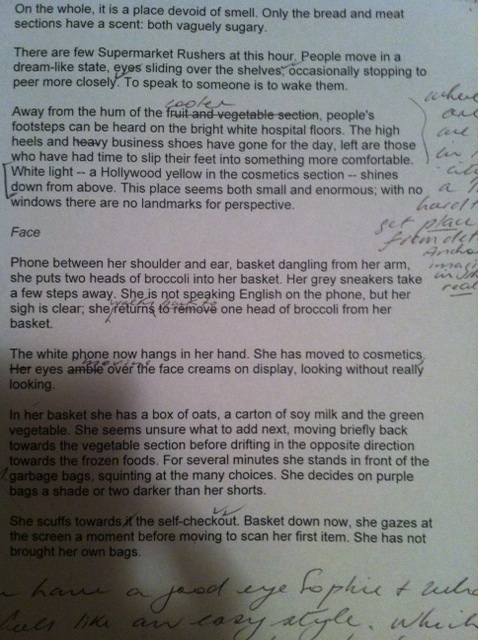
When I got mine back it was covered in notes, questions, underlines and crossings out. I love the way something looks when it’s been edited. I’m not really sure why.

(Excuse the terrible photography.)