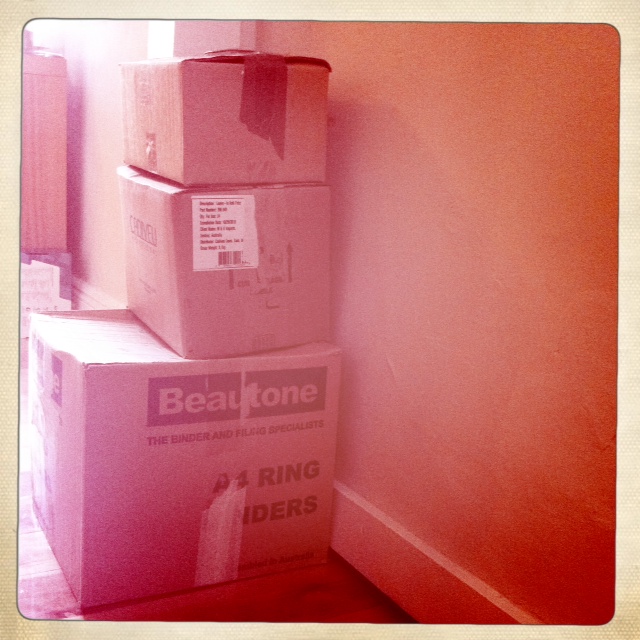
Old houses

Yesterday I wandered, on a whim, over to the south end of Newtown. I’d arranged to meet up with a friend in a cafe on King St, and to get there I chose a route that would take me past a house I lived in for two and a half years.

Pearl Street.

A house that will forever be the source of an enormous amount of nostalgia for me. It was the house in which I rediscovered myself after a major relationship breakup, it was the house in which I began to form an idea of what I wanted my adult life to look like, and in which I began to take steps toward that life. My Pearl Street housemates became like family (which I wrote about here when we all moved out of that house).

The house, when I came to it yesterday, had changed a lot. And it was for sale. Its cracked and worn cement front path had been replaced with neat pavers; the front garden we’d grown veggies in had been restructured and reduced; and the entire house, which had been a sunny yellow when we’d lived there, had been repainted a very mild off-white. Pearl Street as I knew it was gone.

I stood at the front gate, still the old green cast iron thing I knew so well, and stared at the place, trying to take in all its changes. Trying to let them sink in. It was sad, but not devastating.

And it seemed somehow appropriate that this place that is so meaningful in my story should have moved on, when I’m about to do so myself. A month from now, my current housemate (and dear friend) and I will pack up our lives in Sydney so we can move down to Melbourne. I’ve been saying for years that I wanted to move back to Melbourne. In fact, I’m sure I came home to Pearl Street more than once from a trip to Melbourne announcing that I was going to move back down south. But something about that house (and many other things besides) kept me in the sunny city. Somehow, I always knew that while I lived in that house I’d not be able to commit to moving away from Sydney.

My housie and I have been preparing for some months now for this move, and the whole time I’ve been swinging wildly between immense excitement and equally immense sadness. I am sad to leave this city. I am sad to leave all the people I love who live here (and near to here). But seeing yesterday that Pearl Street has moved on has somehow helped me to let go a little, to be sure that it is time for me to move on too. It’s not so much that my sadness at leaving has gone, it’s just that I’ve worked out how to hold it so it doesn’t colour everything else.

Lying on the floor

Walking home from teaching one night, on the phone to my Mum, I rounded a corner to find a woman and her tiny dog, waiting to cross the road.

That dog’s on a long leash, I thought.

“Watch out for my dog, lady.” the woman said.

“It’s okay, I can see him.” I said, probably impatiently.

“Yeah well, how would I know? You’re looking down.” She snapped, and crossed the road.

“Yes,” I said, “Down. To where the dog is.”

And all of a sudden this woman and I were yelling at each other across the street, until she stormed into her apartment building and the door slammed, and I became aware of my Mum, on the phone I still held to my ear, saying “Sophie, who are you talking to?”

As I told her the story, and as is often the case for me, my indignation turned to guilt. “I can’t believe I yelled at her,” I said to Mum.

“Don’t worry,” she said “You’ll never see her again.”

And it’s true. I’ll probably never see that woman with her tiny dog on a stupidly long leash again. But it’s highly unusual for me to yell at strangers in the street. If I am, it’s a pretty good sign that there’s something not so great going on for me. Anger, frustration and grumpiness are usually an indication that I’m feeling overwhelmed by or stressed about life—often I don’t even know why.

I’m pleased that this is something I know about myself. It means I can make some little adjustments to how I organise my days, so I get enough downtime or rest. Because rest is usually the answer to stress. But it’s not always easy. In this recent piece, one of my favourite yoga writers, Yogi J Brown, discusses the ways we should (and usually don’t) deal with stress. Intimacy with ourselves, he says, is the best antidote—that is, spending time with ourselves in a way that allows us to see what’s going on. Noticing the anger or frustration is the first step.

When I was a teenager, I used to spend a lot of time lying on the floor or my bed, just listening to music. One afternoon, my Mum came into my bedroom to find that I’d actually fallen asleep on the floor, my head just centimetres from a speaker that was blaring music. It’s easy to be dismissive, to say that I could afford to do that then because I didn’t have the responsibilities I do now. But that’s a load of crap. Yes, I do have more responsibilities now, but surely that just makes it all the more important that I get some downtime, so I’m able to deal with those responsibilities… well, responsibly.

In my essay for The Emerging Writer, I explored some of the benefits for writing of doing nothing (well, almost nothing—listening still counts as something, really) with the physical body. To briefly summarise that part of the essay, doing nothing allows the body and the mind to process stuff, and potentially to make links between things that might not be immediately obvious, or that the brain might not have made otherwise.

Obviously, this can be good for writing. But it’s also just good for us on a more general level. Rest—waking rest, as well as sleep— is really important. (And ‘rest’, by the way, is just as metabolically active as activity—it just uses energy in different ways.)

In this piece on the benefits of the yoga pose savasana (which translates as ‘corpse pose’ and basically involves lying on the floor doing nothing), Sydney yoga teacher Brooke McCarthy writes in detail about what happens when we relax deeply—and how to do it. After reading this piece I decided I needed savasana to make an appearance in my life every day. I haven’t quite managed that yet, but on the days when I do get to it, everything seems just a little calmer. Honestly, lying on the floor for ten or fifteen minutes when I’m really busy makes the world of difference to my state of mind. And, really, if I’m feeling overwhelmed anyway, what am I really going to get done in those fifteen minutes?

And while I’m on the subject of ‘busy’. That words makes me cranky. I’d never really thought about why until I read this piece about the trap of busyness (interesting: my eyeToy autocorrects busyness to business). Writer Tim Krieder suggests that being busy is an avoidance tactic—if we’re busy, we don’t need to face ourselves, and all those things that are worrying us or upsetting us. And the more I teach yoga, the more I realise that everyone has at leat some of that kind of baggage. Facing it is hard, so makes sense that we don’t want to do it. But avoiding it doesn’t make it go away. For me at least, avoidance often makes the worry warp into something else—like yelling at a woman and her dog on the street.

My response lately to the question ‘how are you?’ has been ‘busy’. And after I’d said it a few times, I realised that it, along with the crankiness I was carrying around, was an indication I was doing too much.

All of this is a very roundabout way of saying that, once again, I’m returning to that teenage habit of lying on the floor listening to music on a regular basis. I’m trying to get some nothing into each if my days. It’s amazing. I feel instantly less busy.


Quietly missing someone

These last couple of days I’ve had a long-time friend staying with me. She and I became friends when, as fifteen-year-olds who caught the same bus home from school, we one day noticed a sheep standing on a hill in a paddock, its head above the rest its flock. It looked so quaint standing there that we looked for it again the next day. And the next day, and the next. And every day, there it was, and so our acquaintance developed into a friendship.

She and I spent so much easy time together over the next three years that it’s always what we return to when we see each other now. We talk for hours about nothing and everything.

This friend lives in another part of the country to me—and has done for all but two years of our adult lives. I miss her. And that missing hurts most whenever we part company again.

For various reasons, I’ve been thinking a lot lately about missing people. And about living away from people that you miss. In my adult life, I’m yet to live in the same city as either of my brothers, and I find myself envying siblings who see each other frequently. In the same way, I wish it was easy for me to just be in my parents’ company. A three hour bus trip, in my opinion, is not easy.

Having grown up in a small country town, I have friends who live all over the country. And having moved interstate more than once myself has only added to the list of people I miss.

Missing people is a strange thing. It’s not strange that it happens—of course it does. What I mean is that the feeling itself is strange. Missing someone feels like it creates a little tear in me somewhere, or a loose stitch. Just something tiny, really. But that tiny instability is something I’m always aware of, and it changes the way I move through life. It means I have to take more care, lest the tear grow larger, or the stitch come looser; lest I begin to fall apart. Those small breakages need to be tended to regularly.

Missing people, for me, is quite separate to missing a place. Missing people does not mean I want to be where they are, necessarily, but it does mean I want to be with them. The difference is subtle, I suppose. And it’s odd to me that there can be that separation, that seeming contradiction. The way I miss people confuses me. That I can still function, and pursue other things, and miss people the way I do seems odd. I guess caring about someone enough to miss them when they’re not near doesn’t mean I don’t want other things. And wanting those other things is not a reflection on my feelings for the people I miss (which is something I’ve worried over from time to time).

Tomorrow it is my recently-departed-from-my-company friend’s birthday. Which reminds me that when I saw her this time last year I started writing a post very much like this one, but never published it. This year I will. Happy birthday, dear friend. Know that I miss you when we are not near one another, and that the missing means I really appreciate the time we do get together. May we have more of it sooner rather than later.

Getting older

That morning, as she pulled a grey hair out of her head — her way of dealing with them, now that they occasionally appeared — her first thought, rather than a vain despairing at her own aging (which she’d certainly also been guilty of), was to wonder at how odd it must be for a parent to see these signs of aging in their children. How odd it must have been for her own mother the first time she noticed a grey hair on her daughter’s head; the first time she saw around her daughter’s eyes the small wrinkles perhaps seen only those whose intimate relationship with her allowed them to look so closely at her face. How odd it would be for her mother, she thought that morning, as those small things became more obvious in the face and body of her child.

Too many things

Last week I finished a masters degree that I’ve been doing on and off now for four years. It’s a degree that I’ve enjoyed immensely at times, and loathed at others, but that, overall, I’m so glad to have done.

I wasn’t sure what to expect of myself when I finished. I guess I expected some relief, and maybe some sadness. But actually what I’ve ended up with is a kind of confusion about what to do now, and about a million suggestions from within my own mind about how to manage that confusion. Since Thursday (the day of my last class), I’ve had this odd excitable (bordering on manic, actually) energy.

“Energy”, when your day job is teaching people yoga, is a troublesome word to use. When I say it, people sometimes look at me strangely, thinking, I suppose, that I might start talking to them about hippy-dippy energy healing or something. I do know (and respect) people who work in that kind of therapeutic field, but when I use that word, I’m aware of those links, but that’s not really what I mean. I’m just talking about the feeling that tells you whether you’re tired or sluggish, or likely to burn through a long To Do list in five minutes flat. And for the last few days, my energy has been the latter. Well, it would be if I could only pin it down long enough to focus on something.

Yesterday morning I half-made myself three separate breakfasts because I couldn’t focus long enough to decide what I wanted. I made plans for some exciting stuff happening later in the hear, I did some reading for some writing work I’m about to start, and i planted some new green-leafy stuff in my garden. Today I made pies for some friends for afternoon-tea-lunch, but I also made a loaf of bread and a bunch of other small things. And walked around in circles in the kitchen because I kept forgetting what I was doing. Tonight I’ve started no less than four writing projects, some small, others not so. I’ve started reading about three different books since Thursday.

As I wonder which of these various projects I’ve started will actually get off the ground, I’m reminded of this talk on the paradox of choice. Because right now I feel a little like that’s what finishing uni has left me with—too much choice (yes, I know: first world problem).

I worry too that at some point I’ll crash, because that’s usually what happens for me. In fact, I’m a little surprised it hasn’t already. What I would love to learn is how to sit still with this energy and just watch it, but I so often feel like I need to use it while it’s there. I wonder how much that feeling is dependent on the pattern of energy-burn-crash-energy-burn-crash, and if I could learn to even it out a little.

This is why I do yoga. Focus. Learning to sit still. Learning to do nothing. (Which, incidentally, is what my essay in this lovely book is about.) Or, at the very least, to be aware of what’s going on and try to work with that. I wonder if it’s something I’ll ever be good at.

Emerging Writers’ Festival—Town Hall Conference Sunday

A little bit late, but I thought I should complete my posts on the Emerging Writers’ Festival. On Sunday I went along to just two sessions at the Town Hall Writers’ Conference—I’m not surely brain could’ve coped with anymore. Some very vague and incomplete notes are below.

~

In a session on Digital Writing, John Weldon came out with this gem: “Having an online presence is a bit like having a gym membership. Most people get one, but then never go. To get something out of it, you have to actually go.”

In the afternoon, I went along to a session on Life Writing, in part because I write personal essays and creative non-fiction, and in part because I’m currently writing an essay about the complexities of narrating the self. Comedian and writer, Luke Ryan, and author and program director of Creative Writing at RMIT, Francesca Rendle-Short, discussed the difficulties of writing about yourself. A couple of interesting notes:

“In any family, you always have as many mothers as the are children.” (Rendle-Short)

Luke, whose writing frequently relates to his two run-ins with cancer, says writing the narrative of his illness allows him to control how people speak to him about it. Because his writing is funny, he hopes that people will stop being terrified of talking about he disease.

~

I came away from the afternoon, and indeed the weekend, with far too much to think about. It’s been awfully difficult to concentrate this week — but it’s kind of nice to know that there are new ideas and connections forming in my mind. Hopefully my vagueness hasn’t worried my yoga students too much.

Emerging Writers’ Festival— the Haunted edition

Sometimes being in Melbourne makes me feel haunted, like I might run into a younger version of myself at any moment. Being here for a festival, something that is so intellectually expansive, only serves to heighten that feeling—like somehow the fact that there are new possibilities opening up in my mind might make a meeting like that possible. It’s not exactly unpleasant, but it is unsettling.

Because I feel like it’ll be some time before any of this stuff settles enough for me to make sense of it, I’m going to continue with the barely-edited-selection-of-notes format. Here’s some impressions of yesterday’s Emerging Writers’ Festival Town Hall Conference panels.

~

A selection of tips from Seven Enviable Lines
Emily Maguire: Writing full-time will not necessarily make you a better writer, & it may make you a worse one. You may begin to lose touch with the world—”I don’t believe you need to write what you know, but I do believe you need to know about what you write.”
Christy Dena: “Let others breathe on your baby.”
Ali Alizadeh: Writing is an extension of reading. Writing is always a dialogue with other writing.
Anita Sethi: Sit down, & the inspiration will come. Writing is very hard work. The inspiration is a spark, but the perspiration is so important.
Lawrence Leung: Listen to feedback, but don’t let it rule your life. If you want to write, no one can stop you except you.

A selection of notes from other panels throughout the day

In Writing on Tough Topics, Sydney Smith suggests that exposing oneself by writing about something tough is also a way of making amazing discoveries. I’m reminded of this TEDtalk on vulnerability.

In a session on Structure, Ali Cobby Eckerman says the structure of her writing is often imposed by her Indigenous cultural background. I wonder how much of the way I put stories together comes from cultural structures I’m hardly aware of.

In a session on Cross Platform writing, I am completely fascinated by the gesticular communication of Deaf writer, Asphyxia. So expressive—perhaps more so than any spoken communication can ever be. This is itself cross-platform communication, if you think of the human voice and body as media through which we tell stories.

Settling in

Last week was an odd one. A few weeks ago, I drafted a post about how I’d realised that rhythm was really important to me—my work hours are different every day with teaching, and often from week to week with writing, so it’s almost impossible to find something as structured as a routine. The word rhythm seems far more appropriate.

Moving house, of course, changes that rhythm in small ways and in larger ways. The route I take to get to all my classes is completely different, and often means I need to leave the house at a different time. The places I often found myself writing—whether at home or out and about—are now much further away. It’s both an exciting and disconcerting experience to have to find a new rhythm to settle into.

I realised a couple of days ago that one of the ways I settle into new places these days is to cook. For me, the kitchen is such an important part of how a house functions. Getting to know a new kitchen by cooking in it is a wonderfully settling activity for me.

I spent last week cooking familiar things in the so far unfamiliar kitchen, and it really helped me settle into the idea that this place is home. On Saturday morning my new housemate and I went to the Eveleigh Farmers’ Market and bought some produce to add to the box of home-grown stuff her parents (who stayed with us a few nights last week) brought us from their property, and in the afternoon I attempted to cook a few new things. Somehow, cooking something new in a new place fits with the idea of a new rhythm. There’s something in the potential for this particular new dish to become an old faithful, like the new routes to work will eventually become so familiar.

The weekend’s new dish was baked beans in the slow cooker my Mum gave me. For me (and, incidentally, for my new housemate), baked beans are one of those comfort foods—along with things like porridge, they’re the food I’ll eat when I can’t be bothered cooking, and I need something familiar, tasty and warm. So the combination of familiarity with the new experience of making them from scratch (rather than opening a can) seems an appropriate meeting of experiences.

They turned out pretty well, for a first try. We had them with toast and an egg for dinner last night. Exactly the kind of comfort we both needed after what proved a very busy week.

(Unfortunately, in my haste to eat the beans, I forgot to take a picture of the finished product. Next time.)

Recipe
(The original recipe I found here, and added a few things — next time I plan to also add some kind of herb, possibly rosemary, right before serving.)

200g cannellini beans (dry weight)
1 large tin chopped tomatoes
1/2 onion, finely chopped
1 clove garlic, finely chopped
2 tbsp dark muscovado sugar
1 tsp vegetable stock powder
1 tsp smoked paprika
1/2 tsp mustard powder
1/2 tsp marmite/promite/vegemite
1 good slug of Worcestershire sauce
1 tsp chilli powder or flakes
salt and pepper

Method
Soak the beans overnight.
Boil them for 10 minutes before using.
Add all the ingredients to the slow-cooker. Stir and mix through thoroughly.
Set the slow-cooker to low.
Cook for at least 6 hours (I put too much water in, so I ended up having to cook mine for about 12 hours).
Serves 2 as supper.
Serves 4 as part of a cooked breakfast.

Moving House (again)

I’ve been packing this week to move house on the weekend. I’ve discovered things I forgot I owned, which I suppose is normal, but it does make me think I can probably get rid of a whole lot of stuff…

This move out of the house is happening a whole lot more quickly than the move into the house did, and so it’s been quite different psychologically (so far). I went back to read what I wrote last time I moved. This stood out.

This house had become home, these housemates like family.

So I guess we began the process of sorting, packing and moving with… well, heavy hearts. Sometime towards the middle of January, I found myself thinking about how I’d only walk this route to a yoga class (or get off the train at this station, or stare out my bedroom windows, or go for a walk in this park, or see this or that neighbour on the street) a finite number of times. And every now and then the four of us would be standing together in the kitchen talking and/or cooking, and one of us would sigh. Sentimentality became a big part of our last weeks in the house.

I’m prone to sentimentality, to brooding over things. The first sentence in the section above is true of the house I’m in now too. But this time around the rest of my housemates are staying put, and I only really found out when exactly I was going to be moving at the beginning of this week. The combination of those two things, I think, means I haven’t yet had time to brood too much. I’m sure that will come once the move has occurred. Of course, this time around I’ll be able to come back and visit my old house and housemates when and if that brooding makes me nostalgic.

At the moment, the whole thing feels a little surreal. I’m teaching all my regular classes, and trying to get other work done, and in between packing my material life into boxes. It’s odd that we feel so attached to all the stuff we accumulate. Some of my things I’ve had since I was a teenager. Some things I’ve only collected more recently, but much of that used to belong to my grandparents, and so is also imbued with sentimental value.

Every time I move, I find myself wanting to just chuck a whole lot of stuff out, but I never manage to get rid of much. It’s just stuff, but it also holds all those memories for me—I’m not sure I’d cope if I had to carry the memories around all on my own. Sentimentality gets me every time.

I’ve written here before about how intrigued I am by what constitutes ‘home’. The relationship between a person and the house, suburb and town or city they live in is such a nuanced one. It will be interesting to see how this shift in homes affects me, how my stuff in a new place changes things.

But for now, back to the packing of boxes.

Writing and Life and Doris Lessing

There’s a beautiful piece by Melanie Joosten up on the Meanjin blog today about writing and how it fits (or doesn’t) into life. Joosten leans on the writing of Doris Lessing, looking for answers. Lessing, she says, “tackles that familiar feeling of inadequacy — that the artist writes out of an ‘incapacity to live’. She reminds me that writing is a way to make sense of the world and to order my thoughts.”

To my discredit, I’ve not yet read any of Lessing’s novels, but I do re-read her 1965 collection of short stories, A Man and Two Women from time to time. I’ve always been struck by the clarity of Lessing’s observations. I agree with Joosten when she writes: “I cannot think of a more electric writer, one whose words speak of things always precisely of the moment.”

But, before now, Lessing is not an author I’d have thought to look to for advice about how to fit writing into my life. Perhaps I should look to her now. Joosten’s thoughts are very familiar: “When I ask myself what kind of person I am going to be, I realise that ‘a writer’ is only part of it. If one of the ways we live our lives is to seek happiness, we have to understand what happiness means. To me, the happy life is an amalgamation of the creative life and the moral life.”

Retraining as a social worker, Joosten seems to be asking herself many of the same questions I am at the moment. Questions about how I want my life to fit together, how I want to fill my days. I realised some time ago that none of the things I currently do, I’d want to do full time. Both writing and teaching are fulfilling, but somehow more so when I’m trying to do them both, turning my life into a fairly complex puzzle. I feel like I’m just starting to get somewhere with it though, like I’ve perhaps got together all of the edge bits and a small section in the bottom right hand corner. And I’m beginning to understand now why my mum, and her mum too, love to do puzzles. Working so slowly to fill this puzzle out requires patience, and rewards that patience with a steady stream of small satisfactions.

~

If you’re interested in reading the full post by Melanie Joosten, you can find it here.