Joan Didion and weddings

I’ve recently found my way to Joan Didion. For all the usual reasons (too many words to read, too little time) her name has been sitting on that list in my mind, and her books on that pile beside my bed for longer than I would’ve liked. I’m so glad I finally did get to her though.

Completely by coincidence, her book The Year of Magical Thinking has been set as one of the texts in the course I’m doing at uni this semester. I haven’t yet started it, but am looking forward to it because of the essays of hers I’ve read. Below are some bits that stood out when I was reading her essays back in February, lying on the beach while I was away on holidays.

It all comes back. Perhaps it is difficult to see the value of having one’s self back in that kind of mood, but I do see it; I think we are well advised to keep on nodding terms with the people we used to be, whether we find them attractive company or not. Otherwise they turn up unannounced and surprise us, come hammering on the mind’s door at 4 a.m. of a bad night and demand to know who deserted them, who betrayed them, who is going to make amends. We forget all too soon the things we thought we could never forget. We forget the loves and the betrayals alike, forget what we whispered and what we screamed, forget who we were. (Joan Didion, ‘On Keeping a Notebook’, Live and Learn, page 113)

However long we postpone it, we eventually lie down alone in that notoriously uncomfortable bed, the one we make ourselves. Whether or not we sleep in it depends, of course, on whether or not we respect ourselves. (Joan Didion, ‘On Self Respect’, Live and Learn, page 116)

I’ve always found the concept of self an interesting one. The idea that we carry around the echoes of the people we used to be (and possibly also of the people we might become) is one that appeals to me — and I’ve written about it here before. And I love this description of self-respect: the ability to rest with the uncomfortable aspects of ourselves.

This weekend just gone, I went to Queensland for the wedding of a very dear friend of mine. She and I lived together for a couple of years while we were at uni, and being at her wedding got me thinking about the people we used to be. We each are quite different now to those people, and yet still the same. We danced like we used to. I cried at her, because I was so happy for her; she laughed affectionately at me. Everything was the same, but different, and it was absolutely lovely in ways that I am not eloquent enough to express.
Home

A few days ago, my friend Sam posted this essay about his impending move away from Adelaide. He’s moving to Sydney (which means I’ll see more of him — hurrah!) sometime in February.

Although it’s about different places, the essay quite aptly describes my own struggle to figure out where to call home. I’ve lived in Sydney now for as long as I lived in Melbourne. In between the two, I lived in Canberra for a few short months. Growing up, I called Forbes, a small town in Central West New South Wales, home.

In a way, all of these places are still home for me. It’s like they contain different versions of me — almost as if, visiting, I might run into myself. And in a way I miss all of these places. Or maybe I just miss those versions of me. Nostalgia is a funny thing.

When it comes time for me to bid Sydney farewell, I’m not sure how I’ll feel about home.

End of Year

Before writing this post, I decided that I’d have a look at what I posted here this time last year. Perhaps unsurprisingly, the general gist of it was very similar to what’s in my mind as I approach the end of the year now. Last year I said I’m not big on resolutions, but I do like to think of New Year’s Eve as a chance to reflect a little, and to let go of some things that have passed to make room for things that might be. This year I feel much the same. I probably won’t make any specific resolutions, but there are some things I’d like to let go of, and some small changes in attitude and behaviour that I’d like to encourage in myself.

Today I’ve read two very different things that have contributed to the Let Go and Look Forward ideas in my head (I was going to call them lists, but that implies some kind of logical structure that just doesn’t exist). Rather than share those half-formed ideas, I’ll simply link to the two posts; one written by my cousin Julia, and another by a yoga teacher, Yogitastic, I’ve become friendly with on Twitter.

In last year’s post, I included this quote from a book I’ve got — and often refer to — on Yoga for Anxiety. The last two months or so have been frustrating for me, and I’m not entirely sure why (which probably means it’s no one thing — although it could just mean that I really needed a holiday), so this is a good reminder for me.

“Perhaps the simplest and most profound practice for deactivating old patterns,” say Mary and Rick NurrieStearns – a pyschotherapist and yoga teacher, and meditation teacher respectively, “is taking the time to be still and quiet. Sitting down and doing nothing gives you a chance to unwind and let your mind relax. You literally stop moving long enough to get your bearings, to see where you are and what’s going on.”

In that spirit, I’m going to spend at least a little time today or tomorrow just sitting quietly, encouraging reflection.

Happy new year.

Teen grump solution

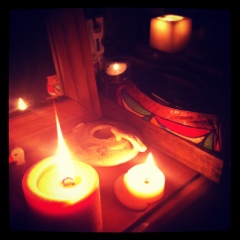
The other night I was irretrievably grumpy (I know what you’re thinking: “You, grumpy!? Surely not!”). I suddenly remembered that when I was grumpy as a teenager, which was often, I used to light all the candles I owned and lie in my room and listen to music. So that’s what I did this night. And it worked. Grumps cured, at least for now.

Hand-painted maps

I’ve been thinking, reading and writing about maps lately (the adventuring to Coogee in my last post was, in part, research related to the map work I’m doing), and I came across this video on Brain Pickings. Fascinating. I love that Jerry’s work on the map is so systematic, and yet there’s such wonder and imagination involved in its creation. It reminds me of some of the reading I’ve done on designing cities, and the idea that we should be designing incompleteness, to allow for some organic development in our urban places.

Jerry’s Map from Jerry Gretzinger on Vimeo.

(There’s also an article about Jerry’s map on The Atlantic website. And if you’re interested in more map-goodness, also check out this Brain Pickings post on the BBC series The Beauty of Maps.)

Quiet time

Last time I wrote here, I wrote about how lots of things were shifting, lots of things were up in the air, and I was hoping they’d settle soon. Yeah. It doesn’t look like that’s going to happen anytime soon. In fact, things seem to be picking up, rather than settling down.

Don’t get me wrong — it’s all exciting stuff. But I do feel like I’ll be in desperate need of a very quiet holiday sometime soon.

While I wait for that opportunity, I’ve been rising ten or fifteen minutes earlier than usual most days, and just letting myself sit in the quiet for a bit. There is, of course, a whole lot of research about the benefits of meditation (and, being a yoga teacher, it’s not like I’m new to the idea that it’s beneficial), but I’ve been pleasantly surprised by just how much of a difference to my day ten short minutes of sitting still and quiet can make. Doing this with some kind of regularity (my meditation practice has always been sporadic, at best) makes those benefits even more noticeable.

Of course. It’s obvious. And I knew it already. It makes me wonder why it is that we avoid doing something even when we know for sure that it’s good for us — or, even more than that, that it will make us feel better immediately. Not some time down the track, not even in an hour, but straight away. Why avoid it? It’s very strange.

Letting things settle

I had thought I’d write a whole lot of blog posts while I was in Melbourne. I thought I’d be so excited about what I was doing that I’d want to share it.

And I was excited. But I worked out pretty quickly that I wouldn’t be able to share it for some time, even if I wanted to. More and more lately, I find I need to let things settle before I can approach them again in writing. This is true in my personal life as well as the stuff I write that I call ‘work’ (the line between the two is often very difficult to distinguish).

It’s nearly two weeks since I came back to Sydney, but I still don’t really feel like things have settled. A number of things have shifted, in subtle but important ways. I’ve tried to find an appropriate analogy for what’s going on in my head, but they all sound far too dramatic, when the action that’s caused the shift wasn’t really anything special.

The first yoga class I taught when I got back to Sydney was strange. It was one of my corporate yoga classes. At lunchtime I found myself in a very familiar office building, sitting on my mat in a very familiar empty wing of the fourth floor, chatting to regular students. Then the little travel alarm clock I use to keep time in yoga classes ticked over to midday, and I suddenly realised that I was the one who had to teach the class. For some reason, it came as a surprise. And then when I did start teaching, I found myself making changes to my usual way of sequencing poses, and the words that came out of my mouth focussed on different things: the spine instead of the arms, the feet instead of the legs. I found myself walking around more, watching, really watching my students. Most of my classes are made up of regulars, but that first week back it was as if I was looking at a whole lot of new people — not because of any real change in the way they moved, but because I was looking at them differently.

The strangest part of all of this was that it all happened without me even thinking about it. Usually when I make these changes to the way I teach (or the way I do anything, really), it’s a conscious decision, but this wasn’t conscious at all. It just happened. I don’t know yet whether they’re good changes or bad changes or changes that make no difference at all, and I don’t know whether the fact that they’re unconscious is good or bad or has no meaning at all.

This teaching anecdote the best way I can think to describe what I feel is happening in every part of my thinking and behaviour now. I’m doing things differently, just subtly, in my writing and in my general life stuff too. To be honest, the fact that it’s happening without any conscious thought on my part is driving me a little batty. I have no idea how any of it is going to turn out, or why I’m even doing it in the first place. I just have to have patience. And, let’s be honest, patience isn’t exactly my strong point. (Just to prove that to myself, last weekend when I was in Canberra with my family I had a couple of little tantrums. The first involved surprise tears before breakfast and a fair bit of confusion for my poor Dad, and the second involved ranting at Mum while I stomped around reluctantly packing my bag to go home.)

I’m sincerely hoping that things do settle (at least a little) sooner rather than later. I think they will. I’m working on a number of exciting projects at the moment — some writing, some yoga — and they seemed to have at least calmed the frustration to below tantrum-causing levels. It’s a better mental place to be.

So I might eventually get to sharing some of the half-complete drafts of posts I wrote about the MWF sessions I went to in Melbourne. I hope I do; we saw some pretty great stuff. But I might not either. And, actually, as frustrating as it has been, not really knowing how things will turn out, even with whether or not I press ‘publish’ on a blog post, is also kind of exciting.

Exhaustion

This week things have shifted. I’ve finally let go of some things, and some new opportunities have presented themselves. Work is beginning to pick up more and more, and I start back at uni again next week.

The change of pace, and the shifts in my thinking and doing have found me feeling lighter, and a little bit excited. I’ve found it difficult to sleep this week. As soon as my head hits the pillow, my mind is off, following all sorts of little paths and trails, guessing at how things might unfold now that I’ve thrown off some of the thought-stuff I didn’t need anymore. Each night this week I’ve lain awake for hours, imagining. Just like a child who can’t sleep because something exciting is happening the next day.

I’ve been aware of a lingering tiredness all week, but it hasn’t really bothered me until this afternoon’s yoga practice. I had lots of energy at the beginning, enough even to practice some fairly intense back-bends. Then I lay down in savasana to relax for a few minutes and was surrounded by exhaustion. My legs and arms tingled with it, my head felt suddenly much heavier. It was almost as if I’d just covered myself in a blanket of tiredness. ‘Surprise! You can’t really cope with very little sleep! Had you fooled, didn’t I?’

But this is part of the reason I love working the way I do (all over the place, and at weird hours, in other words): if I’m exhausted on a Friday afternoon, I can usually take it easy. There’s usually some work I can do that involves sitting on the couch with a cup of tea (and maybe a chocolate biscuit from a bout of procrastibaking earlier in the day). And I think I’m getting better at down time. I’m a really active person (hence the active job), and always have been. But I don’t think I’ve ever been particularly good at… well, resting. I guess many of us aren’t.

Next week will be extremely busy. I think an afternoon of reading and writing is justified. So excuse me while I put my feet up, munch on some baked goods, and get some quiet time.

~

This is cross-posted on my yoga blog, om gam yoga.

Gardening

I never thought I’d be a gardener.

The house I grew up in had an enormous front and back yard, and my brothers and I spent many hours playing in the garden, making cubby-houses out of bushes and soup out of mud and berries. A trip to the local nursery on a weekend with Mum and Dad was a fairly regular occurrence. But I never really understood the appeal of being on hands and knees, with dirty hands, at risk of attack from any number of nasty creepy crawlies.

And yet, as an adult, most weekends I find myself looking forward to spending some time in the garden. I get distracted by nurseries. I notice when my neighbours have planted something new, or pulled something out. These days, gardening for me is very much like yoga: it requires a regular commitment, is full of frustration and disappointment, but made entirely worth the effort by the joy that comes with any achievement, no matter how small. Gardening, like yoga, gives me a chance to really appreciate small things.

The switch from non-gardener to gardener has been a gradual one, and I can’t say exactly where it started. My Mum, a certain former housemate and a few other people have helped me along the way. Hey, maybe I was never really a non-gardener in the first place.

My love of gardening can be directly attributed to my love of food — most of my garden is edible. (Except the jonquils. They’re just purdy.)

In some of my research for a writing project on food and culture, I came across this article on The Conversation (an independent source of information, analysis and commentary from the Australian university and research sector, launched earlier this year):

“Food. It is the great unifier of place and race, the common ground sustaining our very existence. Why then, does food production feature so minimally in public space and urban design?

Under the weight of looming threats to energy, population and economy, the time is ripe to rethink our design focus.

Traditionally, urban design has been dominated by the use of ornamental exotic and indigenous plants while edible species have been minimally utilised.

Now, as we move towards a potential crisis in food production it is more important than ever to rethink our design practices.”

(Read the rest over at The Conversation.)

I firmly support the idea of bringing some food production into cities. It’s unlikely that cities will ever support themselves entirely, but I don’t think that’s the point. My garden does not produce enough to be my sole source of food, but it does contribute to what ends up on my plate. Perhaps more importantly, it gives me a much better idea of where the food I do buy has come from, and the kind of work that’s gone into producing it. That increased awareness, I think, can only lead to good things.

So much of any yoga practice is about noticing what’s there — often below the surface. Food gardening, for me, is another way of practicing yoga without a mat.

~

This is cross-posted over at my yoga blog, om gam yoga.