Sustainable Table and Meat Free Week

There’s been a bit of radio silence from me here lately. I’ve started a new job, writing for this website, and it’s taking up a lot of my time (four full days, to be precise). I’m also teaching some yoga classes and working on some freelance projects.

My first two weeks at work were a bit of a blur, as I tried to get used to a new routine (working any kind of regular hours is very different to the all-over-the-place hours I’ve kept for the last few years teaching yoga full time!), but I finally feel like I’m settling into it a little bit.

Anyway. To get to my point. Because I’m writing for a food news website, I come across all sorts of food-related news every day. The website has a particular focus (as it should), which means that not all of what comes across my desk is necessarily appropriate for that publication. But I feel like some of it is relevant to my freelance work, and to what I sometimes write about here, so I’m going to start posting some of that stuff here.

Starting now.

Just today I got an email from Sustainable Table, who, among other things, produce very beautiful cookbooks.

From their website:

Sustainable Table uses food as an entrée to explore sustainability issues. With up to 60% of our eco-footprint embodied in the food that we buy there is no better place to start.

They’re getting behind Meat Free Week, which will run next week, 18-24 March, by putting out a free meat free cookbook.

I’ll point out now that this post is not in any way sponsored by Sustainable Table (or any other organisation), I just like what they do and think this is a worthwhile venture.

I should also point out that I’m mostly vegetarian, but that my promoting this is in no way a push for other people to make that particular dietary choice forever. However, as Sustainable Table quite rightly point out, there’s a lot of research that suggests that we all need to eat less meat for a whole host of reasons, and I think this kind of awareness-raising week is a good way to experiment a little with what we put in our mouths.

“We need to think about [how much meat we eat] because as a nation we’re consuming way too much,” say Sustainable Table. “Even the Australian Institute of Health and Welfare agrees – the latest Australian Dietary Guidelines stress that we need to halve our meat consumption immediately. The amount of meat we are eating annually – 120kg per person or 190,000 tonnes nationally – is putting pressure on our environment and our farmers. Carbon, nitrogen and methane emissions, water use and ethically-questionable intensive farming practices result.”

The idea of eating less meat (let alone no meat) can be a bit overwhelming. I know it was for me when I first went vego many years ago. The idea behind the free recipe book is to take some of the guesswork out of meat-free eating. The book is designed to cover all meals for a week, which I reckon is rather useful — especially if meat-free eating is a new thing for you.

You can get all the information about Meat Free Week and download your FREE copy of the recipe booklet by clicking the image below:

A Meat Free Week booklet

Sustainable Table are also running a competition during the week. Share your photos of the meat free recipes you cook from our booklet and be in with a chance to win a copy of their book The Sustainable Table, valued at $40. (I got a copy of this book for my birthday last year, and it’s beautiful.)

More information about the competition is can be found here.

Meat Free Week has been organised by animal rights advocacy group, Voiceless.

~

And don’t worry, I’ll still be writing my usual rambling posts as often as I can.
EWF blog post ~ Move it or lose it: exercise and writing

This week my next Emerging Writers’ Festival CAL Digital Mentorship Program blog post went up. This one’s on the way exercise changes our brains and how that, for me, relates to writing.

~

When I was a teenager I loved to run. We lived on the edge of town, not far from where the road turned from bitumen to gravel. Every afternoon I’d head for the gravel, and often I’d close my eyes as I ran, just to listen to the sound of my feet crunching, the sound of my own breath, sometimes the sound of my heartbeat.

I ran for physical fitness, in part. But mainly I ran because it made me feel good mentally, because it calmed my mind.

On days when I was particularly anxious, or even angry, I’d sprint the section between where the bitumen ended and the end of the street. While I caught my breath after those sprints, I’d stretch my legs on top of the white wooden reflector poles, gaze out over the paddocks and feel the tension — the anger, the anxiety — loosen and drop away.

I was one of those angry teens. I was angry for reasons I didn’t understand, prone to outbursts where things were yelled, doors were slammed and where I lashed out at my family. Running calmed me. I didn’t know how it worked, all I knew was that it did. I knew that when I got home I’d be better equipped to do my homework or study, less likely to blow up at the antics of my younger brothers.

My relationship with anger is still one of the strongest driving forces in my life. Anger motivates me to do things, to write things. Expressed in a helpful way, anger can carry passion and fascination, so I don’t think of it as a bad thing. But it can also become a (rather terrifying) hindrance too — it can cloud my judgement, it can leave me full of energy but with no idea where to direct it, rendering it and me effectively useless. None of this is particularly conducive to working or writing or living well.

Anger is why I’ve always been a highly active person; exercise helps me to turn anger into something useful.

Read more here.

Waste and lemons

We go through a lot of lemons in our house. For various reasons, my housemate and I each have a little lemon juice in some warm water to begin our days. I also love to cook with lemon juice — I add it to lots of things. So we end up with a lot of lemon rinds.

For the last six or seven years, I’ve kept a compost of some sort. For many of those years, it’s been a worm farm. Worms don’t like citrus peels. I’ve also found that they take forever to break down in a regular variety compost, even when I’m pedantic and chop them up into tiny pieces, like I do with all the other things that otherwise take a long time to break down, like avocado skins. Yes, I think it’s fair to say that I’m a little obsessed with what happens to food scraps once they become waste.

The research that I’ve been doing for the last six months or so has really only added to that obsession. I’ve spent that time looking at waste, in the food system in particular, but also just as a general concept. It’s for something else I’m writing, so I won’t share too many of my thoughts here, but suffice to say that I think the percentage of food that’s wasted in the world (nearly half — more here, if you’re interested) is horrifying, and I think the concept of waste, generally, is all about perspective.

Which brings me back to the hundreds of lemon rinds. It occurred to me some time ago that there must be something else I can do with the bits of the lemon we don’t drink or eat, other than throw them out. Without really knowing the answer, I started keeping them, putting them in a bag in our freezer. (Living with me, if you want to put anything in the freezer, can be… challenging — I make full use of that space!) And in the meantime, I began looking for uses for lemon rind and peel.

There are heaps, of course. Among other things, I discovered I could soak them in vinegar for a few weeks to make a citrus oil cleaning spray, and, most exciting to me (and perhaps what should have been obvious already), was the idea of lemon marmalade.

I’ve eaten marmalade since I was a child, on and off, and I always knew that it was citrus peel, but for some reason it never occurred to me that I could eat the parts of the lemon I thought of as inedible by making my own spread. That this never occurred to me is especially strange because I make a lot of things myself that other people buy, simply because I’m curious. Cooking, to me, is an exercise in curiosity (quite apart from its leading to eating).

A very quick search brought me hundreds of recipes. It also brought me to this lovely essay on preserving citrus.

Citrus is usually present in most marmalades or jams, because the pith (the white bit under the zest) and the seeds are high in pectin, which is what helps the jams to set. This large amount of pectin means that citrus jams and marmalades are a good place to start when you’re new to the game like I am. (It also means that you can pretty easily make your own pectin at home, for use in jams with other non-citrus fruits.)

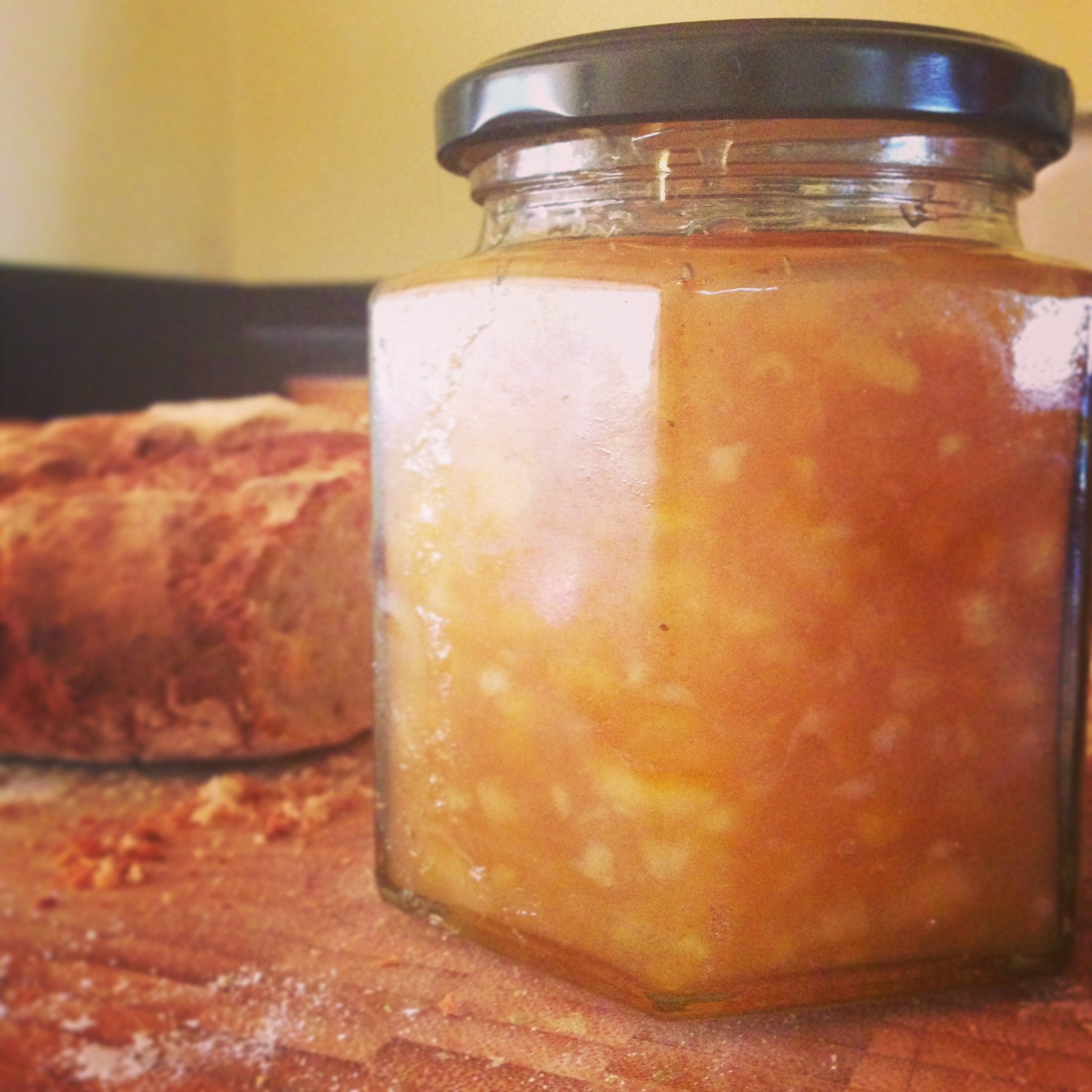
So I made some of my left over lemon peels (plus some orange peels I had lying around as well) into marmalade. It was delicious. And easy.

I cooked some lemon rinds, chopped, for about an hour, or until they were soft. I also added a little package of saved seeds and the fruit flesh, which I’d been keeping in a jar in the freezer, along with a couple of pieces of fresh ginger and some cloves. The recipes I found said to use a muslin bag, but I didn’t have one, so I just sterilised a cotton napkin by soaking it for a few minutes in boiling water and tied it up into a package with a piece of cotton twine. Then I added the mix to a food processor and blitzed it a little. Once I had the texture I wanted with the fruit, I weighed it (I had about 330g). The general rule with jams is 1:1:1 fruit:sugar:water, and so I added about 330g each of water and sugar, along with the fruit, to a saucepan, brought it to the boil and then simmered it for quite a long time, until it thickened. Apparently the magic temperature for setting jam is 220 degrees, but I don’t have a thermometer that goes that high, so I used the “wrinkle test”, where you put a few teaspoons of the mixutre on a saucer, put that in the freezer for five minutes, then run your finger across it. If it wrinkles, you’ve reached the right consistency.

Earlier, I’d put a couple of clean jars in the oven on a high temperature to sterilise them before I put the marmalade in them. Once the marmalade was nice and thick, I pulled those jars out and spooned the jam into them. (There are two tricks here: 1. guessing how much jam you’re making so you have the right number of jars, and 2. remembering the jars are hot — I failed to remember and burnt my thumb quite badly.)

I don’t think I’ll ever throw out a lemon peel again.

Lemon marmalade

This brings me back again to the idea of waste, and how it’s all a matter of perception. I wonder how much of what ends up in my bin — or in anyone’s bin — is in fact something of use, if only we knew what to do with it. (Also, does anyone want some marmalade? Because I’m probably going to be making a lot of it. I’ll take flavour requests.)

~

I’ve not used the citrus/vinegar cleaning spray yet, but I’ll put an update here when I do.

EWF blog post ~ Armchair Love: Posture, Thinking and Writing

Late last year, I was excited to become one of three mentees in the Emerging Writers’ Festival Digital Mentorship program. I’ll be writing about a post a month for them for the next six months or so (you can read more about the program, and the other writers on it, here.)

My first post, an argument for armchairs and an exploration of how posture affects thinking, went up yesterday. You can read it here.

Animals

Last night I went to an event at the Wheeler Centre called A Night at the Zoo. The event was the result of a series of fellowships, in partnership with Melbourne Zoo, that allowed four writers to spend time at the zoo with a view to inspiring some written work. The event last night was an opportunity for the writers to present some of that work and to discuss some of their thoughts and feelings about the zoo, and about zoos in general.

Unsurprisingly, much of the discussion was about animals and our relationship to them. Cate Kennedy admitted that she is ambivalent about zoos, for a whole host of reasons. I feel similarly. Or, at least, I feel confused about them. There’s something deeply disturbing about our desire to put members of other species in cages (or enclosures, as is more likely the case these days) so we can watch them. But at the same time, much of the work zoos do is about education and conservation, which is certainly not a bad thing. And I understand as well as anybody the kind of curiosity that leads people to zoos, to watching.

Some of the stories Estelle Tang relayed about a visual artist forming a kind of friendship or understanding with the gorillas, whom she frequently draws, and about the same artist witnessing the awful behaviour of some human visitors towards the primates, reconfirmed for me that sense of the deep uncertainty we seem to have in our relationship with animals.

Throughout the day yesterday I’d seen posted on Twitter a number of times a link to a letter from Fiona Apple to her fans saying that she was delaying her South American tour to stay home with her dying dog. For various reasons (you know, trying to actually do work), I’d not read it during the day, but when it came up again in my feed last night after I got home from the Wheeler Centre event, reading it seemed appropriate. The relationship she describes with her dog is companionship — actually, no, it’s friendship. And it’s beautiful. (But also sad, so if you’re going to read it, be prepared.)

My family have always kept pets and I’ve developed an enormous affection and/or love for most of them. As an adult, I’ve lived in a number houses (including the current one) with housemates who have cats. And again, I’ve developed a friendship and an affection for with those animals. I guess and hope that those animals understand that relationship as something more than just ‘she gives me food sometimes’, but the potential for anthropomorphisation bothers me.

Earlier in the year, I wrote an essay on how growing my own food has made me seriously question my own vegetarianism (although I’m yet to give up on it)*. It’s made me question my relationship to other creatures and the rest of the non-human world. In fact — and excuse the melodrama here — it’s made me question my whole concept of death and decay, and of life. As part of my research for that essay, I came across Charlotte Wood’s excellent essay on animals (available here as a PDF), and I thoroughly agree with her point about the dangers of anthropomorphising animals. She says:

But I find most of it troubling because it seems so disrespectful. Denying the creature’s essential nature – its very animality – is surely an act not of admiration, but subjugation. To downplay the differences between species is to promote the assumption that “humans will only accept what is like themselves”, as American scholar Shelly R. Scott puts it.

But that’s not all. The flip side of our culture’s grossly sentimental failure to embrace the “otherness” of animals – the failure to imagine them as anything but approximations of ourselves – is a deep ugliness in our treatment of them. We force a dichotomy in which animals are either so like us that we cannot separate their needs from our own, or so unlike us as to be aliens, undeserving of any rights at all. The more we sentimentalise, the more we also brutalise.

Equally — and I think this is partly what Wood is getting at when she speaks about the ‘flip side’ of that sentimentality — I think that denying animals any kind of emotional life is problematic (and there is a growing body of scientific research that suggests that animals do, in fact, experience emotions, often seemingly in similar ways to us). And I wonder whether we sometimes cling to the idea that we are different to animals in our ability to experience emotion (or in any other way) because we can’t quite face our own ‘animalness’.

Which brings me back to a point made in last night’s Wheeler Centre event. Cate Kennedy suggested that our response to animals (and she gave the example of her own ‘give me hugs’ response to the orangutangs at the zoo) says far more about us than it does about them. What is it that we’re looking for — or hiding from — in our relationships with animals? It’s a scary question.

~

As you might be able to tell, this topic fascinates me. Some other reading I’ve come across, if you’re interested:
Eating Animals, Jonathan Safran Foer
Us and Them: on the importance of animals, Anna Krien
Vegans and Ethical Omnivores, Unite!, Tammi Jonas

(There are a whole lot of other things I could add to this list, if I could find them. I’ll endeavour to do so as I draw them out from their various hidey holes in my too-complicated filing system.)

*I don’t think this essay is available online at the moment. You can, however, buy a print copy of the Death of a Scenester Food issue it appears in.

Rearranging

This week I’m editing a piece I’ve been working on now for a few months — lots of research, lots of reworking. This edit, among other things, has involved rearranging the text, slightly changing the structure (thankfully not so much the actual content of the sentences). It continues to amaze me that moving a sentence from one part of a piece to another can change the overall piece so much. A tiny shift, a massive change.

It also seems kind of fitting that I should be doing this work in my writing when I’m doing exactly that kind of work in my life.

Moving interstate forces you to rearrange things.

I will write more about the moving interstate rearranging once things have settled a little. Which, I hope, will be soon.

Thinking About Waste

One of the topic areas I’m researching and writing about at the moment is waste: what it is, what it means, what affect it has on us and the world around us, and what it says about how we relate to the world around us.

I’ve been reading the Milkwood Permaculture blog for several years now, on and off. Recently I worked my way through a big backlog of posts (I’m not exactly consistent in my reading habits) and came across this fantastic video, where Milkwood‘s Nick Ritar discusses the problems with how we deal with our own biological waste.

His point that much of the obstacle is in our own minds is so true. The house I grew up in was in the middle of an acre of land, and we weren’t connected to the town sewerage. We had a sewerage tank instead, and at some point Mum and Dad connected a hose and sprinkler to it, so when the tank was full, it would pump the treated effluent onto the grass or gardens. Perhaps naturally, we called it the Poo Sprinkler, and usually ganged up on Dad when it needed to be moved around the yard (sorry Dad). So it’s probable that my own level of disgust at these things is a little lower than it might be for most, but I still found myself having to get beyond some revulsion while watching Ritar’s talk.

Obviously, the revulsion or disgust is not an entirely unhelpful reaction — our waste mostly needs to be treated in some way before it’s safe to use. But, as this talk very rightly points out, if that revulsion leads to us just wanting to get the stuff as far away from us as possible, it’s not really very helpful at all in the long run. Not recognising ourselves and our waste as part of some larger system is part of why we’re facing the localised environmental and broader climate issues that we are.

Ritar, of course, makes a much more compelling argument than I do. The video is definitely worth watching.

Lying on the floor

Walking home from teaching one night, on the phone to my Mum, I rounded a corner to find a woman and her tiny dog, waiting to cross the road.

That dog’s on a long leash, I thought.

“Watch out for my dog, lady.” the woman said.

“It’s okay, I can see him.” I said, probably impatiently.

“Yeah well, how would I know? You’re looking down.” She snapped, and crossed the road.

“Yes,” I said, “Down. To where the dog is.”

And all of a sudden this woman and I were yelling at each other across the street, until she stormed into her apartment building and the door slammed, and I became aware of my Mum, on the phone I still held to my ear, saying “Sophie, who are you talking to?”

As I told her the story, and as is often the case for me, my indignation turned to guilt. “I can’t believe I yelled at her,” I said to Mum.

“Don’t worry,” she said “You’ll never see her again.”

And it’s true. I’ll probably never see that woman with her tiny dog on a stupidly long leash again. But it’s highly unusual for me to yell at strangers in the street. If I am, it’s a pretty good sign that there’s something not so great going on for me. Anger, frustration and grumpiness are usually an indication that I’m feeling overwhelmed by or stressed about life—often I don’t even know why.

I’m pleased that this is something I know about myself. It means I can make some little adjustments to how I organise my days, so I get enough downtime or rest. Because rest is usually the answer to stress. But it’s not always easy. In this recent piece, one of my favourite yoga writers, Yogi J Brown, discusses the ways we should (and usually don’t) deal with stress. Intimacy with ourselves, he says, is the best antidote—that is, spending time with ourselves in a way that allows us to see what’s going on. Noticing the anger or frustration is the first step.

When I was a teenager, I used to spend a lot of time lying on the floor or my bed, just listening to music. One afternoon, my Mum came into my bedroom to find that I’d actually fallen asleep on the floor, my head just centimetres from a speaker that was blaring music. It’s easy to be dismissive, to say that I could afford to do that then because I didn’t have the responsibilities I do now. But that’s a load of crap. Yes, I do have more responsibilities now, but surely that just makes it all the more important that I get some downtime, so I’m able to deal with those responsibilities… well, responsibly.

In my essay for The Emerging Writer, I explored some of the benefits for writing of doing nothing (well, almost nothing—listening still counts as something, really) with the physical body. To briefly summarise that part of the essay, doing nothing allows the body and the mind to process stuff, and potentially to make links between things that might not be immediately obvious, or that the brain might not have made otherwise.

Obviously, this can be good for writing. But it’s also just good for us on a more general level. Rest—waking rest, as well as sleep— is really important. (And ‘rest’, by the way, is just as metabolically active as activity—it just uses energy in different ways.)

In this piece on the benefits of the yoga pose savasana (which translates as ‘corpse pose’ and basically involves lying on the floor doing nothing), Sydney yoga teacher Brooke McCarthy writes in detail about what happens when we relax deeply—and how to do it. After reading this piece I decided I needed savasana to make an appearance in my life every day. I haven’t quite managed that yet, but on the days when I do get to it, everything seems just a little calmer. Honestly, lying on the floor for ten or fifteen minutes when I’m really busy makes the world of difference to my state of mind. And, really, if I’m feeling overwhelmed anyway, what am I really going to get done in those fifteen minutes?

And while I’m on the subject of ‘busy’. That words makes me cranky. I’d never really thought about why until I read this piece about the trap of busyness (interesting: my eyeToy autocorrects busyness to business). Writer Tim Krieder suggests that being busy is an avoidance tactic—if we’re busy, we don’t need to face ourselves, and all those things that are worrying us or upsetting us. And the more I teach yoga, the more I realise that everyone has at leat some of that kind of baggage. Facing it is hard, so makes sense that we don’t want to do it. But avoiding it doesn’t make it go away. For me at least, avoidance often makes the worry warp into something else—like yelling at a woman and her dog on the street.

My response lately to the question ‘how are you?’ has been ‘busy’. And after I’d said it a few times, I realised that it, along with the crankiness I was carrying around, was an indication I was doing too much.

All of this is a very roundabout way of saying that, once again, I’m returning to that teenage habit of lying on the floor listening to music on a regular basis. I’m trying to get some nothing into each if my days. It’s amazing. I feel instantly less busy.

Getting older

That morning, as she pulled a grey hair out of her head — her way of dealing with them, now that they occasionally appeared — her first thought, rather than a vain despairing at her own aging (which she’d certainly also been guilty of), was to wonder at how odd it must be for a parent to see these signs of aging in their children. How odd it must have been for her own mother the first time she noticed a grey hair on her daughter’s head; the first time she saw around her daughter’s eyes the small wrinkles perhaps seen only those whose intimate relationship with her allowed them to look so closely at her face. How odd it would be for her mother, she thought that morning, as those small things became more obvious in the face and body of her child.

Wendell Berry on industrialisation

“Like the rest of us, farmers have believed that they might safely live a life prescribed by the advertisers of products, rather than the life required by fundamental human necessities and responsibilities.” (A Defence of the Family Farm, 1986)

Quite apart from the point he’s making about industrialising agriculture, what I love most about this quote is how it exemplifies Berry’s ability to take a very specific issue (the one about industrial agriculture) and fits that into a much broader social context. His essays do this as part of their overall structure, and as part of the smaller structures (sections, paragraphs, sentences) within that.

Another example:

“An economic program that encourages the unlimited growth of individual holdings not only anticipates but actively proposes the failure of many people… It is a fact, I believe, that many people have now lost their farms and are out of farming who would still be in place had they been willing for their neighbours to survive along with themselves.” (A Defence of the Family Farm, 1986)

I’m in awe of his use of language and structure. Brilliant.