The social function of literature?

On Thursday I rushed (quite unnecessarily, as it turns out) from a lunchtime yoga class I teach at UNSW to get on a bus to Canberra to visit my family. I’ve written here before about how I like catching a bus or a train somewhere by myself. It means I get Thinking Time.

I’ve got a lot to think about at the moment. Exciting plans, not-yet-plans, writing, reading, family stuff, money (sigh). When I slumped back in the seat on the bus yesterday, I realised that it’s actually been quite some time since I’ve given myself a break to think. I mean, I think a whole lot as I travel all over the place to teach yoga and various forms of writing. But it’s really been ages since I’ve let myself just think. When you’re travelling to teach, there’s only so far you can let your thoughts wander, in case you end up missing the bus stop or distracting yourself so much that you end up referring to your students’ feet as their hands and inadvertently instructing them to tie themselves up in strange knots. (I frequently say things like, “Inhale, walk your feet forwards between your feet… I mean…”)

Anyway. That’s a (very) round about way of saying that I got some thinking time yesterday. I put my headphones in, found some thinking music and stared out the window.
One of the things that’s been on my mind lately is the social function of literature. In my ramblings on writing as activism I touched on the idea that my writing is often an attempt to understand the world from someone else’s point of view. I’m starting to try and unpack that idea bit by bit.

Allow me to be embarrassingly earnest here for a moment.

Essentially, for me, trying to put myself in other people’s shoes in writing is about compassion. Most of the things that anger me most about the world come down to other people’s lack of compassion. Human beings seem to have this innate ability to lose all compassion for other people. And then they’re jerks to one another. It drives me nuts. (Happily, I’m also often pleasantly surprised by people’s capacity — sometimes those very same people — for compassion.) I’m guilty of it too, of course, and I reserve my harshest judgement for myself.

One of things that interests me most about yogic philosophy is its teachings on compassion. Yoga teaches compassion for all living things, human or otherwise, because all those living things are really part of the same thing. Atman, Brahma, the Self, the Buddha Self, the Universe. A whole lot of names for the same idea. Whatever you want to call it, and whether or not you’re interested in identifying yourself as belonging to one of the traditions that teaches this stuff, the idea that we’re all connected to one another — all dependent on one another — is intriguing.

When I write, I certainly don’t sit down and think, “I know, I’m going to write a piece that teaches everybody that they’re equal to the homeless man they wouldn’t normally look at.” I’m not out to write didactically. But I don’t think it’s possible to write or read stories about human beings — particularly fiction — without being pushed in some small way to think about the world from another person’s perspective. Even if just for a moment. And hey, we might not always feel compassion for the people or characters that we’re reading about (especially if you’re not a bleeding heart, like I apparently am), but even just a glimpse into that perspective, I think, has the potential to shift something in the writer and the reader.

For me, this is what literature is all about: exploring and presenting different perspectives, suggestion and question. The word that I use to explain that process is compassion, because it makes sense to me. Compassion doesn’t mean agreeing with the person or character’s perspective, but it does mean attempting to understand it. Which of course means, for me, also attempting to understand the perspective of the people in the world who are jerks to each other.

Let me get down from my soapbox now. Pack away my pompous wanker pants.

Talking about compassion and linking it to the social function of literature is problematic, I think. I’m an eldest child, and was often accused of lecturing my younger brothers (most of the time the accusation was probably spot on). As a result, as an adult I’m really conscious of not lecturing people. Saying that literature teaches people compassion makes me uncomfortable, as if I’m advocating the kind of writing that’s overtly didactic, even patronising. Writing that lectures, in other words. That kind of writing, I think, actually creates obstacles in people’s thinking, rather than chipping away at the obstacles that are already there. I certainly observe that reaction in myself.

I’m not sure how to resolve this discomfort. I don’t know where the balance is. I don’t know if I even need to resolve it.

This is really the beginning of my thinking on this topic — it’s by no means an exhaustive exploration of what’s in my brain (although I do feel slightly exhausted after typing it all up). I feel like my thinking has a lot of room for development. Any thoughts on the matter (the social function of literature or the need for brain development on my part) would be most welcome.

Music obsession

You know, back in the day, how you used to buy a new CD and have it in your seedy player for the next month? I still do that with albums, even though I now use an iPod.

This guy has been my soundtrack lately. For everything. Writing, yoga, working, bed time. He’s made it onto my yoga class playlists too, so I’ve made my students listen to him. Maybe it’s because I play the piano (lazily, and therefore badly), and have done so since I was seven, but piano music seems to work its way right into the deepest, darkest parts of me and hang around for days or weeks at a time.

I also happen to love this clip, as well as the music that it accompanies.

Writing as activism

Things seem to be pushing me lately to get writing again about the things I talk passionately about. Heated discussion (not necessarily heated because of disagreements) has always been a part of my life. My parents always encouraged me to think for myself, to find out when I didn’t know, to constantly question.

Talking about literature as activism (and activism for literature) at the Academy of Words started this ball rolling. Then I went back to uni and my teacher talked about how we use words to explore the consequences of the world’s happenings (“If this is so, then what are the implications?”). Then I read some of my uni texts and found myself sobbing by myself on my couch, hoping my housemates wouldn’t come home in time to see me like that (even with the explanation “Kids with cancer”, a red-eyed 25-year-old with tears running down her face, unable to speak properly, is not a pretty sight). Then my brother posted this to his new blog. He’s doing what’s basically an environmental science degree at ANU, and it’s not unusual for a phone conversation between us to be entirely about worm farms or gardens or cooking or food or what’s wrong with society. Our conversations aren’t short. But I’ve never really spent much time writing about them before.

Everything seems to be pushing me back towards writing about what intrigues me, what sets off that fire in my belly.

See, I tend to write to explore issues or relationships that intrigue me.

In fiction I write about characters with dementia, or men who are trying to deal with grief and still be ‘manly’, or middle-aged siblings trying to deal with their parents’ old age and death. These are situations I’ve not been in myself, but things I’ve observed in other people’s lives. And I just wonder, you know? I just wonder what it’s like to be them, how it feels. I want to come closer to understanding, and in sharing it with other people, I hope to provide an opportunity for others to at least think twice about people they pass in the street.

In non-fiction I write about food and cooking, yoga… Well. See, I’d like to write a whole lot more about some of the things that anger me, or frustrate me. Like some of the muddy definitions of ‘climate change’ that my brother refers to here. I’d like to write about lots of the ideas that he and I discuss. And lots of the ideas that I discuss with other members of my family, and those of my friends who are willing (or have no choice but) to listen to me ramble on in such a non-sensical way.

I’d also like to write a little more about the concepts I ramble about in my yoga classes (and write about on my yoga teacher blog), while my students hang their heads in paschimottanasana. I wonder, sometimes, if they’re wishing I’d just shut up and tell them about their hamstrings, or hurry up and get to the bit where I make the little relaxation-inducing adjustments on them. But they keep coming back, so maybe they don’t mind (or they suffer through it to get to the relaxation bit).

Anyway, I don’t really know what I’m getting at here. This is a bit of a rant. And this is me telling someone what my ideas and goals are, rather than just setting about achieving them — which apparently I’m not supposed to do if I actually want to achieve them.

I feel like my brain’s switching back on after a little rest. I guess that’s not a bad thing.

Summation of Academy – from notes in my phone

My original plan with this was to write up some thought-provoking, rambling discussion that somehow approximated what went on at the Academy of Words. That plan was a little ambitious.

Instead, I’m going to put up some of my notes from the day (still in note form). Unfortunately it looks like I only took notes for three of the sessions. And didn’t take anything down at all for the one that I took part in as a panelist. For anyone watching me thumbing away on my phone on the day, I promise I was taking notes, not distractedly sending text messages. Because, would you believe, I actually didn’t think to pack a notebook to take with me to a festival about words. The bits in italics are thoughts I’ve added after the fact.

I write therefore I am… A writer.

  • Realised that writing is how I deal with the world. It’s how I find out how I feel about things.
  • Fiction writing is how I explore certain ideas; non-fiction is an exploration of other kinds of ideas — I seem to have an innate knowledge of whether I can deal with an idea better in fiction or a non-fiction
  • Realised one day that I’m actually good at putting sentences together (am I?), and that it’s not something that everyone is good at.
  • Connection between writing to get to know yourself and yoga practices. (There have been times in my life when I’ve felt it necessary to write pages and pages of personal journals — hopefully something that will never, ever be read by another individual. What comes out in those journals often surprises me. Sometimes it’s like I don’t know how I feel about something or what I think unless I write it down. My yoga practice is the same. Getting on a yoga mat, for me, is a way of getting myself to look at what’s actually there, rather than whatever it is I imagine might be there.)

Honk if you’re the publishing industry

  • “A book itself is a really good piece of technology.”

Literary activism

  • Advocating for a better industry, using literature as a form of activism.
  • People who are lobbying for more accessible cultural artefacts
  • Developing communities — feeling passionate about developing a writing community
  • “Activism is about knowledge, about finding out” director of SA Writers’ Centre
  • “Doing something is activism. You can’t ever be apolitical.” (This reminds me of a conversation I had with a friend of mine recently about how we’d grown prematurely disillusioned with ‘activism’ and felt useless, but then realised that only a small amount of effort was needed to feel active. She now schedules a little time each week in her diary that’s devoted to acting on social and political things she feels are important.)
  • Need to change the social attitude so that cultural artefacts are valued as highly as, say, season tickets to the local footy team’s games.
  • Chloe Langford (Format Festival): recontexturalusing art so it’s just a part of life.

Tiny snippets of things. Tiny snippets that have started to spring off in all sorts of weird and wonderful directions in my brain. More on that shortly…

~

If you’re in a generous mood (or even if you’re not), you might like to donate some spare change to Format, so they can pay their rent and continue contributing to Adelaide’s cultural community. You can donate here.

Monday Project submission: Redux

For my response to this month’s theme, I returned to some of short pieces I wrote last time I made a big move. Since most of my energy in February seemed to be taken up with moving house, it seemed appropriate somehow.

Unfortunately I was unable to get it together enough to actually put the story together into something that made sense. But then perhaps that’s okay, since it’s really about the chaos of packing up a life. I thought I’d type out what’s in my writing journal pretty much verbatim. I’d love to hear if you think this is going anywhere.

~

Her fingers were dry from handling all the cardboard and she had a collection of bruises on her legs. But before her stood a pile of brown cardboard. It sat in the middle of the room, surrounded by the absence of her furniture and the trails of dust and cobwebs that had been hidden beneath it.

The curtains were freshly washed, still a little damp and slightly crushed. The space around the box mountain looked smaller than it had when the contents of the boxes had been spread around it.

You stand next to her in the doorway as she looks around again and sighs.

“Why do I own so much crap?” She doesn’t want an answer.

Another box marked ‘books’. There have been thousands of these already, you think. Your daughter’s reading habit doesn’t quite keep up with her book-buying one. She sighs again, running her fingers over her own handwriting on yet another box of books, then follows you downstairs with it.

~

You worried vaguely about having an accident as you drove through the city, thought maybe you should pull over until the tears subsided. But then you knew you’d only turn around if you stopped, and that wouldn’t help anyone.

She’d looked small in the rear vision mirror as you drove away. Not at all grown up. You knew she was probably crying too – and that her ridiculous new boyfriend would have no idea how to handle it. He’d helped her find the dingy flat that was to be her first home away from home, and in doing so had proved to you that he had no idea what your daughter might need.

The place was filthy, for starters. Your daughter’s new housemates had layers of newspaper on the dining table so they could just throw away the top one after a meal, rather than wipe down the table; the drain in the bathroom was full of hair; everything was covered in grimy dust. Your daughter’s bedroom was full of someone else’s furniture. Even with some of the knick knacks and books of hers that you’d brought down with the rest of her clothes, she looked out of place in the room.

You told yourself, as you continued to drive away from her, that you’d only thought all that because you were being overprotective – that probably also explained why you thought her boyfriend was an idiot. The thought wasn’t comforting though. It only made you cry more – you felt sorry for yourself. And it wasn’t true anyway.

~

In your garage there are three boxes with her name on them, and several bags that aren’t labelled but that you know are hers. About once every six months – or more often if you haven’t heard from her in a while – you wake up early, pad down the internal stairs and stand in front of the small pile of her things. Both you and her mother are guilty of reminding her a little too often that these things are taking up space in your garage, but if she came to take them away you’d be upset.

The boxes are labelled in her neat handwriting – their contents described in brief detail on the masking tape that keeps them shut. They are mostly full of old things: high school and university books, photo albums, knick knacks, CDs. One box is simply labelled “special things”. Many times, as you’ve stood in front of her boxes and bags, you’ve wondered what constitutes “special” to your daughter. What would she pull out of that box? Undoubtedly it would be a collection of things that mean nothing to you, and whose story you will never know – trinkets from old friends and boyfriends, from far-flung places; letters from people you’ve never known, photos of people you’ve never met.

One day she’ll come back for these boxes – she might even open the “special things” box. The extra space in the garage would be good, certainly, but you’re not sure you could bear watching her going through them. You like the idea that you have a part of her here, neatly contained and labelled, and somehow mysterious.

Often, as you look at the boxes and run your fingers over her handwriting, you wonder what she is doing now, all those plane-hours away. You like to imagine that she is sitting at the kitchen table drinking tea, or reading to her own small daughter.

~

You don’t understand why, but she feels she needs to do it. She’s packing up again – this time leaving him, when it’s always been him leaving her. The him has changed over the years, but it’s been pretty much the same story every time. Being in a relationship with your daughter, you imagine, is very intense.

But no, this time she’s leaving him, and that’s at least half the reason why you think maybe he’s the right one. She’s determined though; packing boxes, taking things that are definitely his, leaving things that are definitely hers because she’s unsure in her frenzy. As she packs she babbles at you, her voice so close to tears. You should really be packing in another room, to speed the process up, but you can’t bear to leave her alone when she’s like this.

Even a little girl she was prone to working herself into a frenzy. Never over nothing, but always over something that didn’t really deserve all the energy she was giving it.

And there is the other half of the reason you think he’s the right one. Determined as she says she is, every part of her seems to be fighting against her own decision. Her hands shake, as if saying no to the words that are coming out of her mouth.

Airports

I love airports. They always give me a little rush of excitement.

When I lived in Melbourne, being inside an airport usually meant I was on my way to spend time with my family, or had just done so. If not that, then being at an airport meant I was heading off on an overseas adventure, or picking up someone I had missed.

That’s part of it. The other part is the other worldly nature of airports. They’re like their own little universe. People are in transit in airports — on their way to somewhere or from somewhere, stuck in between two places. Planes are similar. But I guess airports still allow people to move around, and therefore be more interesting. I love it.

I get nervous when I travel — have I packed everything, will I get to the airport in time, will I be able to find my way? — but once I’m at the airport the nervousness is replaced by excitement. I’m always excited to be going somewhere. And, once the nervousness dies down, I’m thrilled to have (re)discovered that I’m capable of doing this on my own.

Overseas travel excepted, pretty much all my time in airports has been spent alone. And I like it that way. It’s a different kind of adventure when someone else is along for the ride.

Being on my own leaves me free to people watch, and to strike up conversations with strangers. I love talking to and observing strangers. People are so weird and entertaining. Especially when they’re between places, in the midst of a journey. An airport, after all, is not really a destination.

I’m writing all this because this weekend I’m spending time in various airports (being weird — and maybe entertaining — in the corner, furtively doing a few quick yoga poses to realign my spine after sitting in the slump-inducing plane chairs), as I make my way to and from Adelaide for the Academy of Words. I’ll be on a panel today, and hanging around at various other things all day. If you happen to be in Adelaide, come say hi.

Moving House… take two

A little more on moving house…

This last fortnight I’ve been using my Sydney yoga practice a little differently. I’ve been moving house. Reluctantly. As well as taking up all my time and energy, it’s been a sad experience for me. The move was not a voluntary one – our landlord was returning from overseas and wanted to move back into her house. This house has been one of the best houses I’ve ever lived in; my housemates have become almost like family – and it’s the longest I’ve lived in one place since I left home all those years ago.

Unfortunately, it’s also taken up so many of my resources, material and otherwise, that my yoga practice has been substantially reduced. Again. It’s been frustrating.

—–

Read the rest here: Yoga for Moving House | om gam yoga | Sydney yoga, Yoga Sydney, Yoga class Sydney.

Moving House

This last fortnight I’ve been moving house. And it’s been harder than any other move I’ve made. Harder even than moving out of home, or moving from Melbourne to Sydney. It’s strange, because I’ve only moved from one end of Newtown to the other. Both the aforementioned moves involved a great deal more distance, and probably more obvious emotional upheaval. So I’ve spent a lot of time thinking about why this move has been as difficult as it has — and wondering whether I’ve just turned into a big wimp.

It’s been different to any other move I’ve made though. For starters, it was a reluctant move. My housemates and I got a phone call halfway through December telling us the owner of our house was returning from the UK and would like her house back. Two of my housemates were already planning on leaving (they’re travelling around Australia this year in a pop-top van — you can read about their adventures here), but Housemate Three and I were planning on staying in the house. When we realised we’d all be leaving the house at the same time, the phrase “end of an era” found its way into conversation more than a few times.

This house had become home, these housemates like family.

So I guess we began the process of sorting, packing and moving with… well, heavy hearts. Sometime towards the middle of January, I found myself thinking about how I’d only walk this route to a yoga class (or get off the train at this station, or stare out my bedroom windows, or go for a walk in this park, or see this or that neighbour on the street) a finite number of times. And every now and then the four of us would be standing together in the kitchen talking and/or cooking, and one of us would sigh. Sentimentality became a big part of our last weeks in the house.

Then I suppose there was the move itself, which was a bit of a shit fight, if I’m honest. We were really settled in that place. Which is really just a nice way of saying we had a lot of crap, spread out all over the place. Packing, sorting and cleaning was not fun.

For the fortnight it took us all to pack up and move out, I felt like I didn’t really have a home. My new housemates and I had picked up the keys to our new house, so a lot of my stuff was in the new place, but so much of me remained in the old place. For the last week I was sleeping at the new house, and getting up each morning to go to the old house to work more on moving out. That week felt more like ten weeks.

That last week the five of us (four housemates plus Housemate Three’s girlfriend) went out for dinner and drinks — a kind of farewell. I had such a great time with my little sharehouse family.

And I drank a little too much wine. Getting up the next day was difficult.

When we finally handed the keys back last Friday, and went out together for a final housemate breakfast, I think we were all ready to leave. We were glad the move was over (we were also very hungry — we’d all been up since 6 or 7am and we were eating at midday). So in a way, I guess the sadness that had made the process so difficult in the first place was kind of worked through by the horror of the move itself. Or at least pushed to the background for now. I’ll miss that house, and I’ll miss my housemates, but for now I’m ready to focus on what’s going on in my life right now.

I’m excited to be working again. I’ve got writing projects slowly starting to make their way from my head onto paper; next week I’m going to Adelaide for Format Festival’s Academy of Words; and I’m preparing for some new yoga classes I’ll start teaching in the next month.

This move though, and the process of moving in general, is still flitting about inside my head. I’m writing about moving for this month’s Monday Project theme, and I’m thinking again about some of the other writing I’ve done on travel, moving and connection to place.

As difficult as it’s been, moving house has certainly got the cogs turning again. Change, as they say, is as good as a holiday. Except that I feel like I need a holiday to recover from this particular change.

Feeling organised…

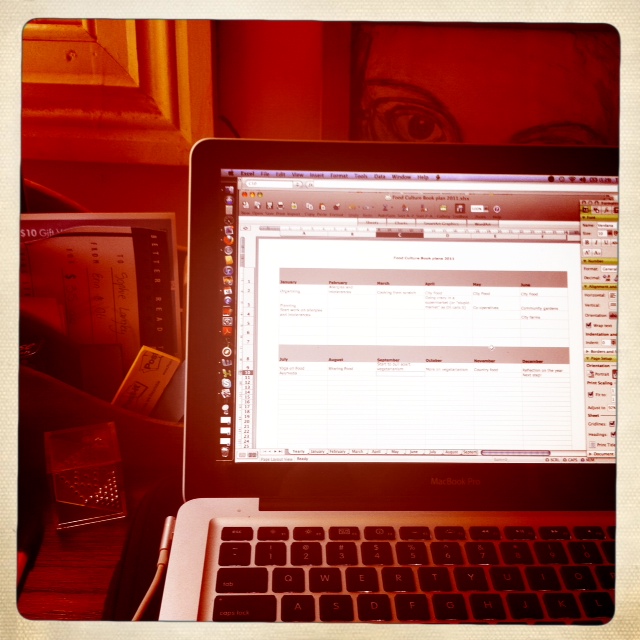
This morning I’ve been busy organising. I’ve planned out a rather large project across 2011, breaking it down into smaller sections, which will be much easier to manage — and will hopefully mean I actually get started on them.

I think having those eyes peering at me over the computer monitor is a good thing… I feel like I’m being supervised. (Supervised by myself incidentally — the picture is a portrait a friend of mine drew for me many years ago in high school. I keep it there to remind myself of me at that age, and all the possibilities that lay ahead of me then.)

On the weekend I cleaned up my desk, organised all my files and stored stuff away under my bed. I have to move house soon, so I’m trying to get rid of anything that I don’t really need, to avoid simply moving it to another location where it will get under my feet.

I think 2011 might be the year of being organised. Last year certainly wasn’t! I’m hoping I can strike a balance between last year’s extreme go-with-the-flow attitude and the more rigidly organised person (otherwise known as a control freak) I’ve been in past years. Fingers crossed.

——

Today is my brother’s 22nd birthday. Happy birthday Tomarse!