Waste and lemons

We go through a lot of lemons in our house. For various reasons, my housemate and I each have a little lemon juice in some warm water to begin our days. I also love to cook with lemon juice — I add it to lots of things. So we end up with a lot of lemon rinds.

For the last six or seven years, I’ve kept a compost of some sort. For many of those years, it’s been a worm farm. Worms don’t like citrus peels. I’ve also found that they take forever to break down in a regular variety compost, even when I’m pedantic and chop them up into tiny pieces, like I do with all the other things that otherwise take a long time to break down, like avocado skins. Yes, I think it’s fair to say that I’m a little obsessed with what happens to food scraps once they become waste.

The research that I’ve been doing for the last six months or so has really only added to that obsession. I’ve spent that time looking at waste, in the food system in particular, but also just as a general concept. It’s for something else I’m writing, so I won’t share too many of my thoughts here, but suffice to say that I think the percentage of food that’s wasted in the world (nearly half — more here, if you’re interested) is horrifying, and I think the concept of waste, generally, is all about perspective.

Which brings me back to the hundreds of lemon rinds. It occurred to me some time ago that there must be something else I can do with the bits of the lemon we don’t drink or eat, other than throw them out. Without really knowing the answer, I started keeping them, putting them in a bag in our freezer. (Living with me, if you want to put anything in the freezer, can be… challenging — I make full use of that space!) And in the meantime, I began looking for uses for lemon rind and peel.

There are heaps, of course. Among other things, I discovered I could soak them in vinegar for a few weeks to make a citrus oil cleaning spray, and, most exciting to me (and perhaps what should have been obvious already), was the idea of lemon marmalade.

I’ve eaten marmalade since I was a child, on and off, and I always knew that it was citrus peel, but for some reason it never occurred to me that I could eat the parts of the lemon I thought of as inedible by making my own spread. That this never occurred to me is especially strange because I make a lot of things myself that other people buy, simply because I’m curious. Cooking, to me, is an exercise in curiosity (quite apart from its leading to eating).

A very quick search brought me hundreds of recipes. It also brought me to this lovely essay on preserving citrus.

Citrus is usually present in most marmalades or jams, because the pith (the white bit under the zest) and the seeds are high in pectin, which is what helps the jams to set. This large amount of pectin means that citrus jams and marmalades are a good place to start when you’re new to the game like I am. (It also means that you can pretty easily make your own pectin at home, for use in jams with other non-citrus fruits.)

So I made some of my left over lemon peels (plus some orange peels I had lying around as well) into marmalade. It was delicious. And easy.

I cooked some lemon rinds, chopped, for about an hour, or until they were soft. I also added a little package of saved seeds and the fruit flesh, which I’d been keeping in a jar in the freezer, along with a couple of pieces of fresh ginger and some cloves. The recipes I found said to use a muslin bag, but I didn’t have one, so I just sterilised a cotton napkin by soaking it for a few minutes in boiling water and tied it up into a package with a piece of cotton twine. Then I added the mix to a food processor and blitzed it a little. Once I had the texture I wanted with the fruit, I weighed it (I had about 330g). The general rule with jams is 1:1:1 fruit:sugar:water, and so I added about 330g each of water and sugar, along with the fruit, to a saucepan, brought it to the boil and then simmered it for quite a long time, until it thickened. Apparently the magic temperature for setting jam is 220 degrees, but I don’t have a thermometer that goes that high, so I used the “wrinkle test”, where you put a few teaspoons of the mixutre on a saucer, put that in the freezer for five minutes, then run your finger across it. If it wrinkles, you’ve reached the right consistency.

Earlier, I’d put a couple of clean jars in the oven on a high temperature to sterilise them before I put the marmalade in them. Once the marmalade was nice and thick, I pulled those jars out and spooned the jam into them. (There are two tricks here: 1. guessing how much jam you’re making so you have the right number of jars, and 2. remembering the jars are hot — I failed to remember and burnt my thumb quite badly.)

I don’t think I’ll ever throw out a lemon peel again.
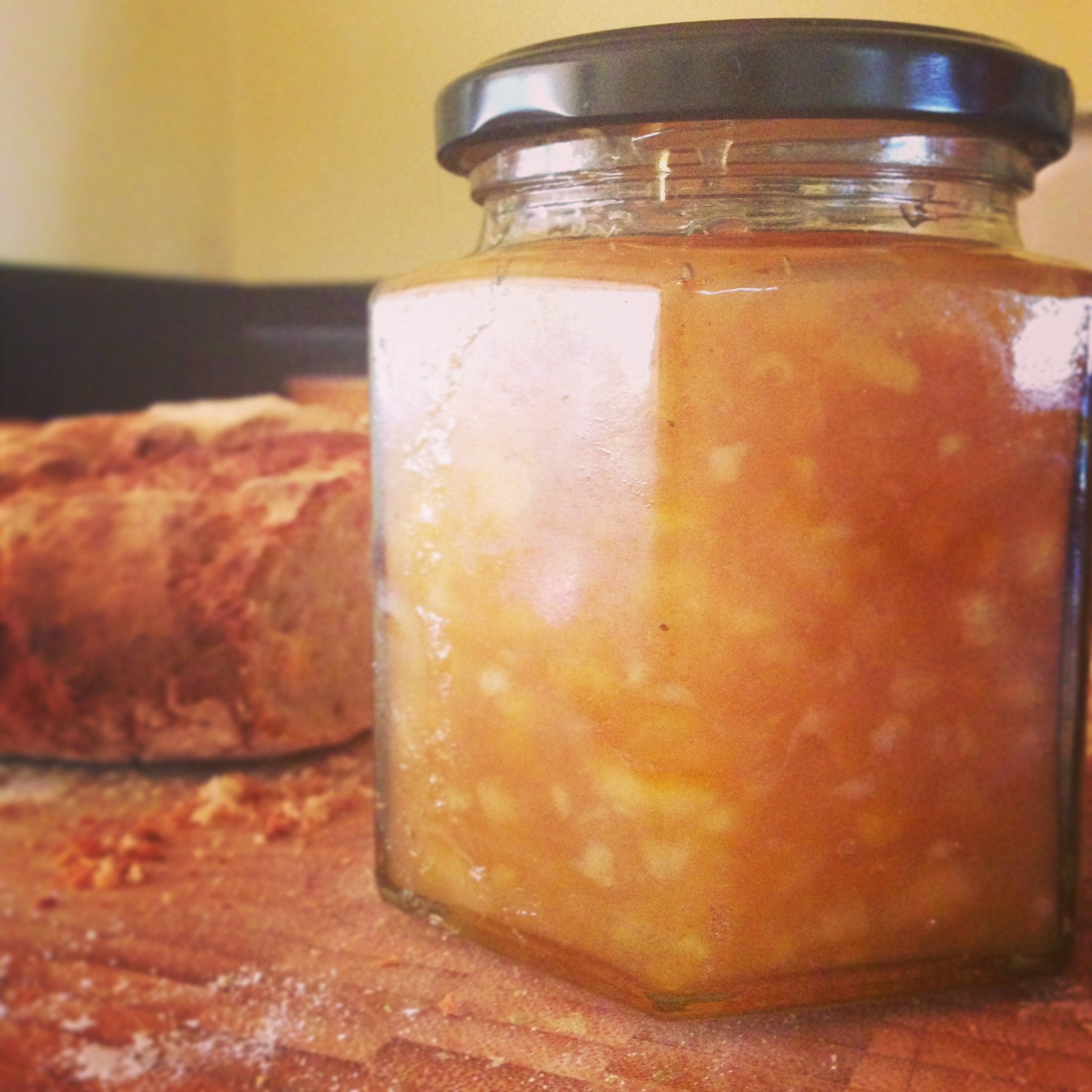
Lemon marmalade

This brings me back again to the idea of waste, and how it’s all a matter of perception. I wonder how much of what ends up in my bin — or in anyone’s bin — is in fact something of use, if only we knew what to do with it. (Also, does anyone want some marmalade? Because I’m probably going to be making a lot of it. I’ll take flavour requests.)

~

I’ve not used the citrus/vinegar cleaning spray yet, but I’ll put an update here when I do.

The balance between self and other

A few weeks ago I went to a workshop run by US teacher, Sarah Powers. Aside from being an incredible physical practice, what I really took away from the workshop was a sense that perspective is really important in a yoga practice (and, let’s face it, in life). At the very beginning of the practice, Powers talked about how many people think of the idea of self-improvement as a selfish act. She suggested that it needn’t be, if the improvements in self are also then used for the betterment of society as a whole in some way. That is, if we improve ourselves in ways which are beneficial to our relationships with other people, and indeed with other creatures and life forms. Ultimately, that kind of practice is more beneficial for us as individuals too.

Perhaps it sounds a bit namby-pamby to talk about realising and improving our connection with everything else. But I mean that in the most realistic and maybe even boring way possible. Every organism on this planet depends in one way or another on something else. We depend on other human beings, we depend on other species even, both in ways that we’re able to identify and perhaps quantify, and in ways that we’ve no idea about. We eat other species (even vegans and vegetarians eat other species — sentience is a whole other discussion and not one I’m going to have here just now), they eat each other. We rely on other human beings for friendship, but also to build the roads we drive on and the buildings we live in. For the most part, we rely on other human beings to manage our eating relationship with other species by growing our food for us.

My lovely friend and fellow yoga teacher (based in Seattle) Kat Selvocki, brought my attention to this article by Matthew Remski on how the ‘social good’ aspects of yoga are missing in the way most of us practice it. The idea of connectivity, both within and beyond ourselves, is certainly present in the philosophy of yoga, but it’s yet to take off in any concrete way in the way we practice yoga in developed countries. He writes about going to a church service and finding out about all the social services that church has on offer, and about then wondering why those sorts of services are not part of the way yoga generally manifests itself in our society.

I don’t think it’s a problem with yoga, per se. I think it’s symptomatic of broader issues of isolation and fading of community that can come with an increased emphasis on individual empowerment. I write about and do a lot of research into food systems, and I see the same problems there. In food systems there’s a huge disconnection between most people and the actual growing of their food — that is, most people don’t grow their own food, and have no idea who does grow it.

What buoys me as I do this research is the fact that there seem to be plenty of other people who are already aware of how problematic this is, and who are trying to do something about it. In the same way, pieces like Remski’s give me hope that some of these issues in the way yoga is practiced are being or will be addressed. The concept of ecological systems, which, essentially, are a way of examining the relationships between things in the non-human world and between the human and non-human worlds, is one that could easily be applied to the relationships between humans themselves. After all, we are actually our own walking ecosystems, made up of a community of our own genes and microbacterial life. (For a really interesting, if a little icky, examination of the bacterial make-up of human beings and how important it is to our health, have a listen to this short podcast about the medical practice of ‘poo transplants’. Gross, but really fascinating.)

But how does all this relate to a yoga practice? How might we keep a sense of perspective when we’re up close and personal with our bodies and all the physical, emotional and mental issues the practice might bring with it? Sarah Powers offered in her workshop a simple exercise that might help here.

As we held an uncomfortable but relatively supported and passive pose (you might do the same just lying on your back on the floor, or sitting upright on a cushion), Powers asked us to allow our awareness to travel around the body until we found the most uncomfortable sensation, and then to watch that sensation. To notice everything we could about it — where it was, how strong it was, whether it was tightness, whether it affected our breath etc etc. After a minute or so, she asked us to keep that point of discomfort as the centre of our awareness, but allow the edges of that awareness to expand out to the edges of our mat. Then after another minute, again keeping the original discomfort as the centre of our awareness, to expand the edges out to the sides of the room. After another minute, to the streets that enclosed the block the building sat on, then out to the suburb, the city, the region, the state, the country, and on and on, perhaps even out to the knowable universe. Once we’d expanded our awareness out as far as we could — still with the centre point being that discomfort in our own body — she asked us to notice how small our discomfort looked when compared to the rest of what we were holding in our awareness. Very small indeed.

This exercise was not used to try and eliminate that discomfort, or to suggest it wasn’t valid; it was merely an exercise in perspective that hopefully helped us to suffer less from the discomfort. And it worked. The discomfort was still there, but it didn’t feel quite as bad. I think it’s really important to remember that yoga isn’t supposed to just be exercise for the physical body. The physical poses are about realising that there’s more to life than what’s going on your head, and to see the connections between your body and your mind.

Additionally, the exercise certainly helped me to remember that there is more going on in the world (solar system, universe, whatever) than just what’s going on for me, even beyond my physical body. And this is hopefully what yoga is about, at least eventually. A big part of the way that Sarah Powers teaches yoga involves the Buddhist ideas of compassion and loving kindness, and an exercise like this one at the very least shows that we have an emotional capacity beyond our own experiences. The trick then, perhaps, is what we do with that capacity, how we put it into practice beyond an exercise on our yoga mats.

Mental ambling

These last two weeks, when I’ve put myself in yoga postures, I’ve found myself mentally traversing the streets of inner-western Sydney that I used to frequent. I’ve travelled mentally down King Street in Newtown, and down various side- and backstreets I wandered; through Darlington and Redfern; up and down Glebe Point Road. I’ve also found myself mentally inhabiting my various bedrooms and lounge rooms in Sydney — particularly those from my last two houses there. It’s an odd experience.

Up until a few weeks ago, I’d not been on the floor for yoga with any kind of regularity, and it seems that being back in my physical body now that I am yoga-ing every day again is putting me back in those places I spent lots of time in. It’s not really like reliving particular memories — although my memory of those places is obviously necessary for the experience. There’s no such specificity. Instead it’s like I’m wandering through those places anew; a mental experience that’s no doubt cobbled together from various more specific memories. It’s like a waking dream.

There’s a sadness to it, a missing. But it’s a missing without longing. Not at all like the way I miss the various important people it’s now much harder for me to see.

It’s almost as though my mind is taking me slowly through the various places that have been important to me — or at least places I went frequently — so that I can let those memories settle and get on with things here.

The strangest part is that these mental journeys only happen when I’m doing yoga. Not when I’m going about my day, not when I’m lying in bed at night trying to sleep, not when I go for a wander in the nearby park. Of course, the mental and emotional sorting that yoga seems to encourage is half the reason I do it in the first place, so it shouldn’t surprise me that the practice is bringing up all this stuff.

Melbourne and Sydney are compared with one another an awful lot, and I don’t really have anything to add to that conversation, except to say that they’re very different places and that each has its own list of pros and cons. But in a way this is a process of comparing my physical experience of them in my own mind. I had a conversation the other day with a friend on Twitter about my missing of Sydney’s farmers’ markets. There are, of course, plenty of farmers’ markets in Melbourne — a number of them a short way from my house. I said to my friend that none of them were quite the same, and while this is true, I think that what I was really trying to get at is that I’ve not yet settled here into the familiarity I had with where the markets in Sydney were, how to get there, what I might find there. Of how those places fitted into my life, or how my life fitted into those places. And this, really, is indicative of where I am with the move on a larger scale. Despite the familiarity of Melbourne itself to me, and despite my fondness for it, I’ve not yet figured out how my life fits in here, of what it is that this place means or will mean for me this time round.

Then I remember that I’ve only been here for just shy of four months and my not feeling completely settled makes a lot of sense. Before we left, a few people said to my housemate and I that it had taken them six months to a year to feel settled in a new place the last time they made a big move, and now I come to think of it, it probably took me that long to feel settled in Sydney when I moved there from here five years ago. So I’ve got a way to go yet, and probably a few more mental journeys through Sydney’s streets to take. In the meantime, it’s awfully interesting to watch those mental organising processes, if that’s what this is, occurring.

And as for the markets question, there are a few contenders that I think I might warm to over the next few months. Here are some shots I took the other day at Collingwood Children’s Farm, which has a market every Saturday that I’ll get to for the first time this coming weekend. (CCF is a city farm, which none of markets I frequented in Sydney were — it’s rather lovely.)