The balance between self and other

A few weeks ago I went to a workshop run by US teacher, Sarah Powers. Aside from being an incredible physical practice, what I really took away from the workshop was a sense that perspective is really important in a yoga practice (and, let’s face it, in life). At the very beginning of the practice, Powers talked about how many people think of the idea of self-improvement as a selfish act. She suggested that it needn’t be, if the improvements in self are also then used for the betterment of society as a whole in some way. That is, if we improve ourselves in ways which are beneficial to our relationships with other people, and indeed with other creatures and life forms. Ultimately, that kind of practice is more beneficial for us as individuals too.

Perhaps it sounds a bit namby-pamby to talk about realising and improving our connection with everything else. But I mean that in the most realistic and maybe even boring way possible. Every organism on this planet depends in one way or another on something else. We depend on other human beings, we depend on other species even, both in ways that we’re able to identify and perhaps quantify, and in ways that we’ve no idea about. We eat other species (even vegans and vegetarians eat other species — sentience is a whole other discussion and not one I’m going to have here just now), they eat each other. We rely on other human beings for friendship, but also to build the roads we drive on and the buildings we live in. For the most part, we rely on other human beings to manage our eating relationship with other species by growing our food for us.

My lovely friend and fellow yoga teacher (based in Seattle) Kat Selvocki, brought my attention to this article by Matthew Remski on how the ‘social good’ aspects of yoga are missing in the way most of us practice it. The idea of connectivity, both within and beyond ourselves, is certainly present in the philosophy of yoga, but it’s yet to take off in any concrete way in the way we practice yoga in developed countries. He writes about going to a church service and finding out about all the social services that church has on offer, and about then wondering why those sorts of services are not part of the way yoga generally manifests itself in our society.

I don’t think it’s a problem with yoga, per se. I think it’s symptomatic of broader issues of isolation and fading of community that can come with an increased emphasis on individual empowerment. I write about and do a lot of research into food systems, and I see the same problems there. In food systems there’s a huge disconnection between most people and the actual growing of their food — that is, most people don’t grow their own food, and have no idea who does grow it.

What buoys me as I do this research is the fact that there seem to be plenty of other people who are already aware of how problematic this is, and who are trying to do something about it. In the same way, pieces like Remski’s give me hope that some of these issues in the way yoga is practiced are being or will be addressed. The concept of ecological systems, which, essentially, are a way of examining the relationships between things in the non-human world and between the human and non-human worlds, is one that could easily be applied to the relationships between humans themselves. After all, we are actually our own walking ecosystems, made up of a community of our own genes and microbacterial life. (For a really interesting, if a little icky, examination of the bacterial make-up of human beings and how important it is to our health, have a listen to this short podcast about the medical practice of ‘poo transplants’. Gross, but really fascinating.)

But how does all this relate to a yoga practice? How might we keep a sense of perspective when we’re up close and personal with our bodies and all the physical, emotional and mental issues the practice might bring with it? Sarah Powers offered in her workshop a simple exercise that might help here.

As we held an uncomfortable but relatively supported and passive pose (you might do the same just lying on your back on the floor, or sitting upright on a cushion), Powers asked us to allow our awareness to travel around the body until we found the most uncomfortable sensation, and then to watch that sensation. To notice everything we could about it — where it was, how strong it was, whether it was tightness, whether it affected our breath etc etc. After a minute or so, she asked us to keep that point of discomfort as the centre of our awareness, but allow the edges of that awareness to expand out to the edges of our mat. Then after another minute, again keeping the original discomfort as the centre of our awareness, to expand the edges out to the sides of the room. After another minute, to the streets that enclosed the block the building sat on, then out to the suburb, the city, the region, the state, the country, and on and on, perhaps even out to the knowable universe. Once we’d expanded our awareness out as far as we could — still with the centre point being that discomfort in our own body — she asked us to notice how small our discomfort looked when compared to the rest of what we were holding in our awareness. Very small indeed.

This exercise was not used to try and eliminate that discomfort, or to suggest it wasn’t valid; it was merely an exercise in perspective that hopefully helped us to suffer less from the discomfort. And it worked. The discomfort was still there, but it didn’t feel quite as bad. I think it’s really important to remember that yoga isn’t supposed to just be exercise for the physical body. The physical poses are about realising that there’s more to life than what’s going on your head, and to see the connections between your body and your mind.

Additionally, the exercise certainly helped me to remember that there is more going on in the world (solar system, universe, whatever) than just what’s going on for me, even beyond my physical body. And this is hopefully what yoga is about, at least eventually. A big part of the way that Sarah Powers teaches yoga involves the Buddhist ideas of compassion and loving kindness, and an exercise like this one at the very least shows that we have an emotional capacity beyond our own experiences. The trick then, perhaps, is what we do with that capacity, how we put it into practice beyond an exercise on our yoga mats.

Mental ambling

These last two weeks, when I’ve put myself in yoga postures, I’ve found myself mentally traversing the streets of inner-western Sydney that I used to frequent. I’ve travelled mentally down King Street in Newtown, and down various side- and backstreets I wandered; through Darlington and Redfern; up and down Glebe Point Road. I’ve also found myself mentally inhabiting my various bedrooms and lounge rooms in Sydney — particularly those from my last two houses there. It’s an odd experience.

Up until a few weeks ago, I’d not been on the floor for yoga with any kind of regularity, and it seems that being back in my physical body now that I am yoga-ing every day again is putting me back in those places I spent lots of time in. It’s not really like reliving particular memories — although my memory of those places is obviously necessary for the experience. There’s no such specificity. Instead it’s like I’m wandering through those places anew; a mental experience that’s no doubt cobbled together from various more specific memories. It’s like a waking dream.

There’s a sadness to it, a missing. But it’s a missing without longing. Not at all like the way I miss the various important people it’s now much harder for me to see.

It’s almost as though my mind is taking me slowly through the various places that have been important to me — or at least places I went frequently — so that I can let those memories settle and get on with things here.

The strangest part is that these mental journeys only happen when I’m doing yoga. Not when I’m going about my day, not when I’m lying in bed at night trying to sleep, not when I go for a wander in the nearby park. Of course, the mental and emotional sorting that yoga seems to encourage is half the reason I do it in the first place, so it shouldn’t surprise me that the practice is bringing up all this stuff.

Melbourne and Sydney are compared with one another an awful lot, and I don’t really have anything to add to that conversation, except to say that they’re very different places and that each has its own list of pros and cons. But in a way this is a process of comparing my physical experience of them in my own mind. I had a conversation the other day with a friend on Twitter about my missing of Sydney’s farmers’ markets. There are, of course, plenty of farmers’ markets in Melbourne — a number of them a short way from my house. I said to my friend that none of them were quite the same, and while this is true, I think that what I was really trying to get at is that I’ve not yet settled here into the familiarity I had with where the markets in Sydney were, how to get there, what I might find there. Of how those places fitted into my life, or how my life fitted into those places. And this, really, is indicative of where I am with the move on a larger scale. Despite the familiarity of Melbourne itself to me, and despite my fondness for it, I’ve not yet figured out how my life fits in here, of what it is that this place means or will mean for me this time round.

Then I remember that I’ve only been here for just shy of four months and my not feeling completely settled makes a lot of sense. Before we left, a few people said to my housemate and I that it had taken them six months to a year to feel settled in a new place the last time they made a big move, and now I come to think of it, it probably took me that long to feel settled in Sydney when I moved there from here five years ago. So I’ve got a way to go yet, and probably a few more mental journeys through Sydney’s streets to take. In the meantime, it’s awfully interesting to watch those mental organising processes, if that’s what this is, occurring.

And as for the markets question, there are a few contenders that I think I might warm to over the next few months. Here are some shots I took the other day at Collingwood Children’s Farm, which has a market every Saturday that I’ll get to for the first time this coming weekend. (CCF is a city farm, which none of markets I frequented in Sydney were — it’s rather lovely.)

EWF blog post ~ Armchair Love: Posture, Thinking and Writing

Late last year, I was excited to become one of three mentees in the Emerging Writers’ Festival Digital Mentorship program. I’ll be writing about a post a month for them for the next six months or so (you can read more about the program, and the other writers on it, here.)

My first post, an argument for armchairs and an exploration of how posture affects thinking, went up yesterday. You can read it here.

Thoughts about the year that’s been

As is so often the case at the end of the year, I find myself today mulling over things, thinking about the year that’s just about to close and the new one that will begin when the clock hits twelve tonight. For me, 2012 has been a really tough but ultimately rewarding year.

I’ve moved house twice (once interstate), taught yoga full time, finished a Masters degree, begun new friendships and built on existing ones, spent time with my family, spent time alone, had some essays published, worked more on my larger writing project, tried my hand again at short fiction. I’ve said goodbye (for now) to some friends and hello to others. I’ve spent plenty of time outdoors, upside down, prone and supine. I’ve watched the plants in my various gardens grow and change and sometimes die. I’ve walked many, many kilometres. I’ve read a lot, cried a lot, laughed a lot. Friendships have been tested and, happily, survived. Ideas and hopes and dreams about life’s direction have shifted, sometimes subtly, other times massively. I’ve spent an awful lot of time practicing yoga. And cooking. And being surprised at myself and at life.

Honestly, if I think back to this time last year, I can hardly believe it was only a year ago. The year that will end tonight feels like two or three years squished into one.

I have a few bits and pieces lined up for 2013, but mostly I have no idea what’s in store for me, which is both exciting and absolutely terrifying. Life is pretty unsettled and confusing right now, but that’s not hugely surprising, given that it was only just over two months ago that I landed in Melbourne. I know I can expect a whole lot more uncertainty and probably some more shifts in perspective—but then that’s half the reason I wanted to make the move to Melbourne. As difficult as change can be, it’s also a really good way of noticing patterns in my thinking and behaviour (in yogic philosophy these are called samskaras, or ‘traces of deeds done in the past’) and giving myself a chance to figure out which of those patterns are useful and which are not. Letting go of the less useful patterns is an additional challenge, of course. Probably a life-long one.

It will be interesting (that word we use when we’re not sure whether something is good or bad or somewhere in between) to see how things unfold in the next few months. To see which patterns stay and which ones go.

Tonight I’ll be celebrating the year that’s been with a couple of dear friends. I’m looking forward to 2013, to getting on with whatever it is that the new year will bring. Happy new year.

Food reading: The People’s Food Plan

I’ve spent many hours over the last year reading food plans from different countries, trying to get a sense of how we feed ourselves, and the problems with how we do that. Earlier in the year, the Australian government put out a green paper to inform a national food plan. I’m still working through that report in detail (it’s some 200 pages long), but there’s already been quite a response to it elsewhere (here, here and here), and the Australian Food Sovereignty Alliance has put together a discussion paper for a People’s Food Plan as an alternative.

The language difference between the two papers is stark. The government report, as is to be expected, I suppose, is rather dry reading. The facts are interesting, but the language is business language — and much of the criticism of this report has suggested that it’s too business focused. There’s quite a lot in the report that isn’t related to business, but I do agree that its overall focus is problematic. Business, and the economy, are only part of what’s affected by food. The People’s Food Plan discussion paper uses more emotive language, which might be criticised by business folk, but I don’t think it’s necessarily a bad thing to talk that way about food. Most of us have an emotional relationship with food, in one way or another — it’s often how we socialise, and our food choices are often highly emotion, even if we’re not always aware of it.

A week or so ago, I went to the first of a series of events put on by the Department of Agriculture, Fisheries and Forestries (DAFF), which they’re calling AgTalks. The session I went to was discussion around the topic “Australians don’t care where their food comes from, as long as it’s cheap and looks good.” The event was chaired by Cameron Wilson, from ABC Radio National’s Bush Telegraph program (and an edited version of the event was broadcast on that show — you can listen to the podcast here), and on the panel were representatives from across the food industry. Interestingly, the panel did not include any farmers, or at least no farmers who didn’t have a vested interest in an industry organisation. Wilson had a number of questions for the panel to consider, but he also threw to the audience and to Twitter (#agtalks) for questions.

Something that bothered me about some of the questions, and about some of the responses from the panel, was the underlying assumption that there is an easy or simple answer to any of the problems that run deep in our food system. I should note that not everyone seemed to be working on this assumption, but it was something that came up frequently. The idea that ‘everyone should just shop at farmers’ markets’ (and I’m definitely paraphrasing here — those exact words were not actually uttered) really irks me. Not everyone has access to farmers’ markets (or organic food, or even fresh food), be that because they can’t afford it, or because it actually just isn’t available anywhere near them. To offer that as a solution just shuts down discussion — very important discussion. Don’t get me wrong: I’m all for farmers’ markets, all for organic and sustainably-grown food, and I certainly think the cost of that kind of food is a more accurate indication of what it actually costs to produce good food. I just think reality of supply is a little more complicated. Supply isn’t just about quantity. It’s also about distribution and access. And the more research I do into food in Australia, the more I come to see that we really must look at food as an inherently social problem, as well as seeing it as an economic and environmental problem.

Which brings me back to a quote from The People’s Food Plan discussion draft: “Being essential to life, food systems must be life-sustaining and life-enhancing.” I would add that it needs to be that for all people. I’ll be watching the development of this plan with great interest, hoping that the social issues that surround access to food are considered carefully and thoughtfully.

Animals

Last night I went to an event at the Wheeler Centre called A Night at the Zoo. The event was the result of a series of fellowships, in partnership with Melbourne Zoo, that allowed four writers to spend time at the zoo with a view to inspiring some written work. The event last night was an opportunity for the writers to present some of that work and to discuss some of their thoughts and feelings about the zoo, and about zoos in general.

Unsurprisingly, much of the discussion was about animals and our relationship to them. Cate Kennedy admitted that she is ambivalent about zoos, for a whole host of reasons. I feel similarly. Or, at least, I feel confused about them. There’s something deeply disturbing about our desire to put members of other species in cages (or enclosures, as is more likely the case these days) so we can watch them. But at the same time, much of the work zoos do is about education and conservation, which is certainly not a bad thing. And I understand as well as anybody the kind of curiosity that leads people to zoos, to watching.

Some of the stories Estelle Tang relayed about a visual artist forming a kind of friendship or understanding with the gorillas, whom she frequently draws, and about the same artist witnessing the awful behaviour of some human visitors towards the primates, reconfirmed for me that sense of the deep uncertainty we seem to have in our relationship with animals.

Throughout the day yesterday I’d seen posted on Twitter a number of times a link to a letter from Fiona Apple to her fans saying that she was delaying her South American tour to stay home with her dying dog. For various reasons (you know, trying to actually do work), I’d not read it during the day, but when it came up again in my feed last night after I got home from the Wheeler Centre event, reading it seemed appropriate. The relationship she describes with her dog is companionship — actually, no, it’s friendship. And it’s beautiful. (But also sad, so if you’re going to read it, be prepared.)

My family have always kept pets and I’ve developed an enormous affection and/or love for most of them. As an adult, I’ve lived in a number houses (including the current one) with housemates who have cats. And again, I’ve developed a friendship and an affection for with those animals. I guess and hope that those animals understand that relationship as something more than just ‘she gives me food sometimes’, but the potential for anthropomorphisation bothers me.

Earlier in the year, I wrote an essay on how growing my own food has made me seriously question my own vegetarianism (although I’m yet to give up on it)*. It’s made me question my relationship to other creatures and the rest of the non-human world. In fact — and excuse the melodrama here — it’s made me question my whole concept of death and decay, and of life. As part of my research for that essay, I came across Charlotte Wood’s excellent essay on animals (available here as a PDF), and I thoroughly agree with her point about the dangers of anthropomorphising animals. She says:

But I find most of it troubling because it seems so disrespectful. Denying the creature’s essential nature – its very animality – is surely an act not of admiration, but subjugation. To downplay the differences between species is to promote the assumption that “humans will only accept what is like themselves”, as American scholar Shelly R. Scott puts it.

But that’s not all. The flip side of our culture’s grossly sentimental failure to embrace the “otherness” of animals – the failure to imagine them as anything but approximations of ourselves – is a deep ugliness in our treatment of them. We force a dichotomy in which animals are either so like us that we cannot separate their needs from our own, or so unlike us as to be aliens, undeserving of any rights at all. The more we sentimentalise, the more we also brutalise.

Equally — and I think this is partly what Wood is getting at when she speaks about the ‘flip side’ of that sentimentality — I think that denying animals any kind of emotional life is problematic (and there is a growing body of scientific research that suggests that animals do, in fact, experience emotions, often seemingly in similar ways to us). And I wonder whether we sometimes cling to the idea that we are different to animals in our ability to experience emotion (or in any other way) because we can’t quite face our own ‘animalness’.

Which brings me back to a point made in last night’s Wheeler Centre event. Cate Kennedy suggested that our response to animals (and she gave the example of her own ‘give me hugs’ response to the orangutangs at the zoo) says far more about us than it does about them. What is it that we’re looking for — or hiding from — in our relationships with animals? It’s a scary question.

~

As you might be able to tell, this topic fascinates me. Some other reading I’ve come across, if you’re interested:
Eating Animals, Jonathan Safran Foer
Us and Them: on the importance of animals, Anna Krien
Vegans and Ethical Omnivores, Unite!, Tammi Jonas

(There are a whole lot of other things I could add to this list, if I could find them. I’ll endeavour to do so as I draw them out from their various hidey holes in my too-complicated filing system.)

*I don’t think this essay is available online at the moment. You can, however, buy a print copy of the Death of a Scenester Food issue it appears in.

House and garden

Yesterday we signed the lease for a little cottage-style house in Melbourne’s Brunswick, and my mind has immediately gone mad, thinking about what I can do with the courtyard garden. So many plans.

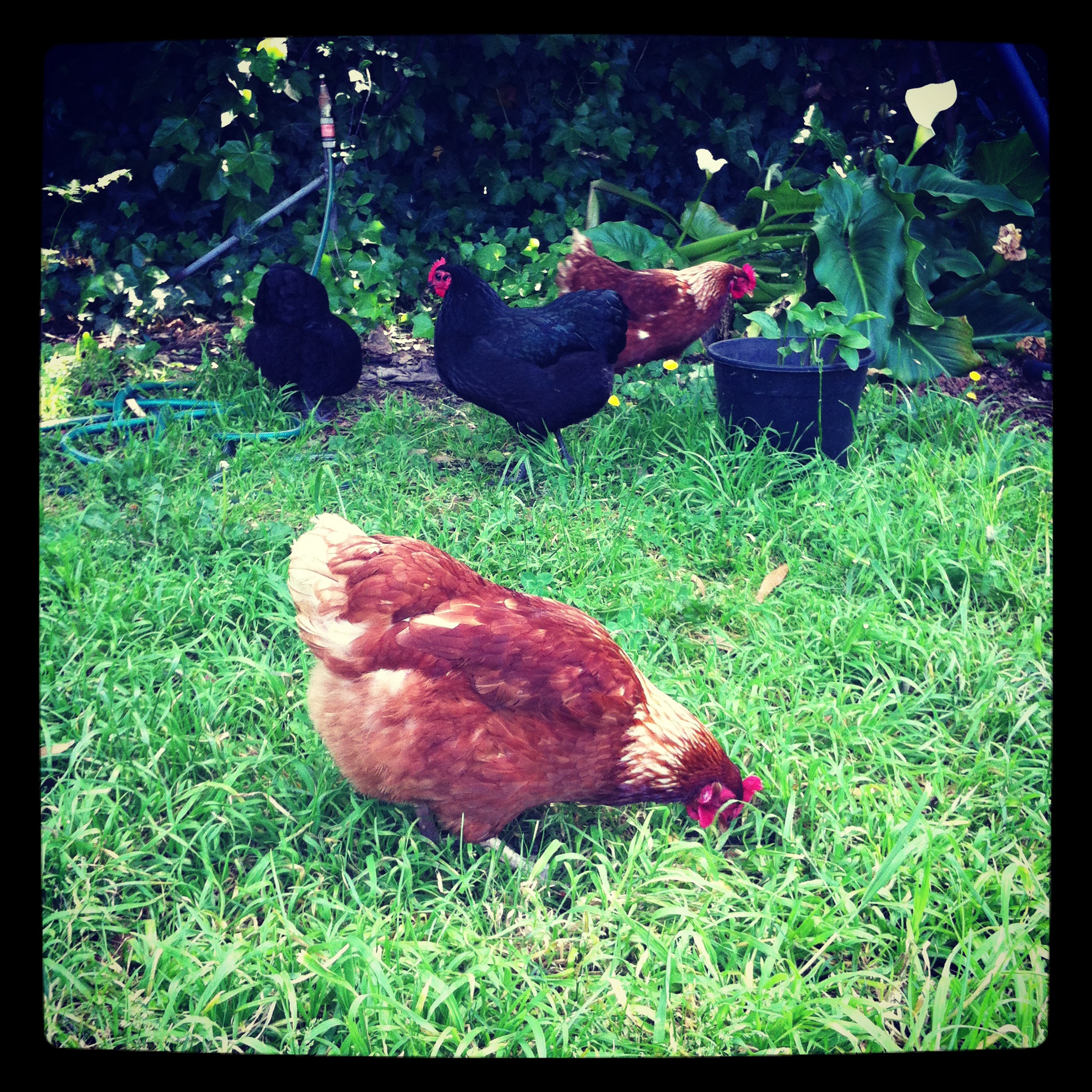
The friends my housemate and I are staying with have chooks, and they’re so lovely that I’d dearly love to take them with me (plus, think of the eggs!). They’re so inquisitive. I crouched down in the grass to take this photo, and they all came over immediately, thinking I had food, and then eyed me curiously when they realised that I didn’t.

Unfortunately, my courtyard garden will not accommodate chooks — there’s no grass for them, it’d be cruel. So I’m adding chooks to my list of things to have when I’m a Proper Grown Up and live on a bit of land somewhere.

Ghosts and New Beginnings

Life is very strange at the moment. Well, it has been for quite some time now, but it’s been extra strange since my housemate and I landed in Melbourne. It’s taken me a little while to tease out the strangeness, to get a good sense of where it’s really coming from.

The answer isn’t simple, of course, but part of why I’ve felt pretty weird these last couple of weeks is that I’ve found myself trying to marry together different parts of myself. The parts of me that existed when I lived in Melbourne, the parts of me that were there when I visited and missed this city, and who I feel like I am now. I’ve mentioned here before that Melbourne often feels to me like it’s haunted. For me, it’s a place full of ghosts — ghosts of the past me, ghosts of long-over relationships, ghosts of friendships changed. And perhaps the missing of the place has made each of those ghosts just a little more powerful now I’m living here again. Nostalgia is a strange thing, cruel at times.

A while ago, for a piece I was writing, I was reading a lot about narration and the self, and how vital it is for our mental wellbeing to build a coherent sense of self. So much of that building process is about making connections between events, objects and places that are, really, not closely related to one another. In other words, we tell ourselves a story about what happens to us in order to make sense of it, and in order to create the character we call our ‘self’. What’s happening to me now, I think, is that those stories aren’t quite matching up. There’s a bit of rearranging to be done in my thinking about them.

Along with that confusion though has been an immense sense of relief. I feel relaxed here, at home. I guess the weirdness will settle eventually, and that I’ll figure out how to fit all those parts of myself back together again. And, I hope, I’ll learn to live more easily with the ghosts here. They are, after all, mostly benevolent ones.

Rearranging

This week I’m editing a piece I’ve been working on now for a few months — lots of research, lots of reworking. This edit, among other things, has involved rearranging the text, slightly changing the structure (thankfully not so much the actual content of the sentences). It continues to amaze me that moving a sentence from one part of a piece to another can change the overall piece so much. A tiny shift, a massive change.

It also seems kind of fitting that I should be doing this work in my writing when I’m doing exactly that kind of work in my life.

Moving interstate forces you to rearrange things.

I will write more about the moving interstate rearranging once things have settled a little. Which, I hope, will be soon.

Breaking

This week I’ve taken (mostly) a break. After last week’s adrenaline-fueled activity, doing very little this week has felt… well, actually, it’s felt a little like breaking. Taking a break has given me space to break a little. And I think that’s a good thing.

But I’m interested in how closely related those two things are — stopping, and falling apart a little, that is. I don’t think it’s a coincidence that the word ‘break’ covers both. My body is sore and bruised and tired from all the moving of belongings. I’ve got back into a more energetic yoga practice this week, and noticed that tiredness more than anything else. My flexibility and strength don’t appear to have changed all that much after a week or so of only restorative yoga, but just how much my body’s willing or able to do has changed quite a lot. There’s just not a lot of energy there.

It’s funny, I often notice the effects of stress as fatigue in my physical body before I notice that I’m feeling it emotionally. Yesterday, my arms didn’t quite want to hold me up in poses they normally have no trouble with, and my legs were wobbly where they wouldn’t normally be. I had to stop for a while quite a lot. My body was relieved when I finally lay down on the floor to rest at the end. Then last night I finally cracked and cried about some of the logistical issues we’re having with the move. And I realised that what I was crying about was not just the particular worries from yesterday, but about all the worries that are associated with this (and any) move.

So today I’m moving slowly. I slept in this morning, then pottered around before going into town to have lunch with Mum. This afternoon I’ve done a few bits and pieces and will spend a little more time on my yoga mat. I’m just letting myself be a little broken because, well, I am a little broken, and it’s not going to help me to pretend otherwise. Instead of pretending I’m okay, when really I’m fragile, I’m going to put that effort into picking up the pieces and making sure I’m keeping them all together in a safe place.