Emerging Writers’ Festival— the Haunted edition

Sometimes being in Melbourne makes me feel haunted, like I might run into a younger version of myself at any moment. Being here for a festival, something that is so intellectually expansive, only serves to heighten that feeling—like somehow the fact that there are new possibilities opening up in my mind might make a meeting like that possible. It’s not exactly unpleasant, but it is unsettling.

Because I feel like it’ll be some time before any of this stuff settles enough for me to make sense of it, I’m going to continue with the barely-edited-selection-of-notes format. Here’s some impressions of yesterday’s Emerging Writers’ Festival Town Hall Conference panels.

~

A selection of tips from Seven Enviable Lines
Emily Maguire: Writing full-time will not necessarily make you a better writer, & it may make you a worse one. You may begin to lose touch with the world—”I don’t believe you need to write what you know, but I do believe you need to know about what you write.”
Christy Dena: “Let others breathe on your baby.”
Ali Alizadeh: Writing is an extension of reading. Writing is always a dialogue with other writing.
Anita Sethi: Sit down, & the inspiration will come. Writing is very hard work. The inspiration is a spark, but the perspiration is so important.
Lawrence Leung: Listen to feedback, but don’t let it rule your life. If you want to write, no one can stop you except you.

A selection of notes from other panels throughout the day

In Writing on Tough Topics, Sydney Smith suggests that exposing oneself by writing about something tough is also a way of making amazing discoveries. I’m reminded of this TEDtalk on vulnerability.

In a session on Structure, Ali Cobby Eckerman says the structure of her writing is often imposed by her Indigenous cultural background. I wonder how much of the way I put stories together comes from cultural structures I’m hardly aware of.

In a session on Cross Platform writing, I am completely fascinated by the gesticular communication of Deaf writer, Asphyxia. So expressive—perhaps more so than any spoken communication can ever be. This is itself cross-platform communication, if you think of the human voice and body as media through which we tell stories.

Emerging Writers’ Festival launch

I’m in Melbourne this weekend (well, I’ve made it a long weekend) with my housemate (my Wifey) for the Emerging Writers’ Festival. We got up early yesterday morning and flew down, both on very little sleep (excitement had kept us both up the night before maybe?), and spent the afternoon doing some writing work in a cafe recommended to us by the lovely Ms LiteraryMinded (Ange).

In the evening we ventured into the city (along with Ange) in search of a cheap and cheerful dinner, which we had along with perhaps a wee bit too much wine. As a result, we turned up at the EWF launch rather giggly. Rather then go into great and lengthy detail about the night, I thought I might just post a selection of my notes from the evening. There are plenty of gaps in these notes, and they were made in the fog of red wine and the excitement that comes with being at a festival. Here they are.

~

Arrived giggly and a little tipsy.
Familiar faces (including a little swoon at nearly literally bumping into songwriter Paul Kelly)
Tessa Waters, MC: “…wipe the creative placenta from your eyes, & just, you know, emerge.”
Tessa dancing. Us laughing. Bottom shaking. Laughing. Tears of laughter. Not that funny but can’t stop laughing. Aware that other people aren’t laughing as much as Wifey, Ange and I. Still laughing. Tassels shaking. Laughing. “Too much champagne already,” says Tessa once she’s finished her dance. Yep. I hear you.

Ruby J Murray
“Everyone of you will know what it feels like when you learn a new word, and you experience the world through this new thing.”
“We only have one word for their thousand beginnings, which is ‘acorn’, and only one word for their thousand ends, which is ‘oak’.”
Talk of loss of Indigenous languages. We miss out on a way to describe this place. “I will do what all writers should do, which is listen.”
“But in the end it’s all up to us to listen.”
Think about the ground beneath our feet, and what it means to the Indigenous leaders for us to be here.

Lisa Dempster introduces the festival.

Wishing suddenly that I could go to the launch of the Emerging Writer at the National Gallery (there’s an essay of mine in this beautiful book).
Aware suddenly that lots of garlic and onion at dinner was probably not a good idea if I want to actually talk to anyone after the official stuff is over.

Monash University Undergraduate Prize for Writing announced.
Monash winner—Michelle Li
Overall winner—Tully Hansen

International guest—Anita Sethi
“Each story itself is a journey” from the mind of the writer, through the pen or computer, to the reader.
The world is teeming with stories.
“History and fiction blur, and the imagination fills in the gap.”

Fiona McGregor, a call to arms:
Suspend the adjectives—get rid of the emerging, or at least think about what it means.
Maybe get rid of the adjective and return to the noun—writer, writing.
“We still have this urge for this gathering in the flesh.”
“Festivals are about the performance aspect.”
“Writing still necessitates retreat.”
Thinking space needed.
George Orwell—Why I Write
The four things: the best writers manage to keep all four in the air.
Ego, aesthetic, history, political purpose.
“As solitary as this work is, it has to be plugged in to the here & now.”
Writing is a job. If you want to survive, you have to set alarm and get up. You have to deal with days where you do nothing—worse, where you do harm.
“What are you doing it for? Because you’re mad.”
But then some days it works—”and when you share it, it chimes.”
Cherish the lonely space, the space of discomfort.
A reminder that solitude is scary, but wonderful. Cherish it.

Tessa Waters, introducing Omar Musa, talks about hip hop and dancing. On krumping: imagine yourself a very short person in a very big boat and you’re just rowing.

Omar Musa
Performed:
My Generation
Fireflies

Restorative Yoga Class in Redfern

A while back, I was going to a restorative yoga class every Wednesday evening. I remember trying to explain to a friend of mine that I often left that class feeling rather drunk—the lovely floaty, happy kind of drunk. I’d walk home, my legs feeling almost fluid, like they were moving with no effort on my part. I slept like a baby every Wednesday night (and never woke up with a hangover!).

Sadly, my schedule changed, and I was no longer able to attend that class. I’ve missed it enormously. So I was really excited to hear that a lovely Twitter friend of mine, Kat Selvocki, is running a restorative yoga series at House of Yoga in Redfern, starting tomorrow. I’m not going to be able to get to all the classes, but I am determined to make it to as many as I can.

As someone who is very bad at taking time out to just refresh, a restorative yoga class provides a structure that helps me do that. If you’re looking for a relaxing way to end your weekends, and a way to start the week feeling refreshed, I can’t recommend this series enough. Details are here.

Stillness

Stillness is not the absence or negation of energy, life, or movement. Stillness is dynamic. It is movement, life in harmony with itself, skill in action. It can be experienced wherever there is total, uninhibited, unconflicted participation in the moment you are in—when you are wholeheartedly present with whatever you are doing. ~ Erich Schiffmann ‘Yoga: the Spirit and Practice of Moving into Stillness’

I must’ve read this paragraph at least ten times over the last two years. It still strikes me every time. Stillness, on the rare occasion we manage to get it right, is dynamic. I love that idea.

Settling in

Last week was an odd one. A few weeks ago, I drafted a post about how I’d realised that rhythm was really important to me—my work hours are different every day with teaching, and often from week to week with writing, so it’s almost impossible to find something as structured as a routine. The word rhythm seems far more appropriate.

Moving house, of course, changes that rhythm in small ways and in larger ways. The route I take to get to all my classes is completely different, and often means I need to leave the house at a different time. The places I often found myself writing—whether at home or out and about—are now much further away. It’s both an exciting and disconcerting experience to have to find a new rhythm to settle into.

I realised a couple of days ago that one of the ways I settle into new places these days is to cook. For me, the kitchen is such an important part of how a house functions. Getting to know a new kitchen by cooking in it is a wonderfully settling activity for me.

I spent last week cooking familiar things in the so far unfamiliar kitchen, and it really helped me settle into the idea that this place is home. On Saturday morning my new housemate and I went to the Eveleigh Farmers’ Market and bought some produce to add to the box of home-grown stuff her parents (who stayed with us a few nights last week) brought us from their property, and in the afternoon I attempted to cook a few new things. Somehow, cooking something new in a new place fits with the idea of a new rhythm. There’s something in the potential for this particular new dish to become an old faithful, like the new routes to work will eventually become so familiar.

The weekend’s new dish was baked beans in the slow cooker my Mum gave me. For me (and, incidentally, for my new housemate), baked beans are one of those comfort foods—along with things like porridge, they’re the food I’ll eat when I can’t be bothered cooking, and I need something familiar, tasty and warm. So the combination of familiarity with the new experience of making them from scratch (rather than opening a can) seems an appropriate meeting of experiences.

They turned out pretty well, for a first try. We had them with toast and an egg for dinner last night. Exactly the kind of comfort we both needed after what proved a very busy week.

(Unfortunately, in my haste to eat the beans, I forgot to take a picture of the finished product. Next time.)

Recipe
(The original recipe I found here, and added a few things — next time I plan to also add some kind of herb, possibly rosemary, right before serving.)

200g cannellini beans (dry weight)
1 large tin chopped tomatoes
1/2 onion, finely chopped
1 clove garlic, finely chopped
2 tbsp dark muscovado sugar
1 tsp vegetable stock powder
1 tsp smoked paprika
1/2 tsp mustard powder
1/2 tsp marmite/promite/vegemite
1 good slug of Worcestershire sauce
1 tsp chilli powder or flakes
salt and pepper

Method
Soak the beans overnight.
Boil them for 10 minutes before using.
Add all the ingredients to the slow-cooker. Stir and mix through thoroughly.
Set the slow-cooker to low.
Cook for at least 6 hours (I put too much water in, so I ended up having to cook mine for about 12 hours).
Serves 2 as supper.
Serves 4 as part of a cooked breakfast.

My words in Death of a Scenester

Melbourne ‘zournal’, Death of a Scenester is launching its fifth issue, Food, next Saturday night in Abbotsford in Melbourne. Some words of mine on growing my own food and the subtleties of vegetarianism will appear in this issue.

Unfortunately I can’t make it to the launch, but if you’re in Melbourne, do try and get along! I’m really looking forward to getting my hands on a copy of this issue.

Moving House (again)

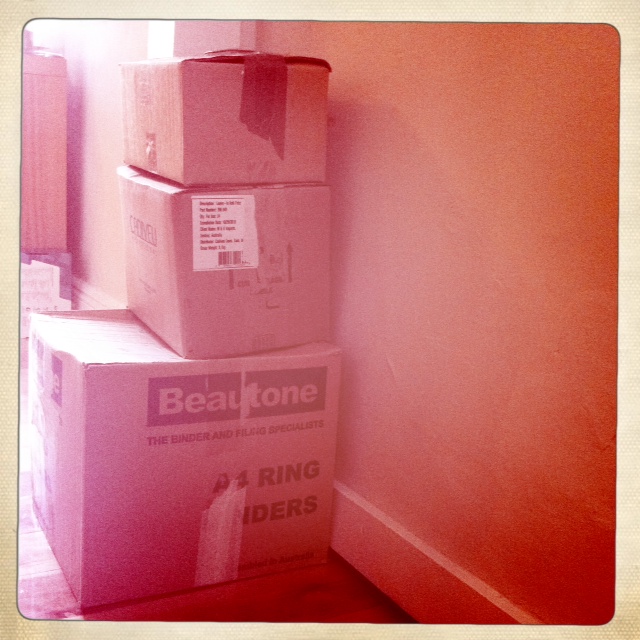
I’ve been packing this week to move house on the weekend. I’ve discovered things I forgot I owned, which I suppose is normal, but it does make me think I can probably get rid of a whole lot of stuff…

This move out of the house is happening a whole lot more quickly than the move into the house did, and so it’s been quite different psychologically (so far). I went back to read what I wrote last time I moved. This stood out.

This house had become home, these housemates like family.

So I guess we began the process of sorting, packing and moving with… well, heavy hearts. Sometime towards the middle of January, I found myself thinking about how I’d only walk this route to a yoga class (or get off the train at this station, or stare out my bedroom windows, or go for a walk in this park, or see this or that neighbour on the street) a finite number of times. And every now and then the four of us would be standing together in the kitchen talking and/or cooking, and one of us would sigh. Sentimentality became a big part of our last weeks in the house.

I’m prone to sentimentality, to brooding over things. The first sentence in the section above is true of the house I’m in now too. But this time around the rest of my housemates are staying put, and I only really found out when exactly I was going to be moving at the beginning of this week. The combination of those two things, I think, means I haven’t yet had time to brood too much. I’m sure that will come once the move has occurred. Of course, this time around I’ll be able to come back and visit my old house and housemates when and if that brooding makes me nostalgic.

At the moment, the whole thing feels a little surreal. I’m teaching all my regular classes, and trying to get other work done, and in between packing my material life into boxes. It’s odd that we feel so attached to all the stuff we accumulate. Some of my things I’ve had since I was a teenager. Some things I’ve only collected more recently, but much of that used to belong to my grandparents, and so is also imbued with sentimental value.

Every time I move, I find myself wanting to just chuck a whole lot of stuff out, but I never manage to get rid of much. It’s just stuff, but it also holds all those memories for me—I’m not sure I’d cope if I had to carry the memories around all on my own. Sentimentality gets me every time.

I’ve written here before about how intrigued I am by what constitutes ‘home’. The relationship between a person and the house, suburb and town or city they live in is such a nuanced one. It will be interesting to see how this shift in homes affects me, how my stuff in a new place changes things.

But for now, back to the packing of boxes.

The Emerging Writer: An Insider’s Guide to Your Writing Journey

At the beginning of June, an essay of mine will be published in the Emerging Writers’ Festival’s yearly publication, which this year is called The Emerging Writer: An Insider’s Guide to Your Writing Journey. Here’s the blurb from the Emerging Writers’ Festival’s website:

Every writer has to find their own way to emerge – there is no set route, no absolute path and no road that must be followed. But there is a lot we can learn from those who have travelled before us: how to get there more directly, how to bypass the road blocks, traverse the peaks and valleys, or which is the most scenic route.

The Emerging Writer is an insider’s guide full of valuable advice from fellow travellers – a resource you can keep within arm’s length, for when you need to consult that map again to help you find your way. Inside you will find information on: how to create publication opportunities, understanding your value and getting paid, why you shouldn’t write what you know, managing your digital domain… and much more! Whether you’re taking your first step, planning the next stage of your trip, or just want inspiration to keep travelling on your writing journey, this book is for you.

I’m being published alongside a wonderful list of writers, and am really looking forward to getting my hands on a copy.

~

Sort-of related: the Emerging Writers’ Festival program came out yesterday. You should check it out here. I’m heading down to Melbourne at the end of May to attend, and I can’t wait.

A Drink with LiteraryMinded

Literary blogger and dear friend of mine, Angela Meyer (aka Ms LiteraryMinded) has just brought out the first two episodes of her new online video series A Drink with….

In her own words:

A Drink with… is a literary-minded chat show. In each episode I chat, informally, with a different writer, over a drink at a Melbourne location. Over the course of the show my co-producer Mark Welker and I will feature both emerging and established writers, and writers of different forms, including criticism.

The first two episodes, with novelist Lisa Lang (co-winner of the Vogel in 2009) and poet Omar Musa (who has won both the Australian Poetry Slam and the Indian Ocean Poetry Slam), have been released simultaneously. You can view them below, on Vimeo, or on the LiteraryMinded blog.

It’s such a brilliant idea. The first two episodes are beautifully shot, and have such a warmth to them. Almost as if you were sitting in the bar/cafe with the writers. The camera takes in both Ange’s obvious rapport with her interview subjects, and all those little details you might notice about a person in close-up — hand gestures, little smiles, listening faces. I’m very much looking forward to future episodes.

A Drink with Lisa Lang from LiteraryMinded (Angela Meyer) on Vimeo.

A Drink with Omar Musa from LiteraryMinded (Angela Meyer) on Vimeo.