The Fortnight of Full

Yesterday afternoon, I found myself slumped in my chair at my office job, heavy limbed, unable to concentrate on the sentence I was trying to construct on the screen in front of me. I desperately wanted to crawl under my desk and go to sleep. Instead took myself to the bathroom, locked myself in a cubicle, and sat on the closed toilet, folded over my legs for five minutes. I let my breath slow down. Let my exhales become longer than my inhales. Kept my focus firmly on the cracks between the grey floor tiles so I wouldn’t drift off. I could feel my slow pulse in my arms and legs, that feeling like the very beginning of pins and needles.

When I made my way back to my desk, I wasn’t really any less tired, but I had realised I couldn’t ignore the fatigue anymore.

This last fortnight (and a half, really, since today is Thursday) has been full. I use the word ‘full’ instead of ‘busy’ quite consciously, and not just because this article from last year about the ridiculousness of ‘busyness’ still plays on my mind. I use the word ‘full’ because the last few weeks have involved so many things that require some level of mental or emotional processing from me, and not very much time to attempt that processing.

I can hardly complain, because most of what I’ve been doing, seeing, saying, hearing has been hugely positive and I’m incredibly grateful for all of it. But it’s possible to be overwhelmed by great stuff too, isn’t it?

I think often of this blog post by yoga teacher and writer Bernadette Birney, where she talks about the balance between work and rest (although she refers to work instead as ‘play’, which I love — especially now that much of my work is stuff I really love doing). The basic premise of her argument in the post is that there’s a limit to how much each of us can do, to how long we can be continuously active, and beyond that point we just feel overwhelmed. And really need to rest.

Some of the wonderful things I was involved in over the last fortnight included running a Yoga and Writing workshop at the Emerging Writers’ Festival this last weekend, and sitting on a panel for a discussion called ‘Keeping Active in the Arts’. So it’s probably not surprising that I’m more conscious of the interplay between activity and rest just at the moment, given that both those events touched on these ideas.

For me, that relationship between activity and rest, and how I attempt to know when to move between the two, essentially comes down to energy. I mean that in the least hippy-dippy way possible — I’m really talking about levels of fatigue. I took a yoga class (as a student) late last week that had been designed to support a flagging immune system, or for periods of heightened stress, and the teacher talked about learning to notice the difference between stress that gives you the strength and vitality to get things done, and stress that is masking deep fatigue.

Thinking here of a ‘stressor’ as anything that makes demands of the body and/or the mind, it shouldn’t really surprise me that today I’m feeling deeply fatigued. Overwhelmed. This last fortnight or so has stretched me in a few different ways and forced me to consider a number of different aspects of my life from a new perspective. And maaaan, as amazing and helpful as it is, that stuff takes up valuable energy.

One of the outcomes of not having a thyroid and instead taking a dose of thyroid hormones each day, is that I’ve only got so much energy each day. (The thyroid hormones are rather directly linked to the body’s energy levels — they control the metabolism, that is, the release of oxygen in the body, or the way the body distributes energy.) Grave’s Disease, which is an autoimmune disease, is the cause of my thyroid issues, and I gather that most people with autoimmune diseases deal with this battle with energy as well. I can’t really hope to outdo this wonderful explanation about the kind of decisions people with chronic illness need to make about what to do with whatever energy they have each day, but suffice to say that the notion of having to ration it out really rings true for me.

Rest is something I’ve been historically and consistently bad at (which ultimately could have contributed to my getting the Grave’s in the first place, but then Grave’s also causes a big spike in thyroid hormone levels and metabolism, so it’s a chicken-or-the-egg argument, really). For instance, I walked the hour home from work yesterday, instead of catching the tram, despite the irrefutable evidence of exhaustion from earlier in the afternoon. I’m an active person. I like to move. Moving is how I deal with the normal mental angst of being human. Plus, I have so many things I want to do! All of them right now! So rest is something I’ve really had to work hard at learning how to do, because when I don’t, I end up collapsing in a heap anyway. Which is rarely fun.

Strangely though, the collapse can be useful too. I’ve given a lot of thought these last few years to what it is that different emotional states can give us. For me, an exhaustion collapse usually involves anger or tears or immense anxiety (told you it wasn’t much fun), as well as the physical tiredness. Because I’m not very good at letting myself rest, sometimes this is what it takes for me to realise I’ve reached breaking point and that maybe I should just lie in bed and read rather than replant the garden and make a loaf of bread and ten litres of lemon marmalade and write those three essays and do all those hours of yoga I’ve been thinking about for the last month. Sometimes those emotions are what make me realise that something else is wrong, or that something bigger than just my activity level needs to change. At times, my periods of great activity are not imposed by anyone other than myself; they’re a way of distracting myself from something that’s troubling me. It’s definitely unpleasant, but I certainly get the message when one of the collapses occurs: look here, stop running away.

Other times, the busyness is really just accidental, or at worst, a case of poor time management. But even then, being overstretched usually highlights something I’ve been pushing away instead of facing, even if avoiding that thing is not what’s caused the busyness in the first place. What makes me really grumpy/sad/fuming when I’m exhausted often surprises me. If I manage to stay observant during an inner (usually) tantrum about the washing up, there’s frequently something other than sheepishness I can take away from it.

Tea and pyjamas

That said, I definitely do not consciously seek out these collapses. Trying to avoid them, useful though they may sometimes be, is what’s helped me begin to learn how to rest.

So this time I’m going to listen to that feeling of being overwhelmed, to that tingling tiredness in my limbs, and I am going to rest these next few days. I am going to be quiet and spend a lot of time in my pjyamas and potter about the garden and reflect on the wonderful fullness of the last fortnight or so, because I’m sure there’s enough I can take from that without the need for a meltdown.

Having brothers

A few weeks ago, I went to stay with my family for a week in Canberra. I arrived the night before my parents were due back from a six-week overseas trip, and my two brothers picked me up at the airport. Every time I see them together now, I’m struck by how strange it is that my little bros are adult men. One of them has a beard, even. They’re both taller than I am, and I’m very aware that if I were ever to push at either of them, like I might have when we were kids, I would lose. (Actually, I tried this once, jokingly, a few years ago. I ended up falling into a bush when the inevitable playful shove back came.)

The next morning, I had several hours with just my two brothers before we were due to pick our travelling parents up from the airport, and I realised later that it was the first time in years the three of us had been alone together. One of the things I love most about my brothers is that we somehow seem to get the balance of seriousness and silliness just right when we spend time together. That morning, we stood together in my parents’ half-finished new kitchen drinking coffee and making breakfast, alternately talking about the big stuff in our lives and engaging in silly banter and giggling. (And I insisted on taking pictures of our feet.)

Kitchen feet

Somewhere in that time, we decided that it would be hysterically funny if we managed to get ourselves taken away by airport security just as Mum and Dad walked through the arrivals gate. The amusement came in some strange way from the idea that, as we were taken away, we’d be able to yell out at our parents: “Look what happens when you leave us alone!” Which, actually, was probably a weird way of us being able to talk about how much we’d all missed Mum and Dad, and how much we were looking forward to seeing them. Warped, I know.

So the car trip to the airport was spent discussing in great detail the different ways we could get the attention of airport security, and what we’d have to do to get them to take us into custody. There were plenty of options, but the one we seemed to keep coming back to was starting a fist fight. Which I was sure to lose, I now realise.

The night before, we’d been to the supermarket and picked up a couple of Mars Bars as a welcome home present for our parents (a family in-joke). When we got to the terminal, we realised we’d left them in the car. It became a matter of great importance that someone go back to the car to get the chocolate bars, but also a point of contention as to who that should be and whether it would mean that person would miss out on the all important moment of arrival/taking away. This could spell disaster for our plan. It had been a foggy morning, and it was likely that the plane would have been delayed, so the older of my two brothers decided he’d take a gamble and make a run for the car. The younger and I decided we’d go to the arrivals gate itself.

It turned out that the running had been completely unnecessary, because the flight had indeed been delayed. We waited near the arrivals gate, watching the sun rise higher in the sky. As we waited, we brainstormed the timing of our ridiculous welcome plan. How could we make sure that we were apprehended at precisely the right moment?

Airport feet

Waiting at the same gate for someone arriving on the same plane were three young men dressed in different animal suits, and we chastised ourselves for not acquiring a crocodile onesie each. Perhaps an animal suit would have been a more appropriate way of making a big deal out of our parents’ arrival.

When the plane finally landed, we stood by the windows watching to see if our parents would cross the tarmac, or use the aerobridge. We bickered vaguely about where we should stand when they came out at the gate. At the last minute, we abandoned all plans to get the attention of airport security, and hoped that the Mars Bars would be enough of a welcome.

Mum and Dad entered the airport at the same time as the friend of the three blokes in animal suits. Our parents noticed us first, of course, but the onesies and animal heads were hard to miss.

“Why didn’t you guys dress up like that?” Dad said.

“Why are they dressed up like that?” Mum said.

We handed them the Mars Bars.

Walking home

This last week or so I’ve been walking home from work on the three days a week that I’m in the office. It takes me about an hour to get from my office to my front door, which is about double the time that it would take if I caught the tram, but I much prefer it.

When I was teaching yoga full-time in Sydney last year, I walked fair distances very regularly. I didn’t realise until I started walking home from my current work just how much I missed it. Walking somewhere gives me a feeling of being capable, on a very basic level, in a way that catching public transport or driving somewhere doesn’t. My body can get me there.

And walking for an hour definitely gives me a good sense of my body – not really of what it looks like, but of what it feels like. When I walk, eventually all the little tight bits make themselves known to me, and the dodgy alignment of my hips and shoulders is increasingly obvious (a side note: when I walk long distances shortly after an osteo session, where my skeleton is nicely aligned, it’s absolutely magic). After an hour’s walk my feet are sore and I’m tired. I sleep better.

Now that autumn’s upon us, walking home in the evening means facing the chill in the air. Something I loved about walking places in winter when I lived in Sydney was watching my body warm itself up with movement. I’d leave the house layered up with jumpers, jackets, gloves and scarves, and usually by the time I’d reached my destination, I’d taken most of it off, even when it was a very cold day.

Walking home this last week or so, I’ve been aware again of that warming process, and I’m still amazed by it (even though it makes complete sense). In cool weather, walking warms me up from the inside, and I love the contrast between that internal warmth and the coolness of the exposed skin of my face and hands.

Walking home, Princes Park It’s always been my habit to end up with favourite sections of regular walks. They’re usually parks or nature strips of some description. I have a feeling my favourite bit of my walk home from Melbourne City to Brunswick will end up being the section along Royal Parade where I can walk along the edge of Princes Park (pictured). Walking, more than anything else, is what helps me feel like I’m really in a place. There’s something about moving through the same place on a regular basis that helps it really sink in.

Of course, the other fantastic thing about walking home is that by the time I get there, I’m calm. Walking, like yoga, helps me move my way through frustration and anxiety. Regular walking (and regular yoga, for that matter) makes me a generally calmer person. This can’t be a bad thing.

EWF, yoga, writing and keeping active

It’s May. I’m not sure exactly how that happened… but I am excited that this month is here, mostly because it means the Emerging Writers’ Festival is just around the corner. And this year I’ll be involved in some sessions at the festival, which makes it doubly exciting.

This year, the second weekend of the festival will be held at the beautiful Abbortsford Convent, which is one of my favourite places to wander around on a weekend anyway. That weekend, The Writers’ Retreat, is focused on wellbeing for writers, and the program includes events on parenting and writing, health and writing, balancing writing with life, and nature writing. You can view the full list of events here.

I’ll be involved in two events on the weekend.

Workshop: Yoga and Writing
11am-12.30pm, 1 June 2013
The Salon, Abbortsford Convent
Tickets $15, $12 concession

I’ll be running a workshop on yoga and writing on the Saturday morning. I can’t even begin to articulate how excited I am about running this. For me, yoga is an absolutely vital part of my writing practice. I use it in all sorts of ways, from a remedy for the physical ills that come with sitting hunched over a desk, to supporting and enhancing (I hope) the intellectual and emotional wrangling necessary to get words on a page.

The workshop will be an opportunity for me to share some of the ways that I use a yoga practice to help my writing, but I also want it to be a pretty open format. I’ll be running the class through some of the yoga postures and other practices, but questions and discussion will be most welcome.

I always hope in my yoga teaching to help people develop sovereignty with their own bodies (and minds, for that matter), so that they can begin to use on their own the tools yoga offers for whatever it is that they need. This workshop is no exception. So come along and ask me as many questions as you like!

Seriously. I love it when people ask me questions about yoga.

Symposium: Keeping Active in the Arts
2.30-4pm, 2 June 2013
Rosina Auditorium, Abbortsford Convent
Admission is free

I’ll also be involved in a symposium-style event on the Sunday called ‘Keeping Active in the Arts’. In this session we’ll be talking about the benefits of staying active, and how to actually do that.

Having recently gone back to a job that keeps me at a desk three days a week (as opposed to teaching yoga full-time, like I was in Sydney), I’ve spent a lot of time in the last few weeks mulling over exactly these questions. I’m really looking forward to discussing some of the ideas I’ve had, and getting some new ones from others.

But honestly, the whole weekend sounds like it’s going to be wonderful, so even if you can’t make it to my events, do come along. Here are some pictures I took on a recent visit to Abbortsford Convent — it’s worth coming just hang out in the place.

EWF blog post ~ Make it a strong one: coffee and the brain

I’m a bit behind the eight ball with posting this here — my latest post on the Emerging Writers’ Festival blog was published more than a week ago. But here it is!

~

I’m afraid I’m going to pick on coffee. I’m sorry. I know, I know, coffee is a writer’s friend. It’s my friend too, often, but I have an ongoing debate with myself about coffee. Most of the time I love it, but often it does strange things to my head, and occasionally I’m repulsed by it. That I could have such complex feelings about a drink fascinates me.

I probably spend far too much time thinking more generally about what I eat and drink. Which I suppose isn’t surprising, given that I currently get paid to write about food a few days a week, and am working on a larger writing project about food and eating. But really I blame my fast metabolism for the amount of time I spend mulling over what I put in my mouth — and indeed it’s probably why I do the work I do. For much of my life, I’ve been the type of person who finishes a big breakfast and is immediately thinking about what I’ll have for morning tea when I’m hungry again in two hours.

Many people don’t believe me when I tell them I eat a lot. I watch them eye my slender frame and raise a skeptical eyebrow. They think I’m joking about second (and sometimes third) breakfast. But hunger for me comes quickly and frequently, and can bring with it dizzy spells along with the kind of raging anger I wrote about in my post on running.

~

You can read the rest of the post here.

Six months in

Today it’s been six months since my housemate and I landed in Melbourne. I can’t quite believe it’s been that long. But at the same time it seems like I’ve been here much longer. Time is still doing strange things for me.

A number of people said to both my housemate and I before we left Sydney that it takes six months to a year to really start feeling at home in a place after you’ve moved, and that’s certainly what I remember from when I moved in the other direction five and a half years ago.

Actually, when I’d been in Sydney six months, I had a bit of a breakdown. The enormity of what I’d done hit me for the first time. I’m not sure it will be like that this time around (well, I certainly hope it isn’t), if only because there was a lot more lead time before this move than there was for the earlier one.

Do I feel at home in Melbourne? The simple answer is yes. Yes, I do feel at home here. The more complicated answer is that I feel more at home in myself here than I think I ever did in Sydney — but I don’t really know how much of that is to do with the places themselves and how much is just growing up a little more.

The first few months in Melbourne were very strange for me. I guess because I’d lived here before, and because my housemate and I have ended up living in a neighbourhood in which I’d lived before, I had the strange sensation of not being entirely sure where I was in time. I mean, I knew intellectually, of course. The best way I can think to describe how I felt was that my body wasn’t quite sure. The scents, the sounds, the particular colourscape of Melbourne; those things belonged to a different time in my life, and here I was all of a sudden living among them again.

I was describing this sensation to a friend from Sydney who came to visit, and he asked me if it was because Melbourne had changed, either subtly or otherwise. I realised that it wasn’t that at all. Melbourne was much the same. But I had changed. I’d changed in the five years I’d lived in Sydney (of course), and being in Melbourne again was like being face to face with the version of me who lived here all those years ago.

Thankfully, that strangeness has mostly passed now. And what’s settled is a increasing calmness. I’ve found myself being paid to do things I love, which is obviously great. I’m living in a great house in a great area. I feel like I can take a breath and, for the first time in a long time, think about what I might like to do in the next few years. Of course there are plenty of little improvements that could be made (there always are), but for the most part, life is pretty good, six months in. Thanks Melbourne.

~

TreesWhile I’ve been settling in, I’ve been taking pictures of the garden as I play around in it, improving the soil and planting things. The bottom picture is of a couple of lilly pillies that were already in the garden when we moved in. I think I took this the day we picked up the keys. The top picture I took a couple of weeks ago. That they’ve grown so much (and gone a bit wild, really) I think perfectly illustrates the first six months of life in Melbourne for me.

EWF blog post ~ You’re getting sleeeepy (or not): sleep, sleeplessness and the brain

I’ve got another essay up on the Emerging Writers’ Festival Blog. This one’s about sleep, sleeplessness and the brain.

~

It’s 3.37am. My bedroom is dark, the edges of all the things in it are fuzzy. I’ve been woken by the whirring of a forklift driving around inside a chicken wholesaler warehouse two doors down from my place in a semi-industrial part of Melbourne’s Brunswick. It beeps as it reverses. Every now and then, someone throws solid objects into a skip that sits outside the business’ front door. I lay awake for hours, fuming, despairing, turning from side to side. I get up a few times to look, unsuccessfully, for the earplugs I know I own.

It’s not a particularly warm night, but at about 4.15am, my body temperature soars, and I have to throw off all the covers, lie in a starfish shape in the middle of the bed, and consciously slow my breath down. I’m overheating because I’m angry. I’m seriously considering going outside in my pyjamas to yell at the forklift driver about noise rules in mixed-zone areas, but then I start to worry about what, exactly, a business is doing moving stock around at that time of day. What is it? Is it part of their legitimate business? Do I live a few doors down from a ‘business man’ rather than a business man? Might I be risking my safety if I complain? And the paranoid spiral continues until the noise finally stops at 6.30am.

Eventually, some time around 7am, I drag myself out of bed and stumble through the day not entirely sure whether I’m awake or asleep. My limbs are heavy and I can feel my body’s exhaustion like the very beginning of pins and needles. I manage, somehow, to call the council and make enough sense that they understand I’m making a noise complaint.

Every now and then I have a bout of sleeplessness, although I’d not go as far as calling myself an insomniac. Most often my sleeplessness is related to noisy neighbours — jackhammers at 7am on a Sunday, idiotic first-home-away-from-homers exploding aerosol cans in a barrel fire under my window late at night in their tiny inner-city back courtyard. Not sleeping fills me with dread; a long-lasting anxiety that, ironically but unsurprisingly, makes it more difficult for me to sleep. I worry about being as useless as I was the day after the all-night forklift.

After that night, I set out to find out what the relationship between my writing work and my sleep (or lack thereof) might be, and ideally to figure out how to encourage a good night’s shut eye.

Read more here.

Sustainable Table and Meat Free Week

There’s been a bit of radio silence from me here lately. I’ve started a new job, writing for this website, and it’s taking up a lot of my time (four full days, to be precise). I’m also teaching some yoga classes and working on some freelance projects.

My first two weeks at work were a bit of a blur, as I tried to get used to a new routine (working any kind of regular hours is very different to the all-over-the-place hours I’ve kept for the last few years teaching yoga full time!), but I finally feel like I’m settling into it a little bit.

Anyway. To get to my point. Because I’m writing for a food news website, I come across all sorts of food-related news every day. The website has a particular focus (as it should), which means that not all of what comes across my desk is necessarily appropriate for that publication. But I feel like some of it is relevant to my freelance work, and to what I sometimes write about here, so I’m going to start posting some of that stuff here.

Starting now.

Just today I got an email from Sustainable Table, who, among other things, produce very beautiful cookbooks.

From their website:

Sustainable Table uses food as an entrée to explore sustainability issues. With up to 60% of our eco-footprint embodied in the food that we buy there is no better place to start.

They’re getting behind Meat Free Week, which will run next week, 18-24 March, by putting out a free meat free cookbook.

I’ll point out now that this post is not in any way sponsored by Sustainable Table (or any other organisation), I just like what they do and think this is a worthwhile venture.

I should also point out that I’m mostly vegetarian, but that my promoting this is in no way a push for other people to make that particular dietary choice forever. However, as Sustainable Table quite rightly point out, there’s a lot of research that suggests that we all need to eat less meat for a whole host of reasons, and I think this kind of awareness-raising week is a good way to experiment a little with what we put in our mouths.

“We need to think about [how much meat we eat] because as a nation we’re consuming way too much,” say Sustainable Table. “Even the Australian Institute of Health and Welfare agrees – the latest Australian Dietary Guidelines stress that we need to halve our meat consumption immediately. The amount of meat we are eating annually – 120kg per person or 190,000 tonnes nationally – is putting pressure on our environment and our farmers. Carbon, nitrogen and methane emissions, water use and ethically-questionable intensive farming practices result.”

The idea of eating less meat (let alone no meat) can be a bit overwhelming. I know it was for me when I first went vego many years ago. The idea behind the free recipe book is to take some of the guesswork out of meat-free eating. The book is designed to cover all meals for a week, which I reckon is rather useful — especially if meat-free eating is a new thing for you.

You can get all the information about Meat Free Week and download your FREE copy of the recipe booklet by clicking the image below:

A Meat Free Week booklet

Sustainable Table are also running a competition during the week. Share your photos of the meat free recipes you cook from our booklet and be in with a chance to win a copy of their book The Sustainable Table, valued at $40. (I got a copy of this book for my birthday last year, and it’s beautiful.)

More information about the competition is can be found here.

Meat Free Week has been organised by animal rights advocacy group, Voiceless.

~

And don’t worry, I’ll still be writing my usual rambling posts as often as I can.

EWF blog post ~ Move it or lose it: exercise and writing

This week my next Emerging Writers’ Festival CAL Digital Mentorship Program blog post went up. This one’s on the way exercise changes our brains and how that, for me, relates to writing.

~

When I was a teenager I loved to run. We lived on the edge of town, not far from where the road turned from bitumen to gravel. Every afternoon I’d head for the gravel, and often I’d close my eyes as I ran, just to listen to the sound of my feet crunching, the sound of my own breath, sometimes the sound of my heartbeat.

I ran for physical fitness, in part. But mainly I ran because it made me feel good mentally, because it calmed my mind.

On days when I was particularly anxious, or even angry, I’d sprint the section between where the bitumen ended and the end of the street. While I caught my breath after those sprints, I’d stretch my legs on top of the white wooden reflector poles, gaze out over the paddocks and feel the tension — the anger, the anxiety — loosen and drop away.

I was one of those angry teens. I was angry for reasons I didn’t understand, prone to outbursts where things were yelled, doors were slammed and where I lashed out at my family. Running calmed me. I didn’t know how it worked, all I knew was that it did. I knew that when I got home I’d be better equipped to do my homework or study, less likely to blow up at the antics of my younger brothers.

My relationship with anger is still one of the strongest driving forces in my life. Anger motivates me to do things, to write things. Expressed in a helpful way, anger can carry passion and fascination, so I don’t think of it as a bad thing. But it can also become a (rather terrifying) hindrance too — it can cloud my judgement, it can leave me full of energy but with no idea where to direct it, rendering it and me effectively useless. None of this is particularly conducive to working or writing or living well.

Anger is why I’ve always been a highly active person; exercise helps me to turn anger into something useful.

Read more here.

Waste and lemons

We go through a lot of lemons in our house. For various reasons, my housemate and I each have a little lemon juice in some warm water to begin our days. I also love to cook with lemon juice — I add it to lots of things. So we end up with a lot of lemon rinds.

For the last six or seven years, I’ve kept a compost of some sort. For many of those years, it’s been a worm farm. Worms don’t like citrus peels. I’ve also found that they take forever to break down in a regular variety compost, even when I’m pedantic and chop them up into tiny pieces, like I do with all the other things that otherwise take a long time to break down, like avocado skins. Yes, I think it’s fair to say that I’m a little obsessed with what happens to food scraps once they become waste.

The research that I’ve been doing for the last six months or so has really only added to that obsession. I’ve spent that time looking at waste, in the food system in particular, but also just as a general concept. It’s for something else I’m writing, so I won’t share too many of my thoughts here, but suffice to say that I think the percentage of food that’s wasted in the world (nearly half — more here, if you’re interested) is horrifying, and I think the concept of waste, generally, is all about perspective.

Which brings me back to the hundreds of lemon rinds. It occurred to me some time ago that there must be something else I can do with the bits of the lemon we don’t drink or eat, other than throw them out. Without really knowing the answer, I started keeping them, putting them in a bag in our freezer. (Living with me, if you want to put anything in the freezer, can be… challenging — I make full use of that space!) And in the meantime, I began looking for uses for lemon rind and peel.

There are heaps, of course. Among other things, I discovered I could soak them in vinegar for a few weeks to make a citrus oil cleaning spray, and, most exciting to me (and perhaps what should have been obvious already), was the idea of lemon marmalade.

I’ve eaten marmalade since I was a child, on and off, and I always knew that it was citrus peel, but for some reason it never occurred to me that I could eat the parts of the lemon I thought of as inedible by making my own spread. That this never occurred to me is especially strange because I make a lot of things myself that other people buy, simply because I’m curious. Cooking, to me, is an exercise in curiosity (quite apart from its leading to eating).

A very quick search brought me hundreds of recipes. It also brought me to this lovely essay on preserving citrus.

Citrus is usually present in most marmalades or jams, because the pith (the white bit under the zest) and the seeds are high in pectin, which is what helps the jams to set. This large amount of pectin means that citrus jams and marmalades are a good place to start when you’re new to the game like I am. (It also means that you can pretty easily make your own pectin at home, for use in jams with other non-citrus fruits.)

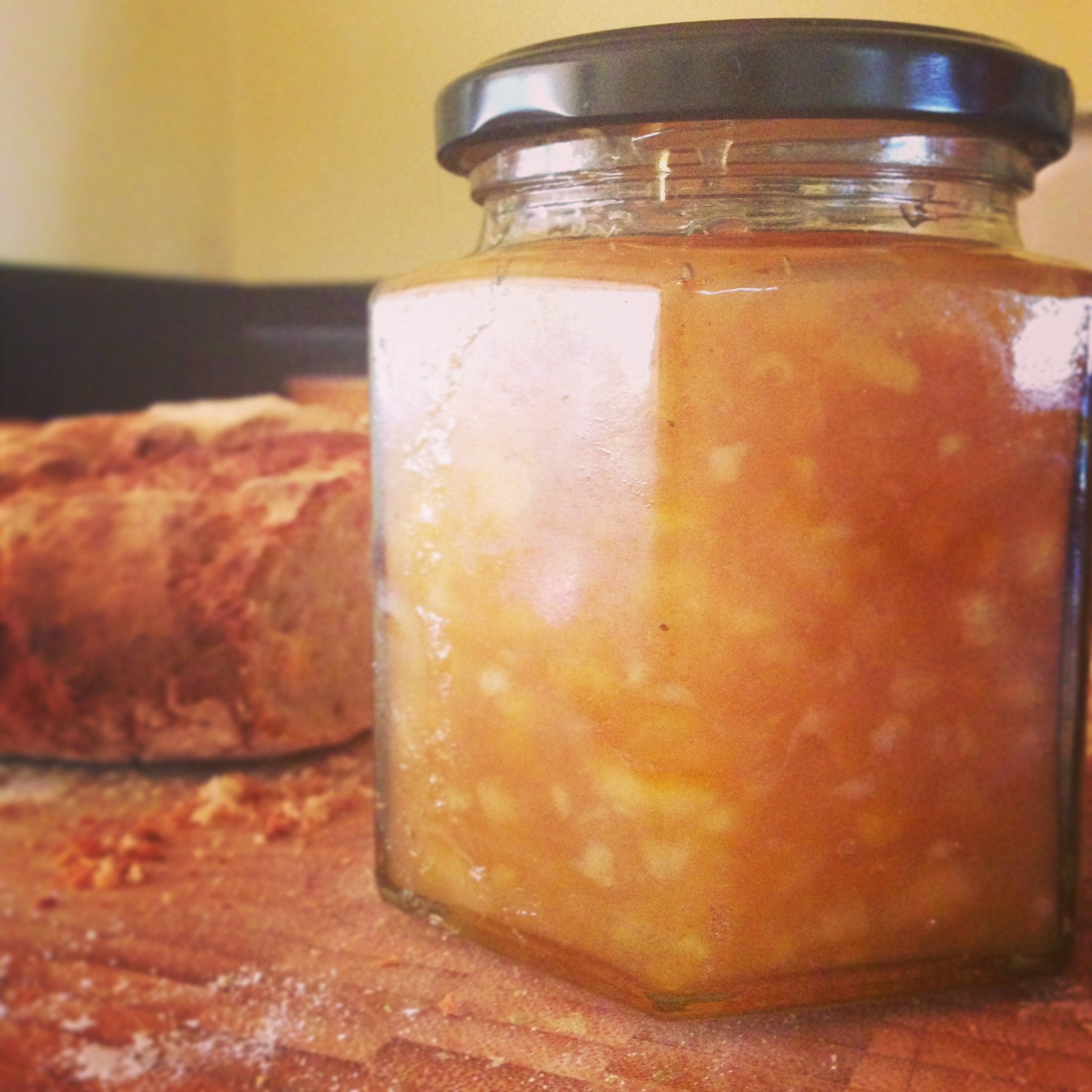
So I made some of my left over lemon peels (plus some orange peels I had lying around as well) into marmalade. It was delicious. And easy.

I cooked some lemon rinds, chopped, for about an hour, or until they were soft. I also added a little package of saved seeds and the fruit flesh, which I’d been keeping in a jar in the freezer, along with a couple of pieces of fresh ginger and some cloves. The recipes I found said to use a muslin bag, but I didn’t have one, so I just sterilised a cotton napkin by soaking it for a few minutes in boiling water and tied it up into a package with a piece of cotton twine. Then I added the mix to a food processor and blitzed it a little. Once I had the texture I wanted with the fruit, I weighed it (I had about 330g). The general rule with jams is 1:1:1 fruit:sugar:water, and so I added about 330g each of water and sugar, along with the fruit, to a saucepan, brought it to the boil and then simmered it for quite a long time, until it thickened. Apparently the magic temperature for setting jam is 220 degrees, but I don’t have a thermometer that goes that high, so I used the “wrinkle test”, where you put a few teaspoons of the mixutre on a saucer, put that in the freezer for five minutes, then run your finger across it. If it wrinkles, you’ve reached the right consistency.

Earlier, I’d put a couple of clean jars in the oven on a high temperature to sterilise them before I put the marmalade in them. Once the marmalade was nice and thick, I pulled those jars out and spooned the jam into them. (There are two tricks here: 1. guessing how much jam you’re making so you have the right number of jars, and 2. remembering the jars are hot — I failed to remember and burnt my thumb quite badly.)

I don’t think I’ll ever throw out a lemon peel again.

Lemon marmalade

This brings me back again to the idea of waste, and how it’s all a matter of perception. I wonder how much of what ends up in my bin — or in anyone’s bin — is in fact something of use, if only we knew what to do with it. (Also, does anyone want some marmalade? Because I’m probably going to be making a lot of it. I’ll take flavour requests.)

~

I’ve not used the citrus/vinegar cleaning spray yet, but I’ll put an update here when I do.